What is fuel burn rate?
Fuel burn rate measures how quickly a vehicle consumes fuel, expressed either over time (liters per hour) or over distance (liters per kilometer, or liters per 100 km). It is a key metric for drivers, fleet managers, boaters and pilots who need to estimate operating cost, plan refueling stops, and compare efficiency across vehicles or trips.
How to use this calculator
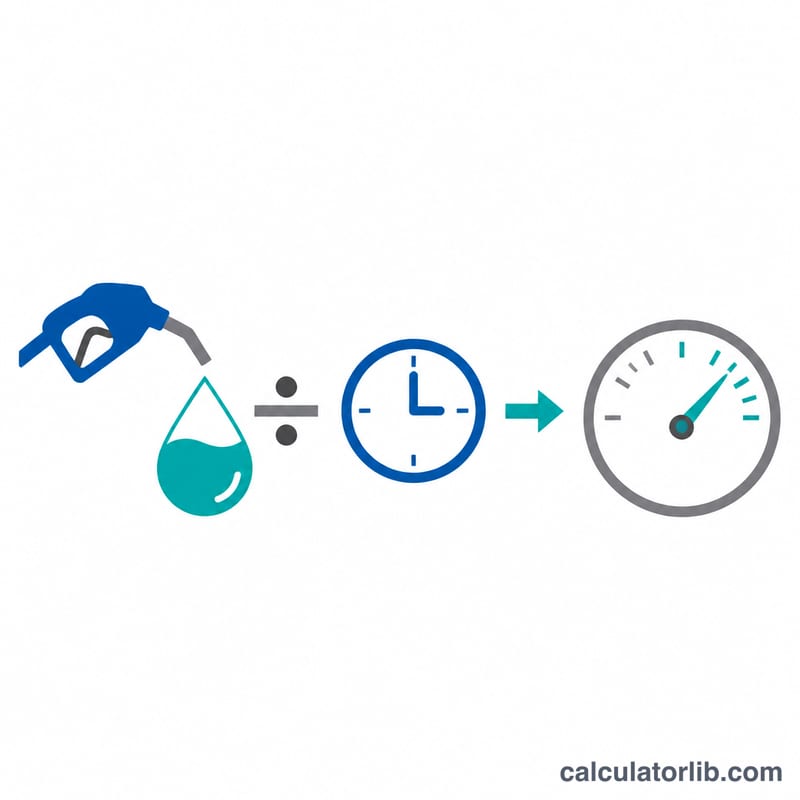
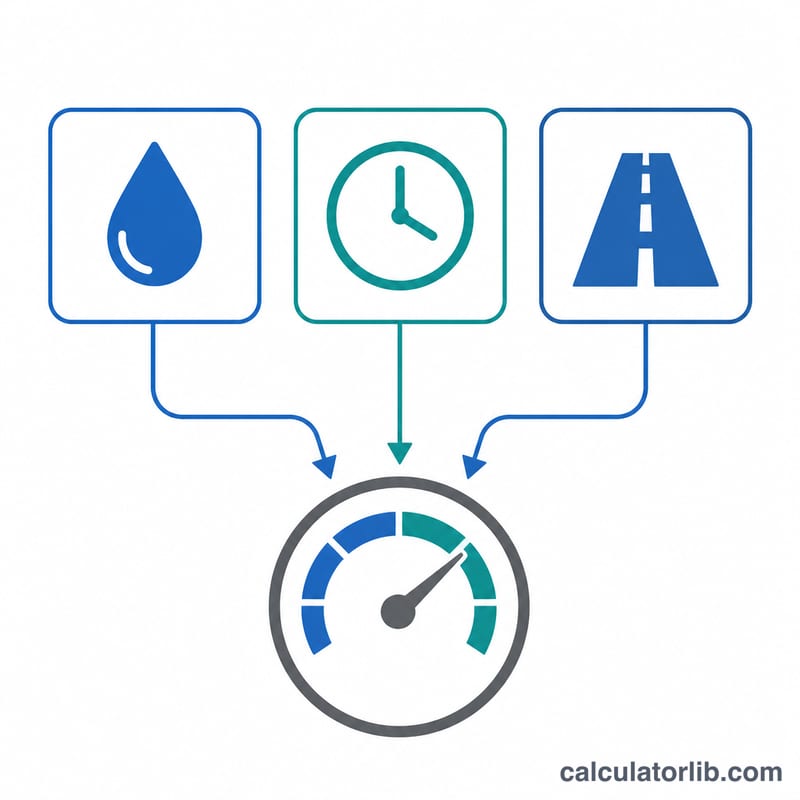
Enter the total fuel consumed, the time the engine ran, and the distance covered during that period. The calculator returns the burn rate per hour and the consumption per unit of distance. All three inputs use the same trip, so results stay consistent.
The formula explained
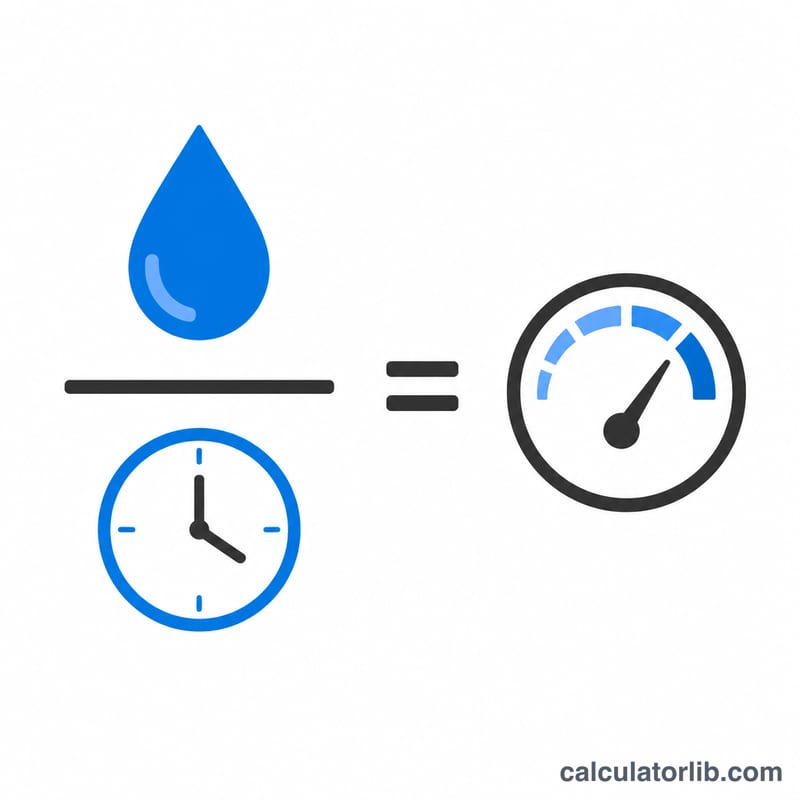
The time-based burn rate divides fuel by hours, while the distance-based rate scales fuel per kilometer up to a per-100-km figure:
$$\text{Rate}_{time} = \frac{ {\text{Fuel Used}}}{\text{Time}}, \qquad \text{L/100km} = \frac{ {\text{Fuel Used}}}{\text{Distance}} \times 100$$Here \(\text{Fuel Used}\) is in liters, \(\text{Time}\) in hours, and \(\text{Distance}\) in kilometers.
Worked example
Suppose a vehicle burns 50 liters over 5 hours while covering 400 km. The hourly burn rate is:
$$\text{Rate}_{time} = \frac{50}{5} = 10\,\text{L/h}$$And the distance-based consumption is:
$$\text{L/100km} = \frac{50}{400} \times 100 = 12.5\,\text{L/100km}$$Fuel Consumption Unit Conversions
Fuel economy can be written as an amount of fuel per distance (liters per 100 km, or L/km) or as a distance per amount of fuel (km/L, miles per gallon). The two are inversely related, so converting between them uses division rather than a simple multiplier. Note that the two "MPG" figures are not the same: US MPG uses the US gallon (3.785411784 L) while UK (Imperial) MPG uses the larger Imperial gallon (4.54609 L), so the same car always shows a higher number in UK MPG.
Exact conversion factors (based on 1 mile = 1.609344 km):
- \(\text{km/L} = \dfrac{100}{\text{L/100km}}\)
- \(\text{L/km} = \dfrac{\text{L/100km}}{100}\)
- \(\text{MPG}_{\text{US}} = \dfrac{235.215}{\text{L/100km}}\)
- \(\text{MPG}_{\text{UK}} = \dfrac{282.481}{\text{L/100km}}\)
| L/100km | km/L | L/km | US MPG | UK (Imperial) MPG |
|---|---|---|---|---|
| 5 | 20.00 | 0.050 | 47.04 | 56.50 |
| 8 | 12.50 | 0.080 | 29.40 | 35.31 |
| 10 | 10.00 | 0.100 | 23.52 | 28.25 |
| 12.5 | 8.00 | 0.125 | 18.82 | 22.60 |
| 15 | 6.67 | 0.150 | 15.68 | 18.83 |
Example substitution for 8 L/100km: \(\text{MPG}_{\text{US}} = \dfrac{235.215}{8} = 29.40\) and \(\text{MPG}_{\text{UK}} = \dfrac{282.481}{8} = 35.31\). Because the relationship is reciprocal, halving the L/100km value roughly doubles the km/L and MPG values.
Typical Fuel Burn Rates by Vehicle Type
The table below gives representative fuel burn rates for common vehicle categories. Distance-based rates (L/100km) suit road vehicles, while time-based rates (liters per hour, L/h) are the natural unit for engines that spend significant time running while stationary or at cruise, such as an idling car, a boat, or an aircraft. All figures are approximate and vary widely with load, speed, terrain, engine size, driving style, and maintenance.
| Vehicle / situation | Typical burn rate | Usual unit |
|---|---|---|
| Small / compact car | ~5–7 L/100km | Distance-based |
| Midsize car | ~7–9 L/100km | Distance-based |
| SUV / light truck | ~10–13 L/100km | Distance-based |
| Heavy truck (loaded) | ~30–40 L/100km | Distance-based |
| Passenger car idling (engine on, stationary) | ~0.6–1.2 L/h | Time-based |
| Small recreational motorboat | ~10–30 L/h | Time-based |
| Small piston (single-engine) aircraft | ~25–60 L/h | Time-based |
These ranges are broad, order-of-magnitude guides drawn from typical consumer and light-commercial vehicles, not certified figures for any specific make, model, or regulatory test cycle. A large boat engine at full throttle or a heavily loaded truck climbing a grade can easily exceed the upper values, while gentle cruising sits near or below the lower ones. To find the true figure for your own vehicle, measure the fuel used over a known time or distance and use the burn-rate formula \(\text{Burn Rate} = \dfrac{\text{Fuel Used}}{\text{Time}}\) rather than relying on the categories above.
FAQ
Why measure burn rate per hour? For idling engines, boats and aircraft, time-based flow matters more than distance because the vehicle may not travel far while consuming fuel.
How do I convert to miles per gallon? First convert your L/100km value using unit conversions, or re-enter the trip in your preferred units; the ratio logic stays identical.
What if my distance is zero? Distance-based metrics require a positive distance, so the calculator reports zero when no distance is provided.