What is the Levelized Cost of Energy?
The Levelized Cost of Energy (LCOE) is the average cost per unit of electricity a project must earn over its life to break even. It lets you compare technologies with very different cost structures—for example a solar farm with high upfront capital and near-zero fuel cost versus a gas plant with lower capital but ongoing operating cost—on a single, honest basis: dollars per megawatt-hour.
The formula
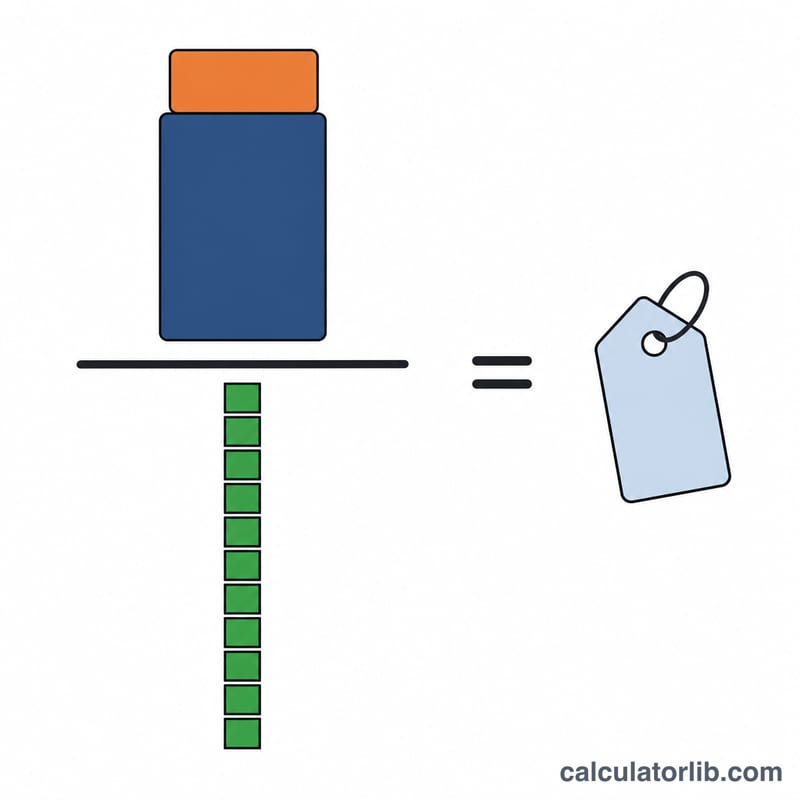
This calculator discounts both lifecycle costs and lifetime energy to present value and divides one by the other:
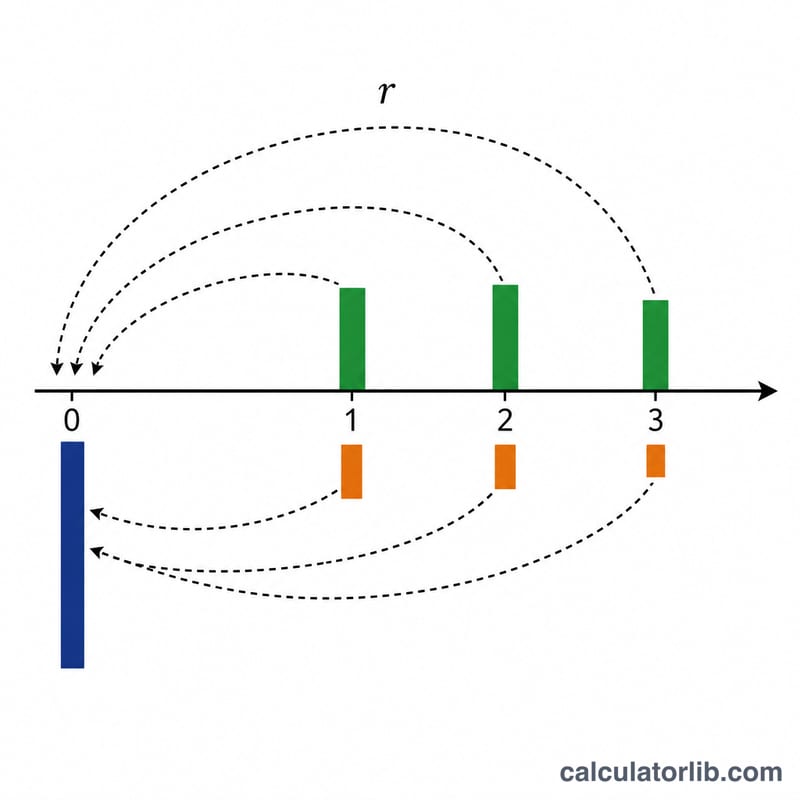
$$\text{LCOE} = \frac{I_0 + M \times A}{E \times A}$$Here \(I_0\) = initial capital cost, \(M\) = annual operating and maintenance cost, \(E\) = annual energy output, and \(A\) is the annuity factor that turns a level annual stream into a present value:
$$A = \frac{1 - (1+r)^{-n}}{r}$$where \(r\) is the discount rate (as a decimal) and \(n\) is the project lifetime in years. When \(r = 0\), the factor simplifies to \(A = n\).
How to use it
Enter the initial capital cost, the annual O&M cost, the expected annual energy output, a discount rate reflecting the cost of capital, and the project lifetime. The result is the LCOE in dollars per MWh—lower is more competitive.
Worked example
Suppose $1,000,000 of capital, $50,000 annual O&M, 5,000 MWh per year, a 5% discount rate, and a 20-year life. First the annuity factor:
$$A = \frac{1 - (1.05)^{-20}}{0.05} = 12.4622$$Then the levelized cost:
$$\text{LCOE} = \frac{1{,}000{,}000 + 50{,}000 \times 12.4622}{5{,}000 \times 12.4622} = 26.05\ \$/\text{MWh}$$FAQ
Does a higher discount rate raise or lower LCOE? A higher rate shrinks the present value of future energy more heavily relative to upfront capital, so capital-intensive projects usually show a higher LCOE.
What if the discount rate is zero? The calculator uses \(A = n\), a simple undiscounted average of total cost over total output.
Does LCOE include subsidies or revenue? No—this is a pure cost metric. Compare it against your expected power price or against other technologies to judge viability.