
What Is Pour Cost?
Pour cost is the percentage of your liquor sales that goes toward the cost of the alcohol itself. It is one of the most important profitability metrics in any bar or restaurant beverage program. A lower pour cost means you keep more of every dollar a guest spends. Most bars target a pour cost between 18% and 24%, though it varies by concept, drink mix, and pricing strategy.
How to Use This Calculator
Enter the cost of liquor used over a period (your beginning inventory plus purchases minus ending inventory, measured at your wholesale cost) and your liquor sales for the same period. The calculator returns your pour cost percentage, gross profit in dollars, and the markup on cost.
The Formula Explained
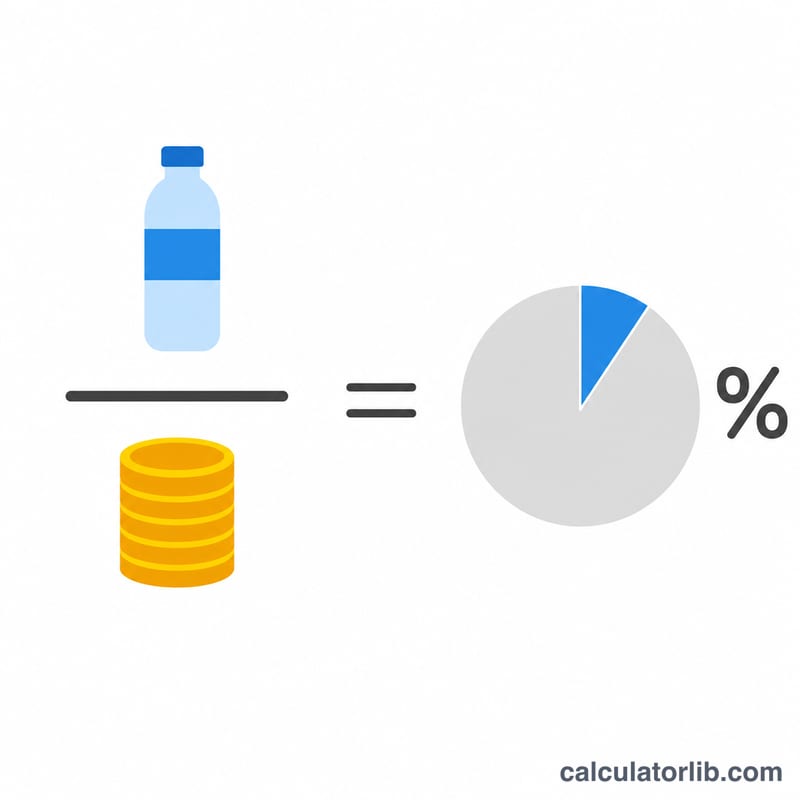
$$\text{Pour Cost \%} = \frac{\text{Cost of Liquor Used}}{\text{Liquor Sales}} \times 100$$ The cost is what you paid for the product; sales is the revenue you collected. Gross profit is simply \(\text{Sales} - \text{Cost}\), and markup expresses profit relative to cost.
Worked Example
Suppose a bar used $500 of liquor and rang up $2,500 in liquor sales for the week. $$\text{Pour cost} = \frac{500}{2{,}500} \times 100 = \textbf{20\%}$$ $$\text{Gross profit} = 2{,}500 - 500 = \textbf{\$2{,}000}$$ and $$\text{markup on cost} = \frac{2{,}000}{500} \times 100 = \textbf{400\%}$$
FAQ
What is a good pour cost? Many operators aim for 18–24%. Spirits often run lower than beer or wine, so blended targets depend on your mix.
How do I lower pour cost? Right-size pours with jiggers, reduce over-pouring and spillage, review menu pricing, and negotiate supplier costs.
Is pour cost the same as cost of goods sold? It is the beverage-specific version of COGS, expressed as a percentage of beverage sales.