
What Is the Sigma Level Calculator?
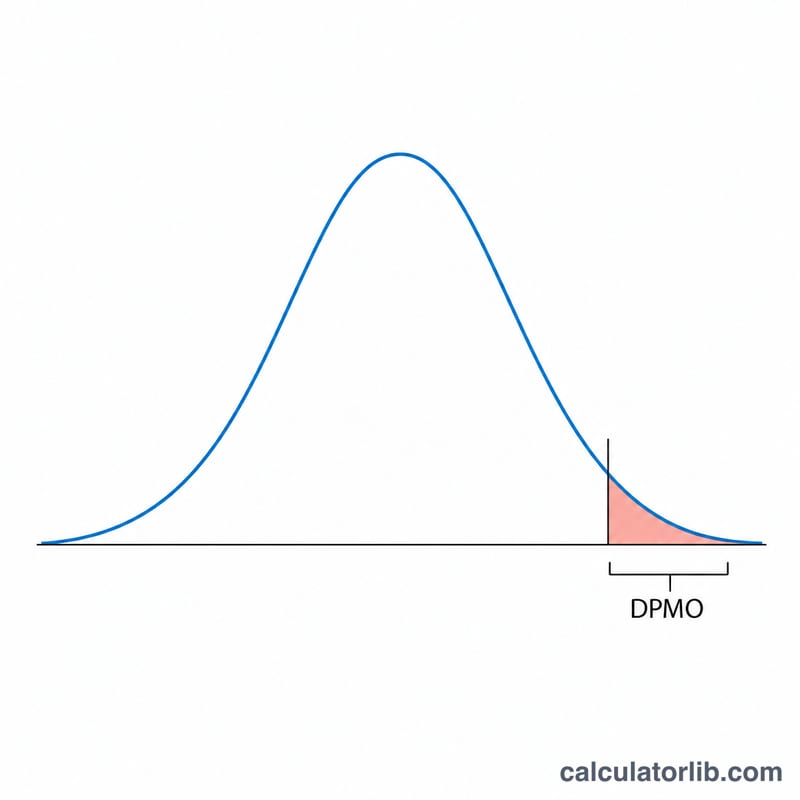
This calculator converts DPMO (Defects Per Million Opportunities) into a process sigma level, the central metric of Six Sigma quality management. The sigma level expresses how many standard deviations fit between a process mean and the nearest specification limit — a higher sigma level means fewer defects. A "Six Sigma" process produces only about 3.4 defects per million opportunities.
How to Use It
Enter the number of defects per million opportunities your process produces. The calculator returns the sigma level (including the standard 1.5σ long-term shift), the corresponding process yield, and the underlying Z-score. If you only know your defect rate, multiply (defects ÷ total opportunities) by 1,000,000 to get DPMO first.
The Formula Explained
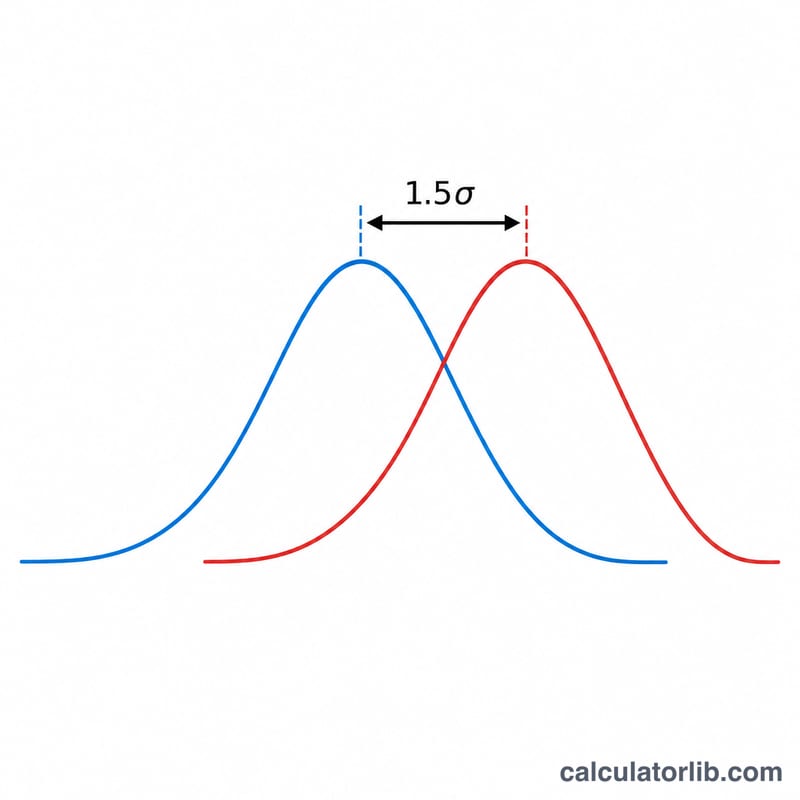
First compute the process yield: \(\text{Yield} = 1 - \dfrac{\text{DPMO}}{1{,}000{,}000}\). Then take the inverse standard normal cumulative distribution (NORMSINV in spreadsheets, written \(\Phi^{-1}\)) of that yield to get the short-term Z-score. Finally add the conventional 1.5 sigma shift that accounts for long-term process drift: $$\text{Sigma Level} = \Phi^{-1}(\text{Yield}) + 1.5$$ This calculator uses Acklam's high-accuracy rational approximation of the inverse normal function.
Worked Example
Suppose a process has 66,807 DPMO. \(\text{Yield} = 1 - 0.066807 = 0.933193\). The inverse normal of \(0.933193 \approx 1.5004\), and adding 1.5 gives a sigma level of \(\approx 3.0\) — a classic "3 Sigma" process.
FAQ
Why add 1.5 sigma? Empirical Six Sigma practice assumes a process mean drifts up to 1.5σ over the long term. The shift converts long-term (observed) performance into the short-term sigma level that's quoted by convention.
What DPMO equals Six Sigma? About 3.4 DPMO corresponds to a 6.0 sigma level with the 1.5σ shift.
Can DPMO be over one million? No — DPMO is capped at 1,000,000 (100% defective). Inputs above that are clamped.