
What Is the MRR & ARR Calculator?
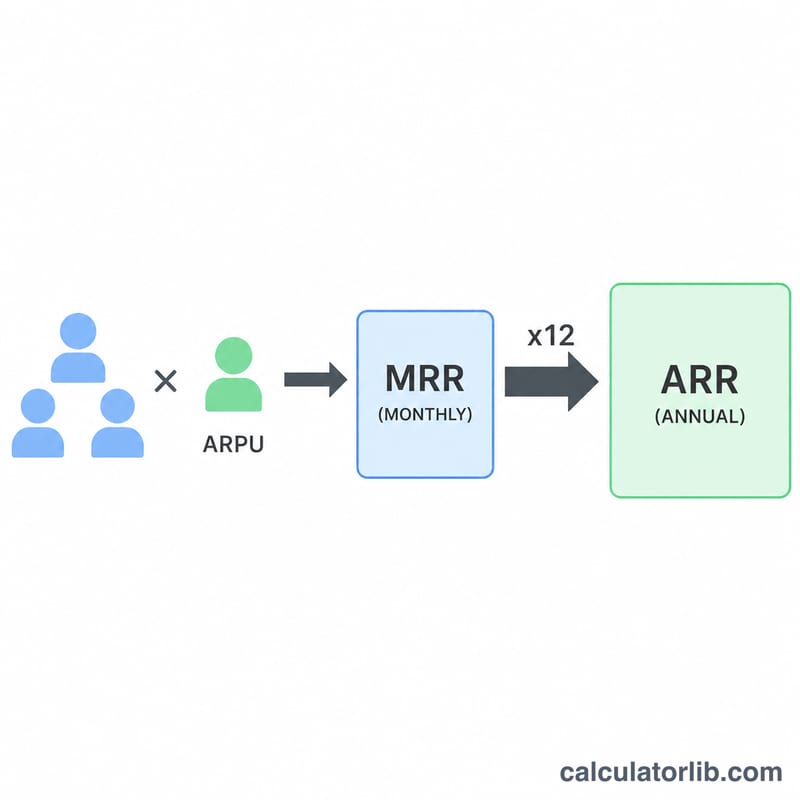
This calculator turns your subscription metrics into two of the most important numbers in any recurring-revenue business: Monthly Recurring Revenue (MRR) and Annual Recurring Revenue (ARR). MRR is the predictable revenue you collect every month from active subscriptions, and ARR is that figure annualized. Together they are the heartbeat of SaaS, membership, and subscription businesses, used by founders and investors alike to track growth and value the company.
How to Use It
Enter your total number of paying customers and your average revenue per customer per month (ARPU). Optionally add your monthly churn rate to see how much recurring revenue you lose each month and your net MRR after those cancellations. The calculator instantly returns MRR, ARR, churned revenue, and net MRR.
The Formula Explained
The core math is simple: $$\text{MRR} = \text{Customers} \times \text{ARPU}$$ This assumes a normalized monthly value for every subscription — if you sell annual plans, divide their price by 12 before computing ARPU. \(\text{ARR} = \text{MRR} \times 12\) projects the current monthly run-rate across a full year. Churned revenue is estimated as \(\text{MRR} \times (\text{churn rate} \div 100)\), and net MRR subtracts that from gross MRR.
Worked Example
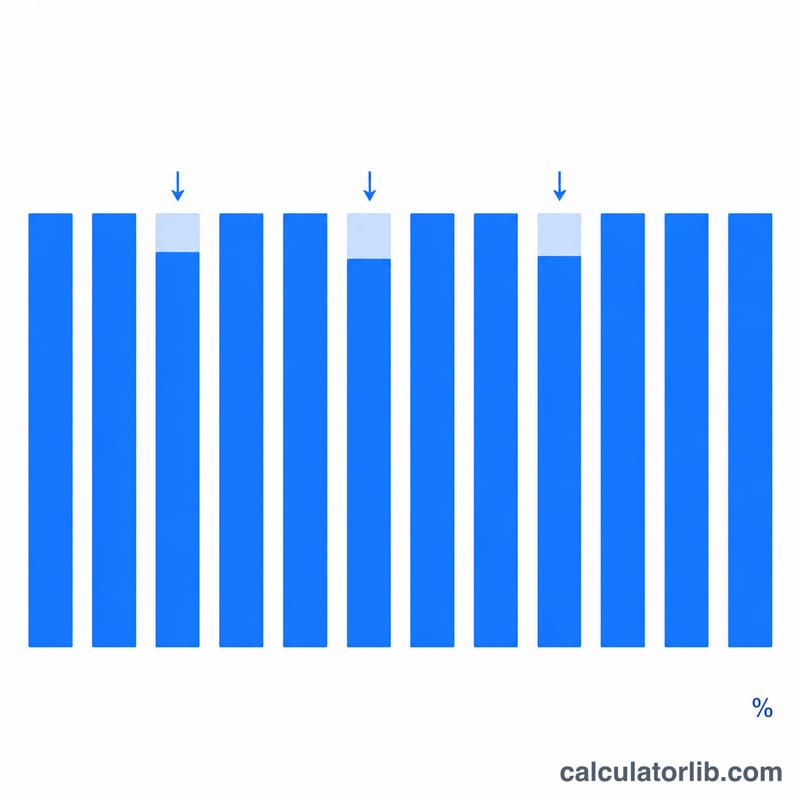
Suppose you have 100 customers each paying $50 per month with a 5% monthly churn. $$\text{MRR} = 100 \times 50 = \$5{,}000$$ $$\text{ARR} = 5{,}000 \times 12 = \$60{,}000$$ Revenue lost to churn $$= 5{,}000 \times 0.05 = \$250,$$ leaving a net MRR of $4,750.
FAQ
Should I include one-time fees in MRR? No. MRR only counts recurring subscription revenue. Exclude setup fees, one-off charges, and usage overages that don't repeat.
How do I handle annual contracts? Normalize them to monthly by dividing the annual price by 12, then include that amount in your ARPU.
Is ARR just MRR times 12? Yes, as a run-rate. It assumes your current MRR stays constant for a year, so it's a snapshot rather than a forecast that accounts for future growth or churn.