
What this calculator does
The Gravel & Aggregate Calculator estimates how much loose material — gravel, sand, crushed stone, or topsoil — you need to fill a rectangular area to a given depth. It reports the result in both cubic yards (how material is usually sold) and tons (how it is usually weighed and trucked), so you can order with confidence and avoid costly second deliveries.
How to use it
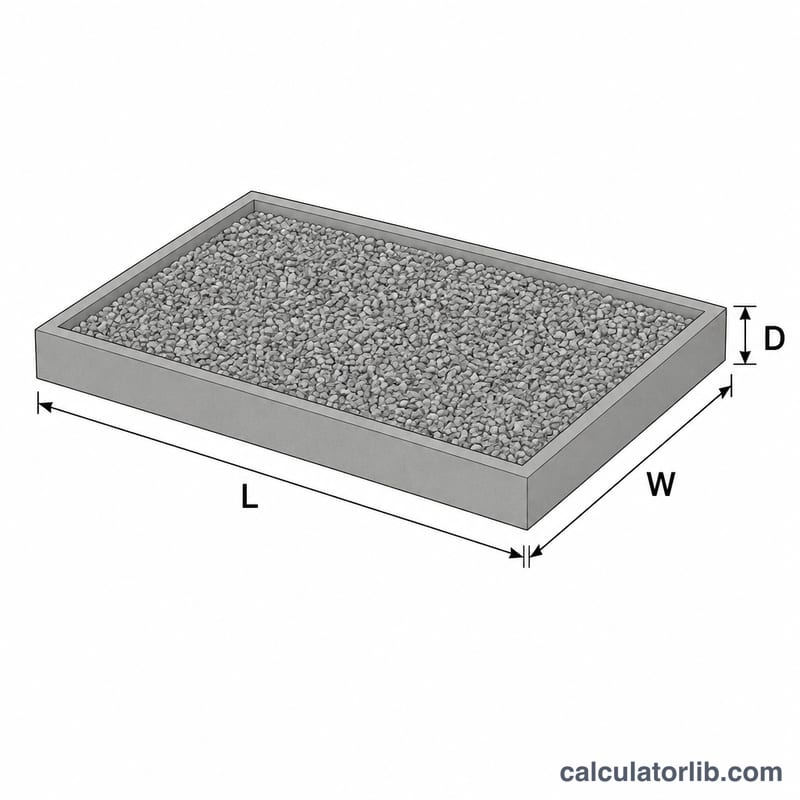
Measure your area and enter the length and width in feet, plus the desired depth in inches. Then enter the material density in tons per cubic yard. Most suppliers list this figure; if not, use the typical values shown next to the field. Press calculate to see the cubic yards and tonnage required.
The formula explained
First the volume is found in cubic feet: length × width × (depth ÷ 12), where dividing the depth by 12 converts inches to feet. That figure is divided by 27 to convert cubic feet into cubic yards (since 1 yd³ = 27 ft³). Finally, multiplying the cubic yards by the density gives the weight in US tons.
$$\text{Tons} = \frac{\text{Length (ft)} \times \text{Width (ft)} \times \frac{\text{Depth (in)}}{12}}{27} \times \text{Density (t/yd}^3\text{)}$$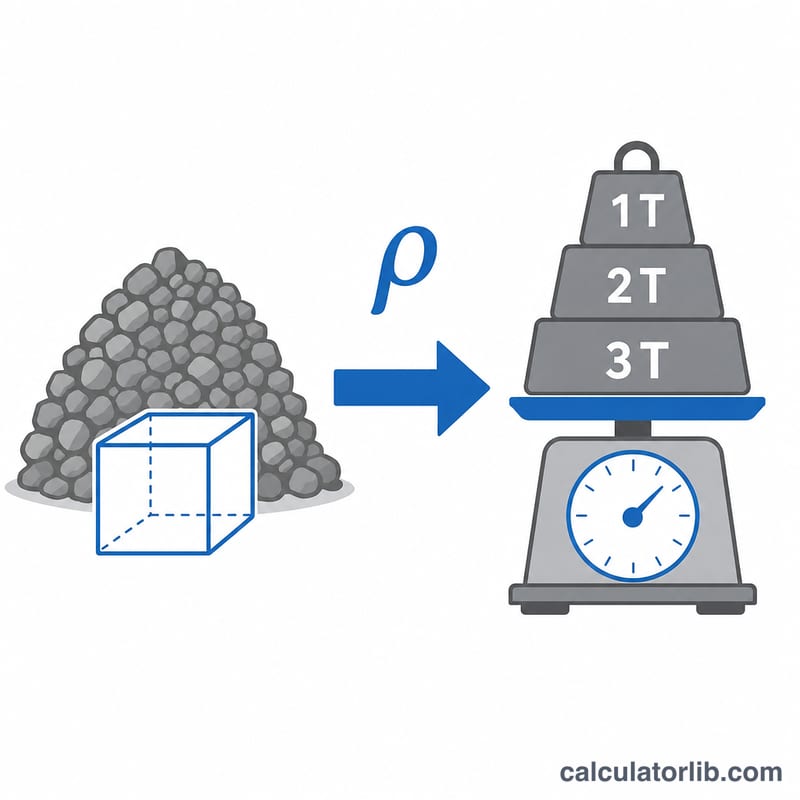
Worked example
Suppose you want to cover a 20 ft × 10 ft driveway with 4 inches of gravel (density 1.4 t/yd³). Depth = 4 ÷ 12 = 0.333 ft. Volume = 20 × 10 × 0.333 = 66.67 ft³ = 2.47 cubic yards. Tons = 2.47 × 1.4 ≈ 3.46 tons. Order about 3.5 tons.
$$\text{Depth} = \frac{4}{12} = 0.333 \text{ ft}$$$$\text{Volume} = 20 \times 10 \times 0.333 = 66.67 \text{ ft}^3 = 2.47 \text{ cubic yards}$$$$\text{Tons} = 2.47 \times 1.4 \approx 3.46 \text{ tons}$$FAQ
What density should I use? Dry gravel is roughly 1.4 tons per cubic yard, sand about 1.35, and crushed stone around 1.5. Wet or compacted material weighs more.
Should I order extra? Yes — adding 5–10% accounts for compaction, spillage, and uneven ground.
Does this work for round or irregular areas? This tool assumes a rectangle. For other shapes, calculate the area separately and multiply by depth, or break the space into rectangles.