
What the Gravel Calculator Does
This gravel calculator estimates how much gravel you need for a landscaping, driveway, or drainage project. It works in US imperial units — feet, inches, pounds, cubic yards and US tons (2,000 lbs). Enter four simple measurements and it returns the coverage area, the gravel volume in both cubic feet and cubic yards, and the total weight in pounds and tons. Knowing these figures helps you order the right amount of material and avoid paying for extra deliveries or returning surplus stone.
The Four Inputs
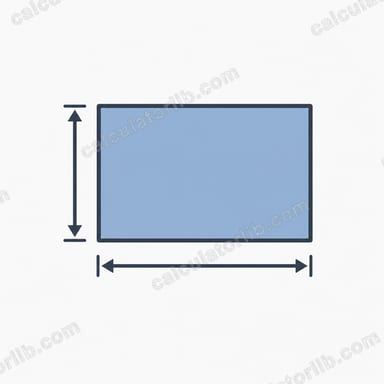
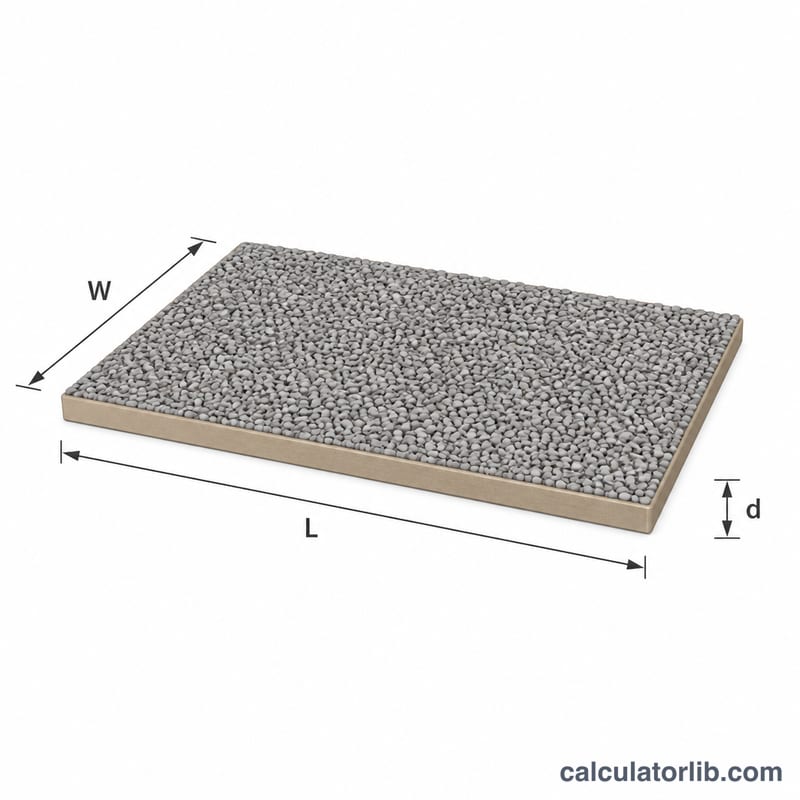
- Length of Area (feet) — the longer side of your rectangular space.
- Width of Area (feet) — the shorter side of the space.
- Depth of Gravel (inches) — how thick you want the gravel layer. A typical decorative layer is 2–3 inches; a driveway base may be 4 inches or more.
- Gravel Density (lbs/cu ft) — the weight of your specific gravel per cubic foot. Most crushed stone falls between 95 and 105 lbs/cu ft, with around 100 being a common default.
The Formula
The calculator runs these steps:
- Area (sq ft) = \( \text{Length} \times \text{Width} \)
- Volume (cu ft) = \( (\text{Area} \times \text{Depth}) \div 12 \) — dividing by 12 converts the depth from inches to feet
- Volume (cu yd) = \( \text{Volume (cu ft)} \div 27 \) — there are 27 cubic feet in a cubic yard
- Weight (lbs) = \( \text{Volume (cu ft)} \times \text{Density} \)
- Weight (tons) = \( \text{Weight (lbs)} \div 2{,}000 \)
$$\text{Weight (tons)} = \frac{\text{Length (ft)} \times \text{Width (ft)} \times \frac{\text{Depth (in)}}{12} \times \text{Density (lbs/cu ft)}}{2000}$$
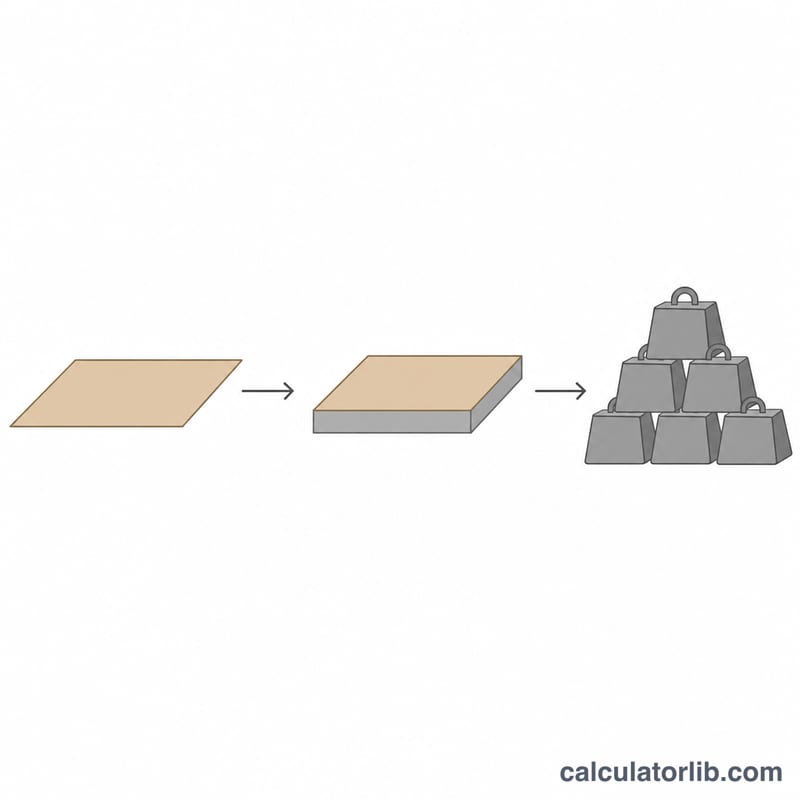
Worked Example
Suppose you have a patio area 20 feet long by 10 feet wide, with a 3-inch gravel depth and a density of 100 lbs/cu ft:
- Area = \( 20 \times 10 = 200 \) sq ft
- Volume = \( (200 \times 3) \div 12 = 50 \) cu ft
- Volume = \( 50 \div 27 \approx 1.85 \) cu yd
- Weight = \( 50 \times 100 = 5{,}000 \) lbs
- Weight = \( 5{,}000 \div 2{,}000 = 2.5 \) tons
So you would order roughly 1.85 cubic yards, or 2.5 tons, of gravel.
FAQ
What gravel density should I use? Check with your supplier, but 100 lbs/cu ft is a safe estimate for most crushed stone and pea gravel.
Should I order extra? Yes — adding about 5–10% covers settling, compaction and uneven ground.
My area isn't rectangular. Can I still use it? Break the space into rectangles, calculate each separately, then add the volumes together.