
What the Concrete Slab Weight Calculator Does
This calculator estimates the total weight of a poured concrete slab using imperial (US) units. You enter the slab's length and width in feet, its thickness in inches, and the concrete density in pounds per cubic foot. The tool then works out the slab's volume, its surface area, and—most importantly—its total weight in pounds. It's handy for planning transport, checking floor or trailer load limits, ordering material, and confirming that supporting structures can carry the load.
How to Use It
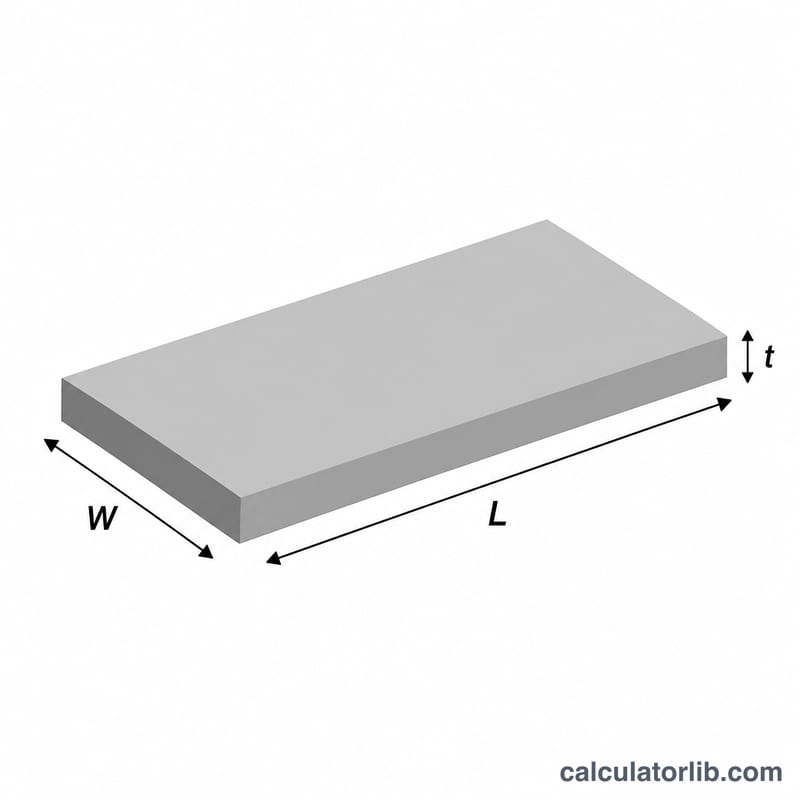
- Length (feet): the longer horizontal dimension of the slab.
- Width (feet): the shorter horizontal dimension.
- Thickness (inches): how deep the pour is. Because length and width are in feet, the calculator divides thickness by 12 to convert it to feet before multiplying.
- Concrete Density (lbs/ft³): standard normal-weight concrete is about 150 lbs/ft³. Use a lower figure (around 100–120) for lightweight mixes.
The Formula Explained
The calculator follows this exact relationship:
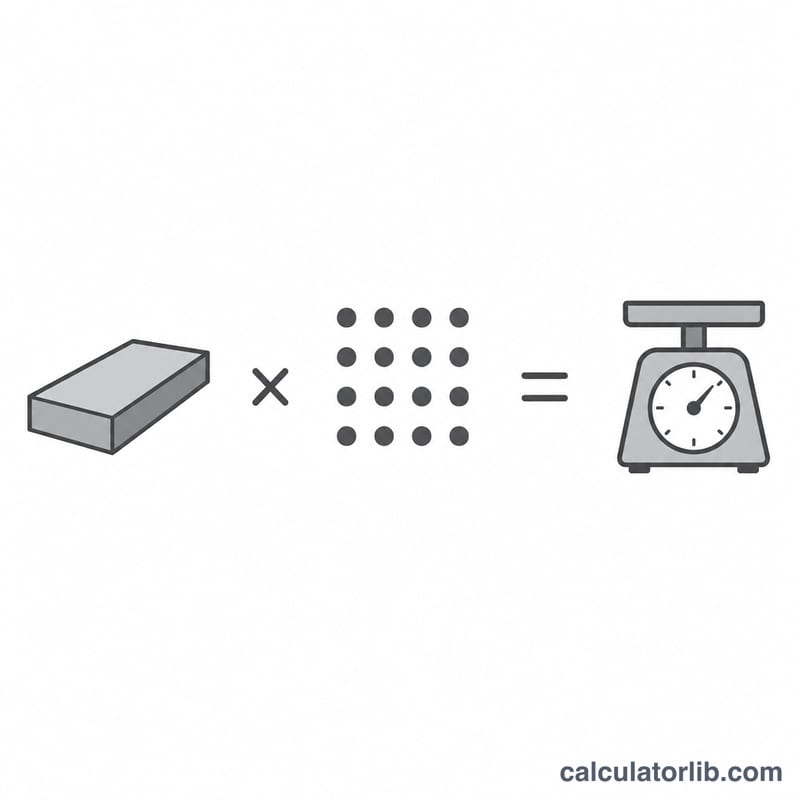
$$\text{Weight} = \text{Length} \times \text{Width} \times \frac{\text{Thickness}}{12} \times \text{Density}$$
First it finds volume in cubic feet: \(\text{Length} \times \text{Width} \times \frac{\text{Thickness}}{12}\). The ÷ 12 step converts thickness from inches to feet so all dimensions share the same unit. That volume is then multiplied by density to give weight in pounds. The calculator also reports the slab's surface area (\(\text{Length} \times \text{Width}\)) as a useful by-product.
Worked Example
Suppose you pour a slab 20 feet long, 10 feet wide, and 4 inches thick using normal concrete at 150 lbs/ft³:
- Thickness in feet: \(4 \div 12 = 0.333 \text{ ft}\)
- Volume: \(20 \times 10 \times 0.333 = 66.7 \text{ cubic feet}\)
- Weight: \(66.7 \times 150 =\) 10,000 lbs (about 5 US tons)
- Area: \(20 \times 10 = 200 \text{ square feet}\)
FAQ
What density should I use? Standard reinforced concrete is roughly 150 lbs/ft³. Lightweight aggregate concrete can range from 90 to 120 lbs/ft³—check your mix specification.
How do I convert pounds to tons? Divide the result by 2,000 for US (short) tons. The 10,000 lb example equals 5 tons.
Does this include rebar or wire mesh? No. The result reflects concrete only. Steel reinforcement adds a small amount of extra weight, so treat the figure as a close estimate for the concrete portion.