
What the Power to Weight Ratio Calculator Does
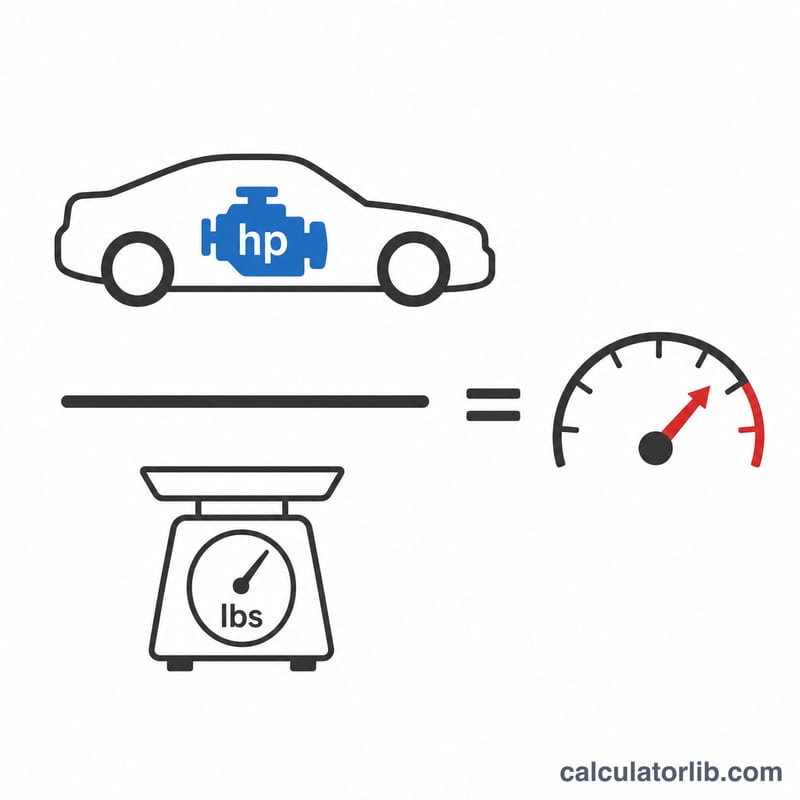
This calculator works out how much engine power your vehicle carries per pound of its weight. It takes two simple inputs — Power (in horsepower) and Weight (in pounds) — and divides one by the other to produce a single performance number. Because the inputs use horsepower and pounds, the result is expressed in horsepower per pound (hp/lb), the unit commonly used in the United States. A higher ratio means more power is available to move each pound, which generally translates into quicker acceleration and livelier performance.
The Formula
The maths behind the tool is straightforward:
- $$\text{Ratio} = \frac{\text{Power}}{\text{Weight}}$$
If the weight you enter is zero (or blank), the calculator safely returns a ratio of 0 instead of dividing by zero. Once it has the ratio, it sorts your vehicle into a performance category and draws a visual bar. The bar fills based on \(\text{ratio} \div 0.5 \times 100\), capped at 100% — so a ratio of 0.5 hp/lb or higher fills the bar completely.
Performance Categories
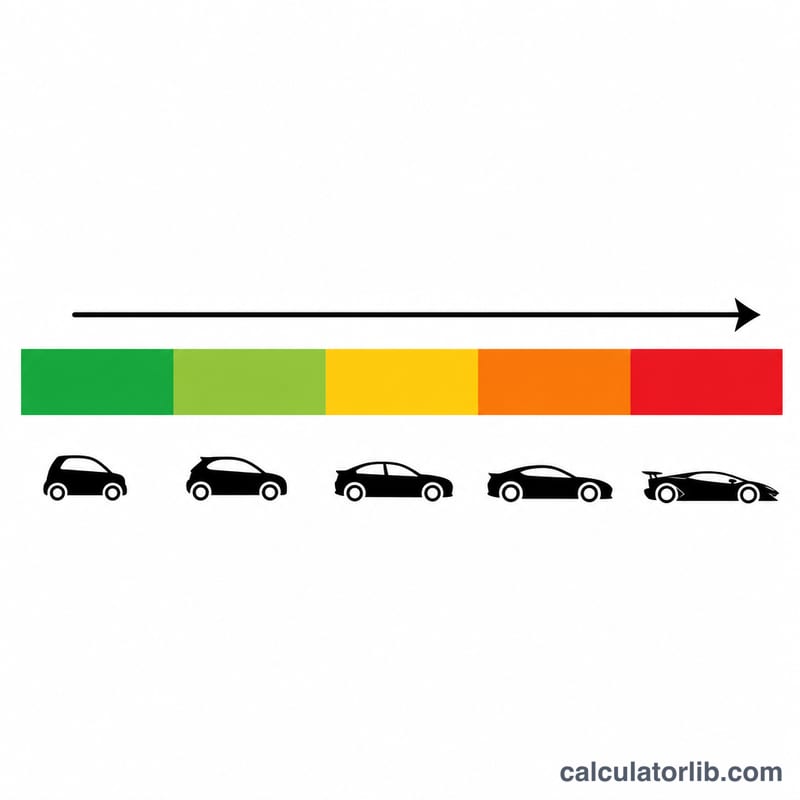
The calculator labels your result using these thresholds:
- 0.08 or below — Underpowered
- 0.08 to 0.15 — Adequate
- 0.15 to 0.25 — Good
- 0.25 to 0.35 — Very good
- Above 0.35 — Excellent
Worked Example
Imagine a sports sedan producing 300 horsepower and weighing 3,500 pounds:
- $$\text{Ratio} = 300 \div 3{,}500 = 0.0857 \text{ hp/lb}$$
- Category = Adequate (just over the 0.08 threshold)
- Visualization width = \(0.0857 \div 0.5 \times 100 \approx 17\%\) of the bar
Swap in a 500 hp car at 2,800 lb and the ratio jumps to \(0.179\) hp/lb, landing in the "Good" category — clearly showing how trimming weight or adding power changes the outcome.
Frequently Asked Questions
Should I use curb weight or weight with driver and fuel? For consistent comparisons, most people use curb weight (the vehicle ready to drive but empty). Whichever you choose, use the same basis when comparing two vehicles.
Why is my ratio a small decimal? Because the formula divides horsepower by pounds, results are naturally small (often between 0.05 and 0.40). Some references flip this to weight-per-power (lb/hp); this tool uses power-per-weight, so higher is better.
Can I use it for motorcycles or trucks? Yes. Any vehicle works as long as you enter horsepower and total pounds. Motorcycles often score in the "Very good" or "Excellent" range thanks to their light weight.