
What the Pulley Ratio Calculator Does
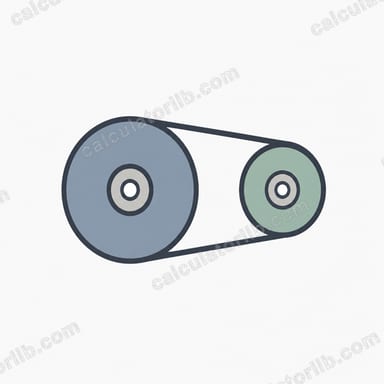
This calculator works out the pulley ratio and the output (driven) speed of a simple two-pulley belt drive. You enter the diameter of the driving pulley, the diameter of the driven pulley and the speed of the driving pulley in RPM, and the tool instantly returns the pulley ratio and the resulting driven pulley speed. It also scales both pulleys to draw a proportional visualization so you can see the size difference at a glance.
It is useful for anyone setting up belt-driven systems — workshop machinery, fans, compressors, lathes, drill presses, automotive accessory drives or DIY projects — where you need to speed up or slow down the driven component.
The Three Inputs
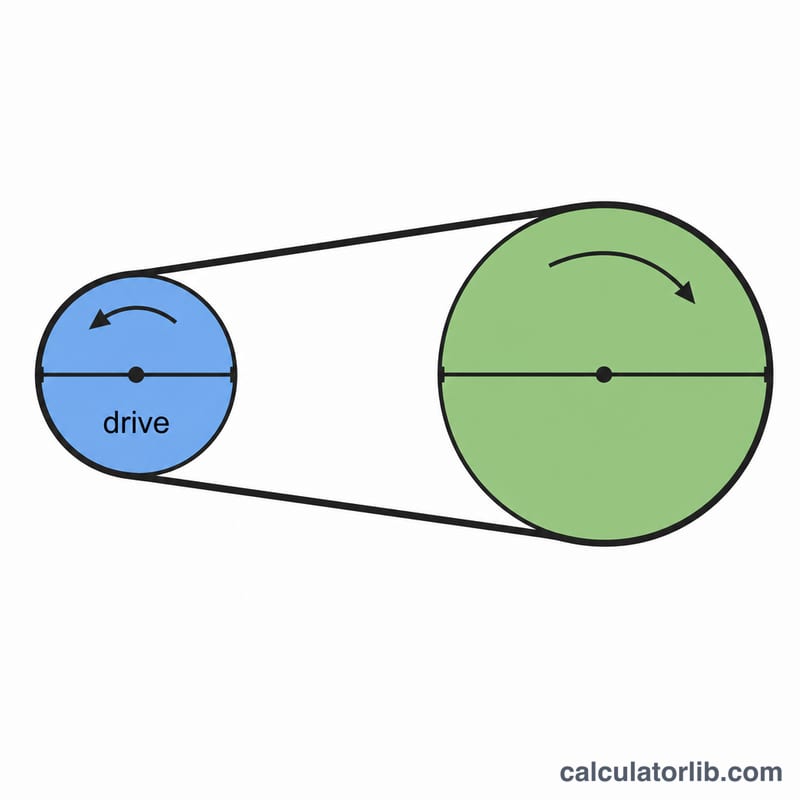
- Driving Pulley Diameter — the diameter of the pulley connected to the power source (motor or engine). Use any consistent unit (mm, cm or inches); the ratio is unit-independent as long as both diameters use the same unit.
- Driven Pulley Diameter — the diameter of the pulley being turned by the belt.
- Driving Pulley Speed (RPM) — how fast the driving pulley spins, in revolutions per minute.
The Formula Explained
The calculator uses two simple relationships:
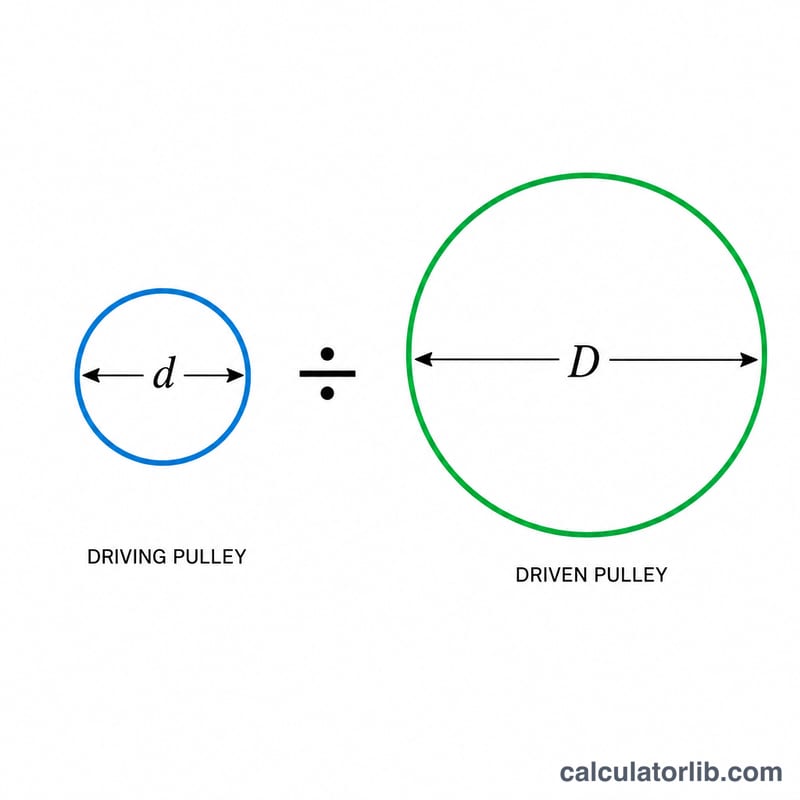
- Pulley Ratio = Driven Diameter ÷ Driving Diameter
- Driven Speed = Driving Speed ÷ Pulley Ratio
A ratio greater than 1 means the driven pulley is larger and turns slower (gearing down for more torque). A ratio less than 1 means the driven pulley is smaller and turns faster (gearing up for more speed). Note that surface belt speed stays the same on both pulleys — only rotational speed changes.
Worked Example
Suppose your motor pulley (driving) is 100 mm in diameter and spins at 1,800 RPM, driving a 250 mm pulley.
- Pulley Ratio = \(250 \div 100 = \mathbf{2.5}\)
- Driven Speed = \(1{,}800 \div 2.5 = \mathbf{720\ \text{RPM}}\)
Because the driven pulley is 2.5 times larger, it turns at 720 RPM — slower, but with more torque.
Frequently Asked Questions
Does the unit of diameter matter? No. Since the ratio divides one diameter by the other, any consistent unit works — millimetres, centimetres or inches — as long as you use the same unit for both pulleys.
How do I make the driven pulley spin faster? Use a driven pulley smaller than the driving pulley. This produces a ratio below 1, which increases the output RPM (at the cost of torque).
Does belt thickness or length affect the result? No. This calculation depends only on pulley diameters and input speed. Belt length affects centre distance and tension, not the speed ratio.