
What This Calculator Does
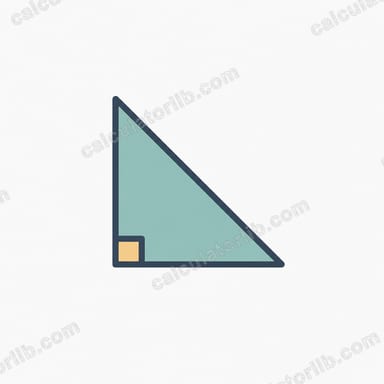
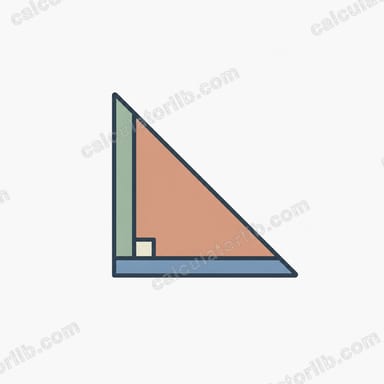
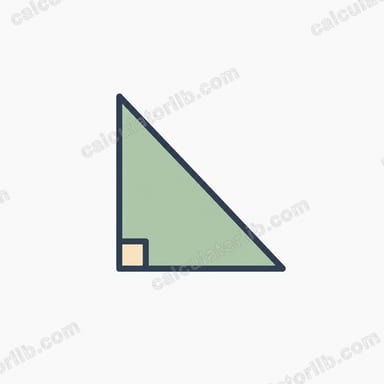
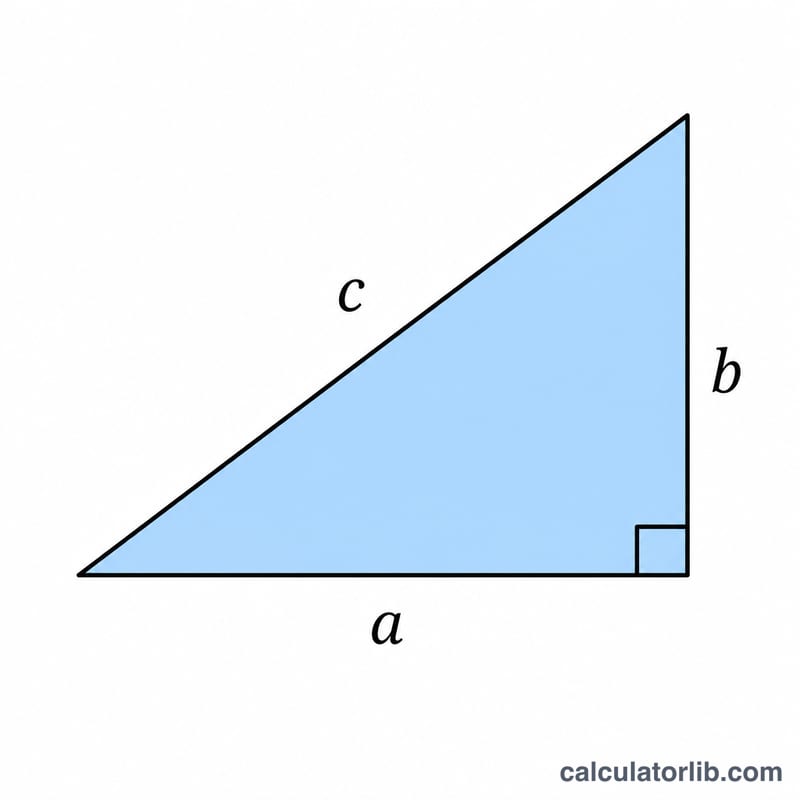
The Pythagorean Theorem Calculator finds the length of the hypotenuse — the longest side — of a right-angled triangle. You enter the two shorter sides that form the 90° angle, and the calculator instantly returns the third side. It works with any unit of measurement (metres, centimetres, inches, feet) as long as both sides use the same unit, and the result is rounded to two decimal places.
The Inputs
- Side A — the length of one leg (a side touching the right angle).
- Side B — the length of the other leg touching the right angle.
You do not enter the hypotenuse — that is what the tool calculates for you.
The Formula
The calculator uses the classic Pythagorean theorem:
$$c = \sqrt{\text{Side A}^{2} + \text{Side B}^{2}}$$Internally it squares Side A and Side B, adds them together, then takes the square root of that sum. The answer (\(c\)) is the hypotenuse. The result is formatted to two decimal places, so a value like 5 is shown as 5.00.
Worked Example
Suppose you enter:
- Side A = 3
- Side B = 4
The calculator squares each side: \(3^{2} = 9\) and \(4^{2} = 16\). It adds them to get 25, then takes the square root:
$$\sqrt{25} = 5$$So the hypotenuse is 5.00. This is the well-known 3-4-5 right triangle.
A second example: with Side A = 6 and Side B = 8, you get
$$\sqrt{36 + 64} = \sqrt{100} = 10.00$$Frequently Asked Questions
Can I find a missing leg instead of the hypotenuse?
This calculator solves only for the hypotenuse from two legs. To find a missing leg when you already know the hypotenuse, you would rearrange the formula to \(a = \sqrt{c^{2} - b^{2}}\), which this tool does not do directly.
What units should I use?
Any unit works, but Side A and Side B must be in the same unit. The hypotenuse will be returned in that same unit.
Does it only work for right triangles?
Yes. The Pythagorean theorem applies only to right-angled triangles, where Side A and Side B meet at exactly 90°. For other triangles you would need the law of cosines instead.