
What the Speed & Distance to Time Calculator Does
This calculator works out how long a journey will take when you know the distance you need to cover and the speed you expect to travel. It is unit-flexible: you can enter distance in kilometres or miles and speed in km/h or mph, and the tool reconciles the two automatically. The result is broken down into hours, minutes and seconds, so it suits everything from a short commute to a long road trip — anywhere in the world, with no country-specific rules.
The Inputs Explained
- Distance — the total length of your trip, entered as a number.
- Distance unit — choose km or miles.
- Speed — your average travelling speed (not your top speed).
- Speed unit — choose km/h or mph.
Because you can mix units (for example miles for distance and km/h for speed), the calculator first converts both values to a common metric base before dividing.
The Formula
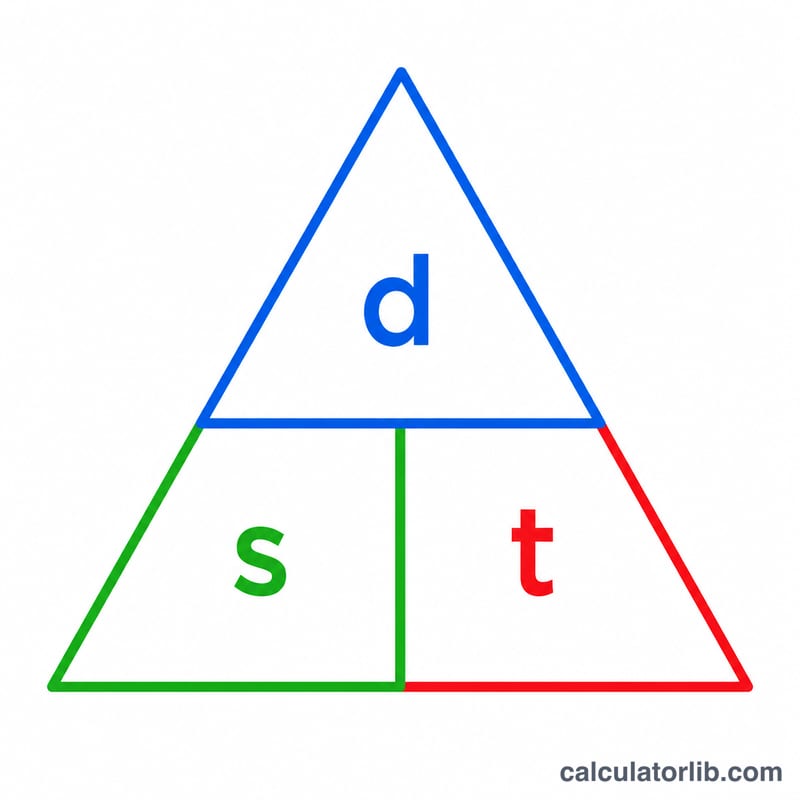
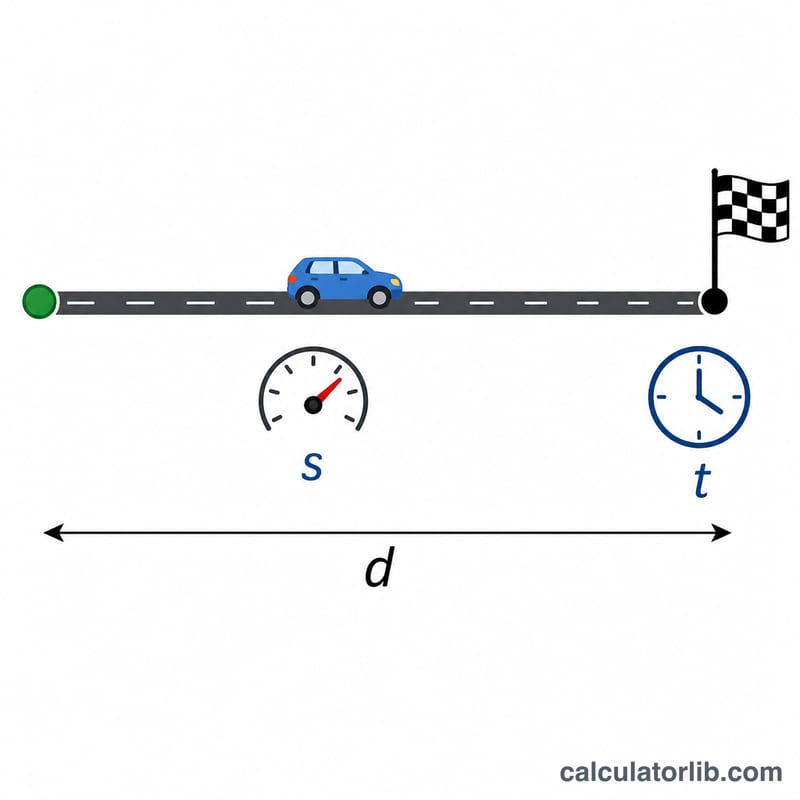
The core relationship is simply \(\text{Time} = \text{Distance} \div \text{Speed}\). To make this reliable across units, the tool converts internally to kilometres and km/h, using the factor \(1 \text{ mile} = 1.60934 \text{ km}\):
$$\text{Time (hours)} = \frac{\text{Distance (miles)} \times 1.60934}{\text{Speed (km/h)}}$$- Distance in km = \(\text{miles} \times 1.60934\) (or unchanged if already km)
- Speed in km/h = \(\text{mph} \times 1.60934\) (or unchanged if already km/h)
- Time in hours = \(\text{distance in km} \div \text{speed in km/h}\)
That decimal time is then split: whole hours, the remaining whole minutes, and the leftover seconds.
Worked Example
Suppose you plan to drive 150 miles at an average speed of 60 mph. Both are converted to metric: \(150 \times 1.60934 = 241.4 \text{ km}\), and \(60 \times 1.60934 = 96.56 \text{ km/h}\). Dividing gives:
$$241.4 \div 96.56 = 2.5 \text{ hours}$$Broken down, that is 2 hours, 30 minutes and 0 seconds — the same answer you would get directly from \(150 \div 60\), confirming the unit conversion is consistent.
Frequently Asked Questions
Can I mix miles and km/h? Yes. The calculator converts both inputs to kilometres and km/h before dividing, so any combination of distance and speed units produces a correct result.
Should I use average or maximum speed? Use your realistic average speed. Real journeys include traffic, junctions and rest, so your peak speed will overstate how far you get and give a too-optimistic time.
Why is the time shown in hours, minutes and seconds? A raw answer like 2.5 hours is harder to read than "2 h 30 m 0 s." The tool floors the hours, takes the remaining minutes, and converts the final fraction into seconds for a clear, practical duration.