
What the Tangent Line Calculator Does
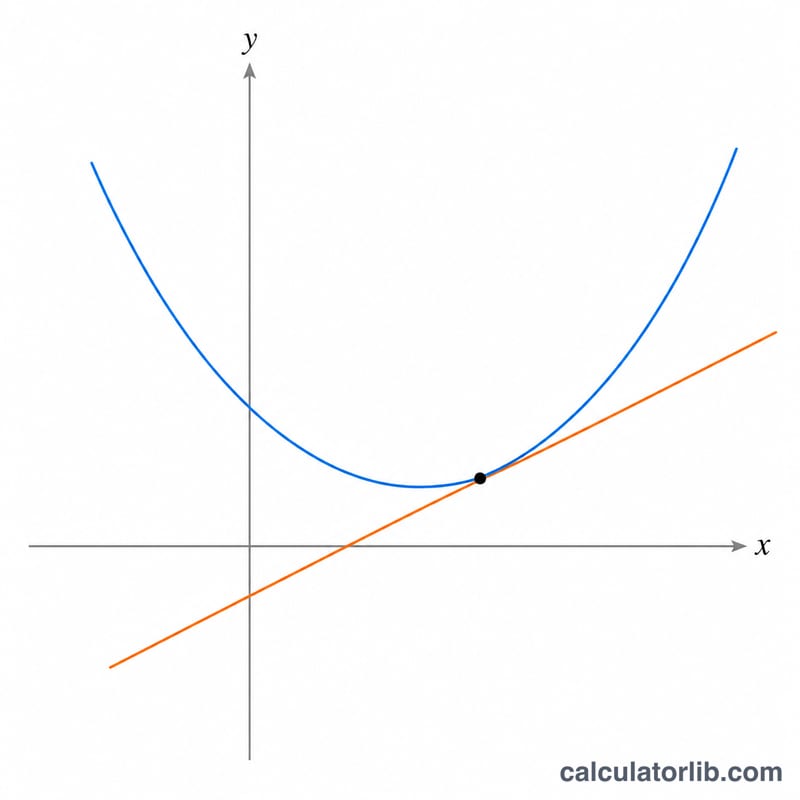
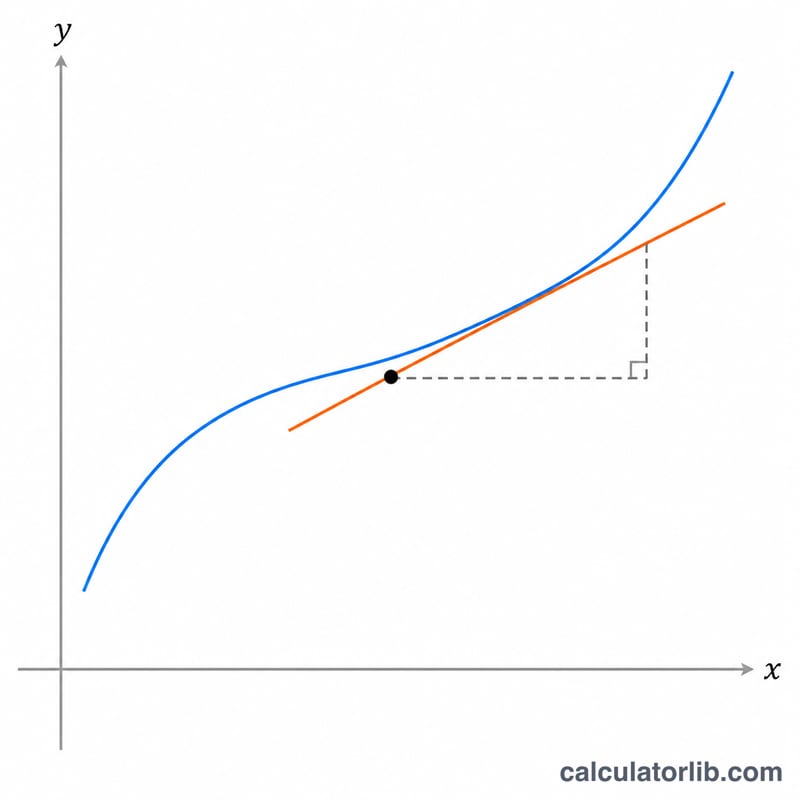
This calculator finds the equation of the tangent line to a simple power function of the form \(f(x) = a\cdot x^{n}\) at a chosen point. A tangent line touches the curve at exactly one point and has the same slope as the curve at that spot. The tool returns three things: the slope of the line, the y-value of the function at your point, and the y-intercept of the tangent line — everything you need to write the line in the form \(y = mx + b\).
The Three Inputs
- Coefficient (a) — the number multiplying the power term, e.g. the 3 in \(3x^{2}\).
- Exponent (n) — the whole-number power x is raised to, e.g. the 2 in \(3x^{2}\).
- Point x — the x-coordinate where you want the tangent line drawn.
The Formula It Uses
The function value is calculated as \(f(x) = a\cdot x^{n}\). The slope comes from the power rule for derivatives:
- Slope (m) \(= f'(x) = a\cdot n\cdot x^{(n-1)}\)
- Function value (y) \(= a\cdot x^{n}\)
- Y-intercept (b) \(= y - m\cdot x\)
The tangent line equation is then $$y = m\cdot x + b.$$
Worked Example
Suppose \(a = 3\), \(n = 2\), and the point \(x = 4\), giving \(f(x) = 3x^{2}\).
- Function value: $$y = 3 \times 4^{2} = 3 \times 16 = \mathbf{48}$$
- Slope: $$m = 3 \times 2 \times 4^{(2-1)} = 6 \times 4 = \mathbf{24}$$
- Y-intercept: $$b = 48 - 24 \times 4 = 48 - 96 = \mathbf{-48}$$
So the tangent line at \(x = 4\) is \(y = 24x - 48\).
Frequently Asked Questions
Can it handle functions with more than one term? No. It works only on single power terms of the form \(a\cdot x^{n}\). For sums like \(x^{2} + 5x\) you would need to compute each term separately or use a more general tool.
What if I enter a negative or fractional point? Negative x-values are fine. The exponent, however, is read as a whole number, so fractional powers (like square roots) aren't supported.
Why is the y-intercept sometimes negative? The intercept is simply where the tangent line crosses the y-axis. Because \(b = y - m\cdot x\), a steep slope at a point far from the origin often pushes the intercept well below zero, as in the example above.