
What Are the X and Y Intercepts of a Line?
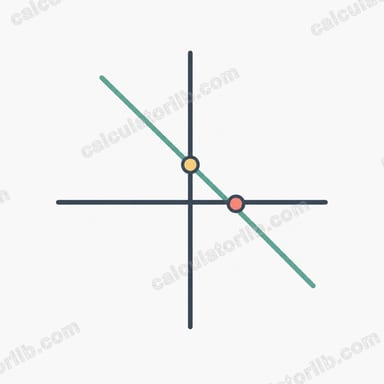
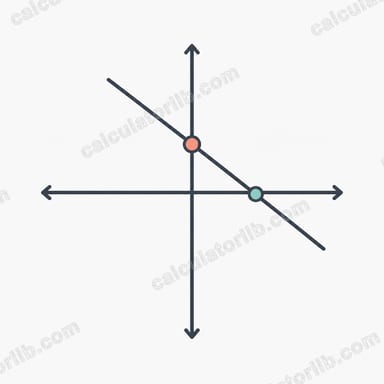
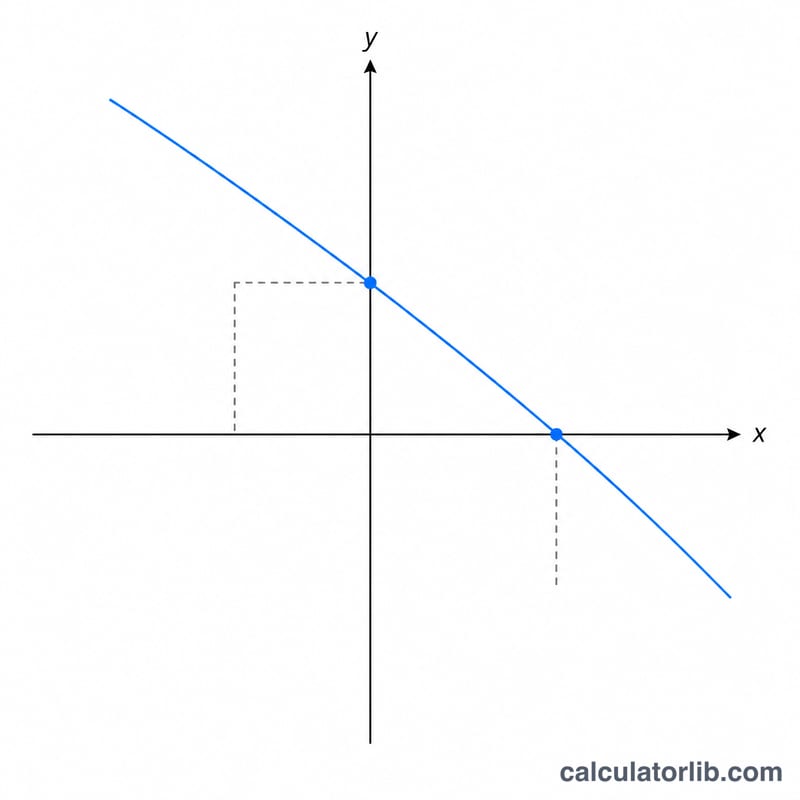
The intercepts of a line are the points where it crosses the coordinate axes. The x-intercept is where the line meets the x-axis (where y = 0), and the y-intercept is where it meets the y-axis (where x = 0). This calculator works from the general (standard) form of a linear equation, \(ax + by + c = 0\), and instantly returns both intercepts.
How to Use This Calculator
Enter the three coefficients a, b, and c from your equation written as \(ax + by + c = 0\). For example, the line \(2x + 3y - 6 = 0\) has \(a = 2\), \(b = 3\), \(c = -6\). If your equation is in slope-intercept form like \(y = mx + k\), rewrite it as \(mx - y + k = 0\), so \(a = m\), \(b = -1\), \(c = k\).
The Formula Explained
To find the x-intercept, set \(y = 0\) in \(ax + by + c = 0\). This gives \(ax + c = 0\), so $$x = -\frac{c}{a}.$$ To find the y-intercept, set \(x = 0\), giving \(by + c = 0\), so $$y = -\frac{c}{b}.$$ If \(a = 0\) the line is horizontal and has no x-intercept; if \(b = 0\) the line is vertical and has no y-intercept.
Worked Example
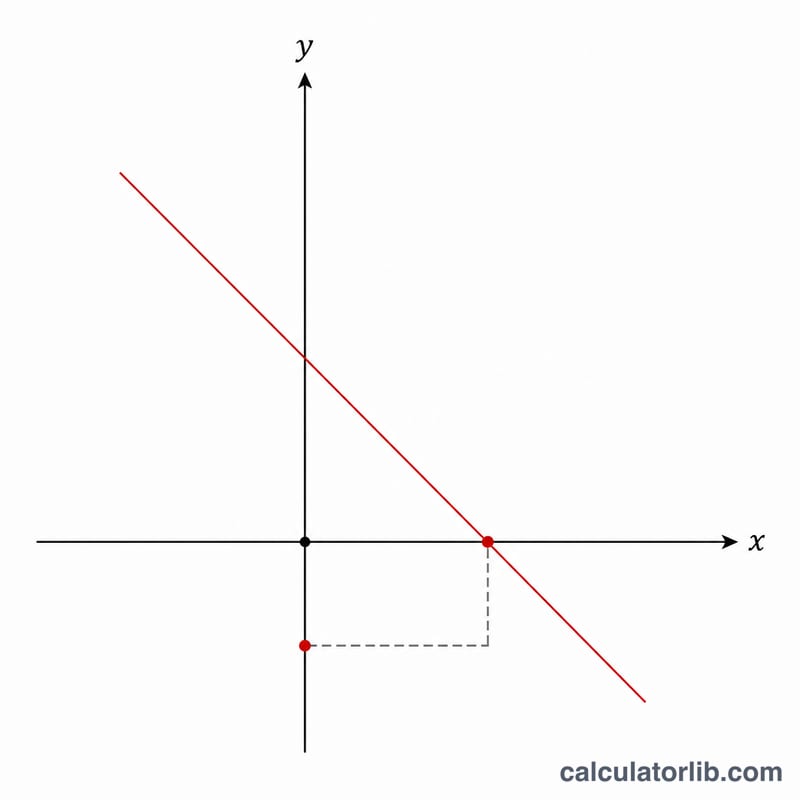
Take \(2x + 3y - 6 = 0\) (\(a = 2\), \(b = 3\), \(c = -6\)). The x-intercept is $$x = -\frac{-6}{2} = 3,$$ so the line crosses the x-axis at \((3, 0)\). The y-intercept is $$y = -\frac{-6}{3} = 2,$$ so it crosses the y-axis at \((0, 2)\).
FAQ
What if a is 0? The line is horizontal (\(by + c = 0\)) and never crosses the x-axis, so there is no x-intercept.
What if b is 0? The line is vertical (\(ax + c = 0\)) and never crosses the y-axis, so there is no y-intercept.
How do I convert y = mx + k? Move everything to one side: \(mx - y + k = 0\). Then \(a = m\), \(b = -1\) and \(c = k\).