
What Are Equivalent Ratios?
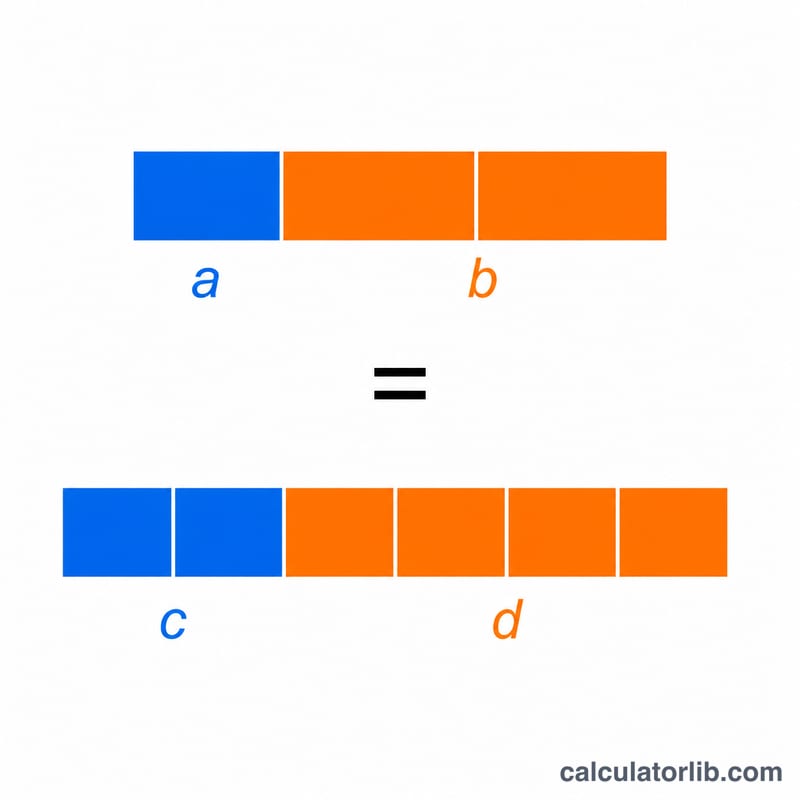
Two ratios are equivalent when they express the same relationship between quantities, even though the numbers differ. The ratio 2:3 is equivalent to 4:6, 8:12, and 20:30 because each is obtained by multiplying both terms by the same number. This calculator does two jobs: it generates an equivalent ratio from a:b using a multiplier k, and it checks whether two given ratios a:b and c:d are truly equal.
How to Use It
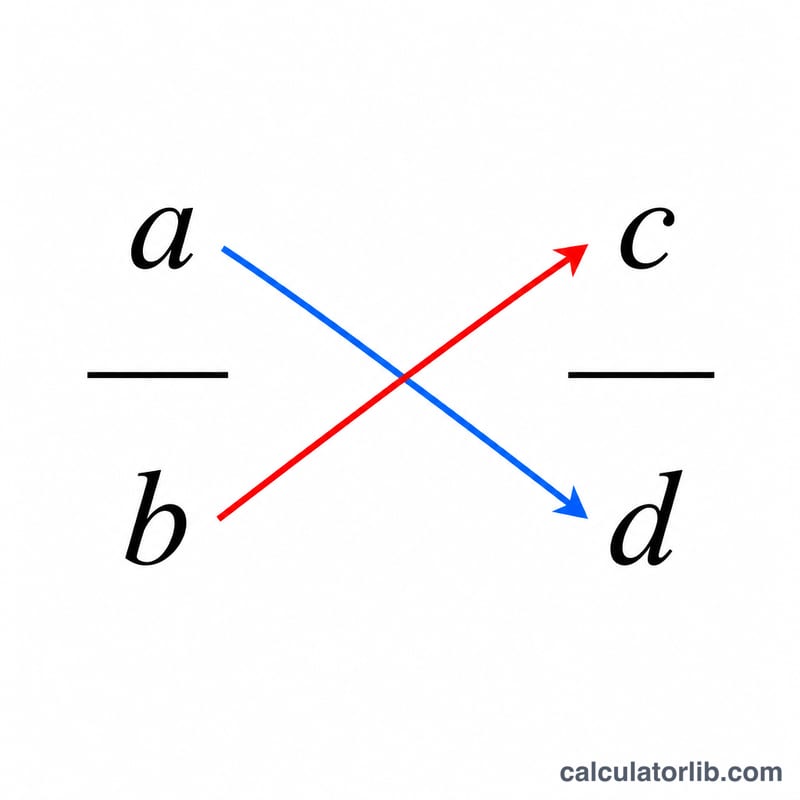
Enter the first ratio as two terms, a and b. Type a multiplier k to scale it: the calculator returns \((a \cdot k):(b \cdot k)\). To verify equivalence, also fill in c and d — the tool compares the cross products \(a \cdot d\) and \(b \cdot c\) and tells you whether the two ratios match.
The Formula Explained
To build an equivalent ratio, scale both terms equally: $$\text{a} : \text{b} \;=\; \left(\text{a} \times \text{k}\right) : \left(\text{b} \times \text{k}\right)$$ Because both sides grow by the same factor, the proportion is preserved. To test equality, use cross multiplication: $$\text{a} : \text{b} = \text{c} : \text{d} \iff \text{a} \times \text{d} = \text{b} \times \text{c}$$ If the two cross products match, the ratios are equivalent; if not, they differ.
Worked Example
Start with 2:3 and a multiplier of 4. Multiplying gives 8:12, so 2:3 is equivalent to 8:12. To confirm with cross multiplication:
$$a \cdot d = 2 \cdot 12 = 24 \quad \text{and} \quad b \cdot c = 3 \cdot 8 = 24$$The cross products are equal, so the ratios are indeed equivalent.
FAQ
Can the multiplier be a decimal or fraction? Yes. Any nonzero number works; using 0.5 produces a smaller equivalent ratio, and 1.5 produces a larger one.
Why use cross multiplication instead of dividing? Cross multiplication avoids division, so it never runs into divide-by-zero and works cleanly even with decimals.
Does order matter? Yes. The ratio 2:3 is not the same as 3:2, so keep your terms in the correct order when comparing.