
What is Carbon Equivalent (CE)?
The carbon equivalent (often written CEV) is a single number that combines the influence of carbon and other alloying elements on the hardenability and weldability of steel. Because elements such as manganese, chromium and nickel each contribute to hardening — but to different degrees — they are weighted and converted into an "equivalent" amount of carbon. The widely used International Institute of Welding (IIW) formula expresses this as a single percentage value.
The formula
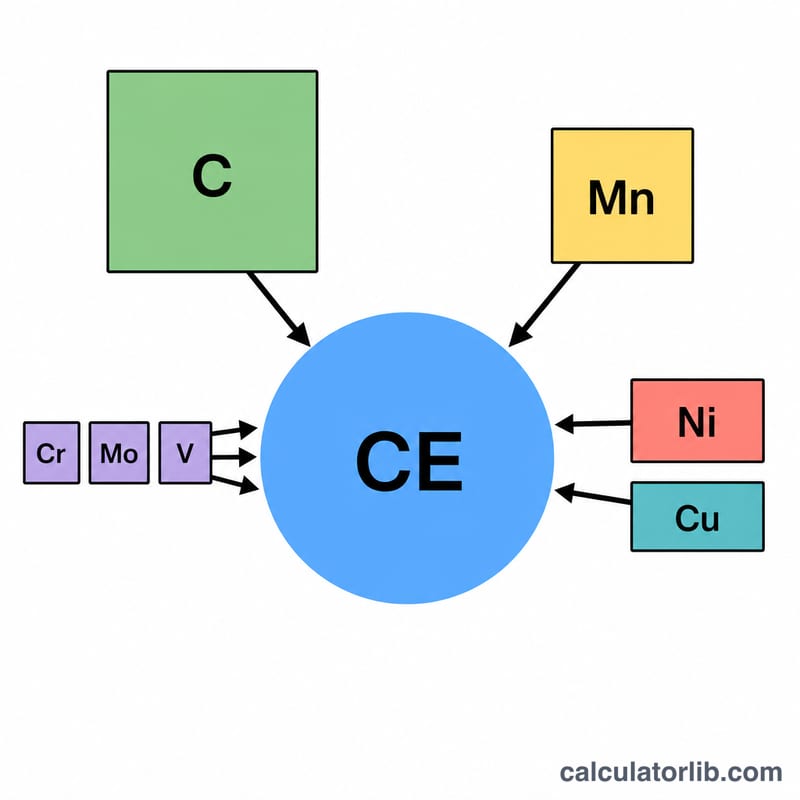
$$\text{CE} = \text{C} + \frac{\text{Mn}}{6} + \frac{\text{Cr} + \text{Mo} + \text{V}}{5} + \frac{\text{Ni} + \text{Cu}}{15}$$ where every element is its weight percent in the steel. Carbon counts at full weight; manganese is divided by 6; chromium, molybdenum and vanadium share a divisor of 5; nickel and copper share a divisor of 15.
How to use this calculator
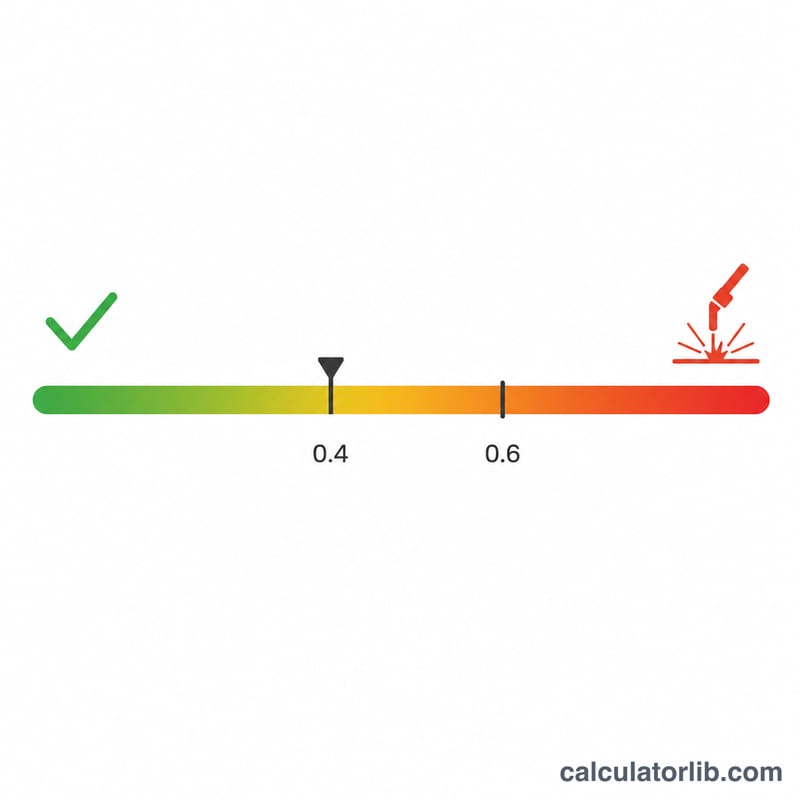
Enter the percentage of each element from the steel's mill certificate or composition analysis. Leave a field at zero if the element is absent. The calculator returns the carbon equivalent and a quick weldability rating. As a rule of thumb, steels with CE below \(0.40\) are readily weldable without preheat, while values above \(0.45\) typically require preheating and controlled cooling to avoid hydrogen cracking in the heat-affected zone.
Worked example
For a steel with C = 0.18%, Mn = 1.2%, Cr = 0.2%, Mo = 0.05%, V = 0%, Ni = 0.1%, Cu = 0.15%: $$\text{CE} = 0.18 + \frac{1.2}{6} + \frac{0.2+0.05+0}{5} + \frac{0.1+0.15}{15} = 0.18 + 0.20 + 0.05 + 0.016667 = \mathbf{0.4467}$$ This falls in the "preheat usually required" range.
FAQ
What CE is considered weldable? A CEV up to about \(0.40\)–\(0.45\) is generally weldable with standard procedures; higher values need preheat and care.
Which formula does this use? The IIW (International Institute of Welding) carbon equivalent, the most common version cited in standards like EN 10025.
Do I enter percentages or fractions? Enter the weight percent directly (e.g. 0.18 for 0.18% carbon), exactly as shown on a mill test certificate.