
What is radiocarbon dating?
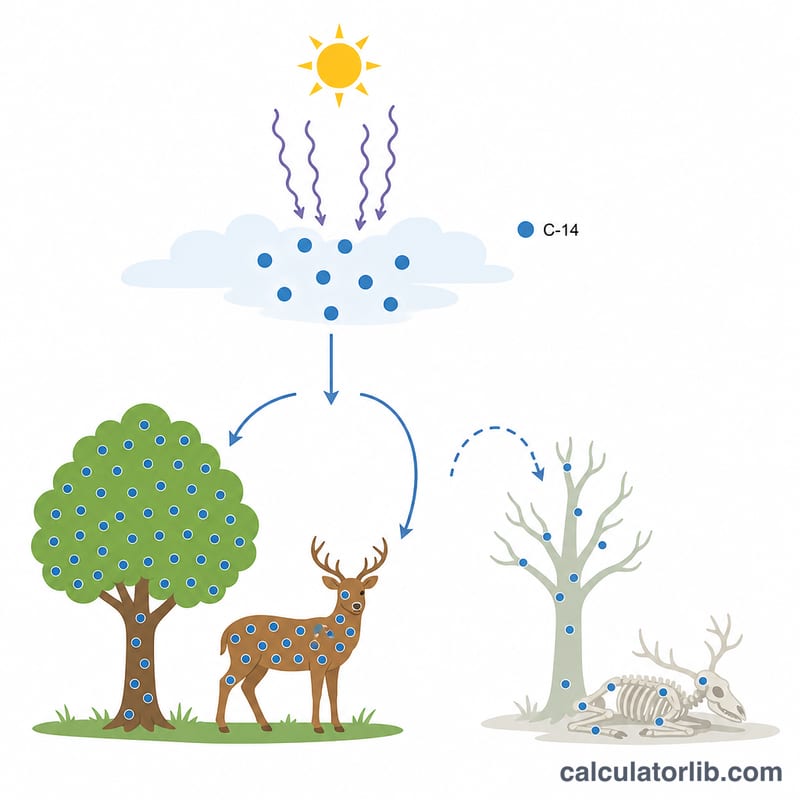
Radiocarbon (Carbon-14) dating estimates the age of once-living material by measuring how much of its radioactive Carbon-14 has decayed. Living organisms constantly exchange carbon with their environment, keeping a roughly constant level of C-14. When the organism dies, intake stops and the C-14 decays at a known rate. By comparing the amount remaining today to the original amount, we can calculate how long ago the organism died.
How to use this calculator
Enter the percentage of Carbon-14 still present in the sample (relative to a living reference, which is 100%). The default half-life is 5730 years (the Cambridge value); you can change it to 5568 years (the conventional Libby half-life) if your reference data uses it. The calculator returns the estimated age in years before measurement.
The formula explained
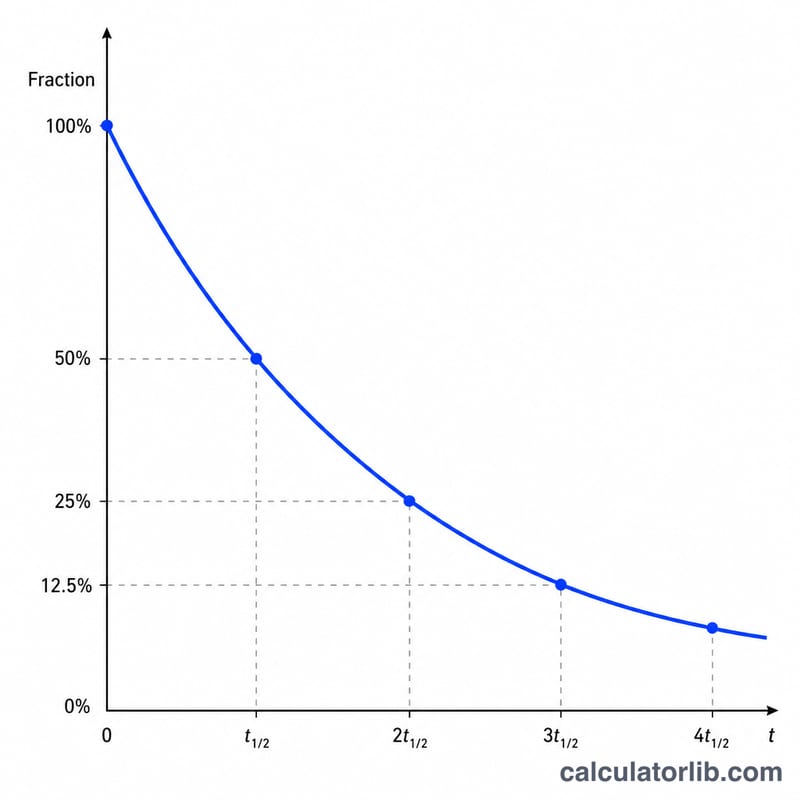
Carbon-14 decays exponentially: \( N = N_0 \cdot \left(\tfrac{1}{2}\right)^{t/t_{1/2}} \). Solving for time gives $$t = \frac{t_{1/2}}{\ln 2} \cdot \ln\!\left(\frac{N_0}{N}\right)$$, where \(N_0\) is the original amount, \(N\) is the amount remaining, and \(t_{1/2}\) is the half-life. Because we work with the ratio \(N_0/N\), you only need the percentage remaining: \( N_0/N = 100 / \text{percent} \).
Worked example
Suppose a wooden artifact has 25% of its original Carbon-14. Then \( N_0/N = 4 \), and $$t = \frac{5730}{0.6931} \times \ln(4) = 8266.6 \times 1.3863 \approx 11{,}460 \text{ years}$$ This makes sense: 25% means two half-lives have passed (\( 5730 \times 2 = 11{,}460 \) years).
FAQ
What half-life should I use? The physically accurate value is 5730 years. Many published "radiocarbon years" use the conventional Libby half-life of 5568 years for historical consistency.
How far back does C-14 dating work? Practically about 50,000 years; beyond that too little C-14 remains to measure reliably.
Why isn't this exact? Real ages require calibration curves because atmospheric C-14 has varied over time. This tool gives the raw decay-based age.