
What Is Nuclear Binding Energy?
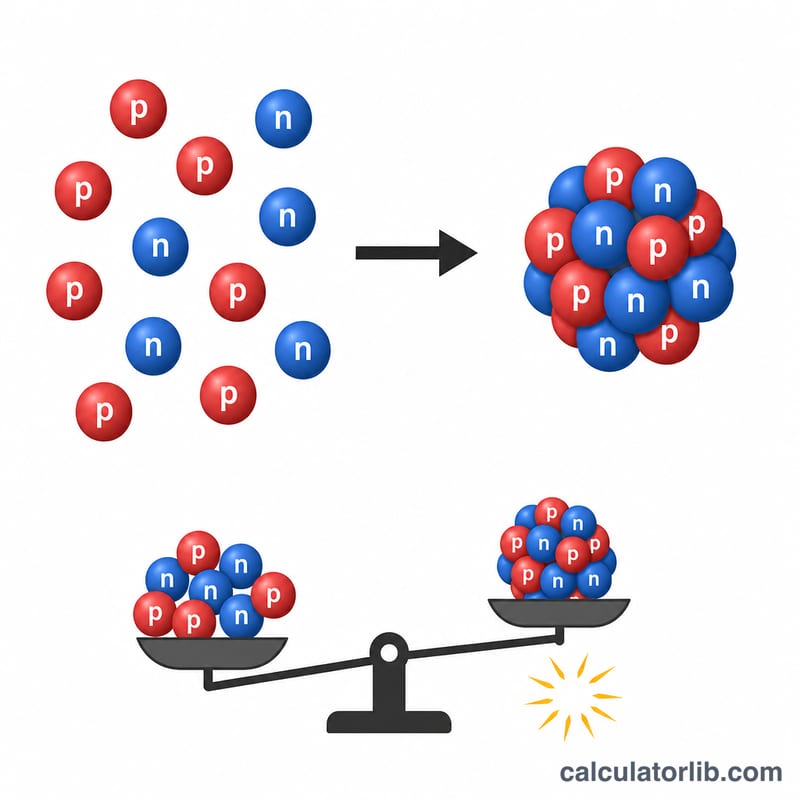
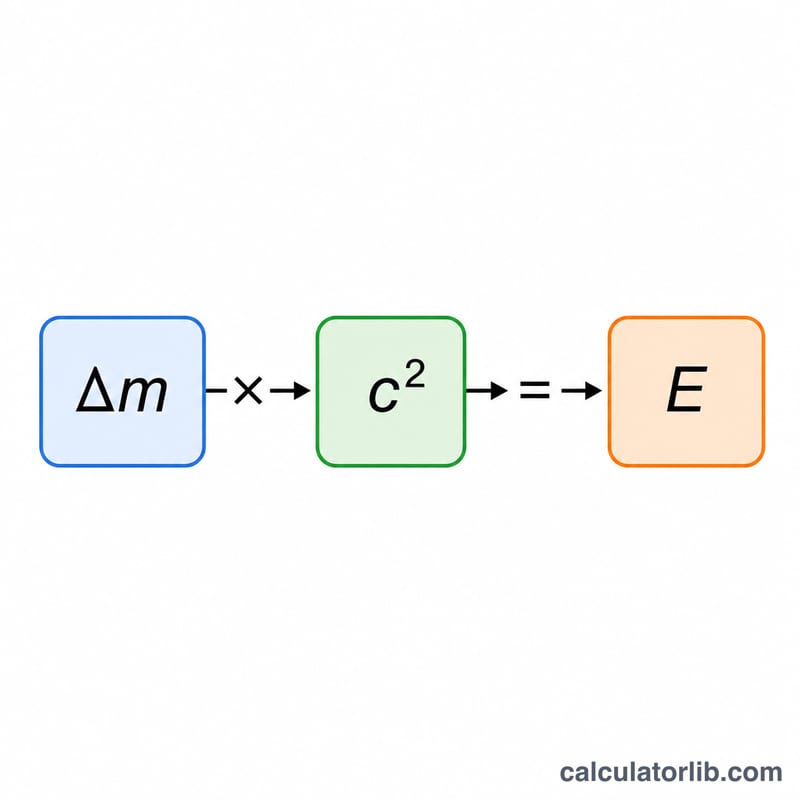
Nuclear binding energy is the energy required to split an atomic nucleus into its individual protons and neutrons. It arises because the actual mass of a nucleus is slightly less than the combined mass of its free nucleons. That "missing" mass — the mass defect (\(\Delta m\)) — is converted into the energy that holds the nucleus together, following Einstein's relation \(E = mc^2\). This tool is a universal physics calculator and applies everywhere.
How to Use the Calculator
Enter the number of protons (\(Z\)), the number of neutrons (\(N\)), and the measured nuclear mass of the isotope in atomic mass units (u). The calculator sums the rest masses of the free nucleons, subtracts the actual nuclear mass to get the mass defect, then converts that defect into energy. It reports the total binding energy in MeV and the binding energy per nucleon, a key indicator of nuclear stability.
The Formula Explained
Using proton mass \(m_p = 1.007276\ \text{u}\) and neutron mass \(m_n = 1.008665\ \text{u}\), the mass defect is $$\Delta m = \left( Z \cdot m_p + N \cdot m_n \right) - m_{\text{nucleus}}$$ The conversion constant is \(1\ \text{u} = 931.494\ \text{MeV}/c^2\), so $$E = \Delta m \times 931.494\ \text{MeV}$$ Dividing by the total nucleon count \(A = Z + N\) gives binding energy per nucleon.
Worked Example: Helium-4
For ⁴He, \(Z = 2\), \(N = 2\), and nuclear mass \(\approx 4.001506\ \text{u}\). Mass of free nucleons = $$2(1.007276) + 2(1.008665) = 4.031882\ \text{u}$$ $$\Delta m = 4.031882 - 4.001506 = 0.030376\ \text{u}$$ Binding energy = $$0.030376 \times 931.494 \approx 28.3\ \text{MeV}$$ or about \(7.1\ \text{MeV}\) per nucleon — explaining helium-4's exceptional stability.
FAQ
Should I use atomic mass or nuclear mass? Strictly, the formula uses the bare nuclear mass with proton/neutron masses. If you only have atomic masses, use the hydrogen-atom and neutron masses instead so electron masses cancel.
Why is iron-56 special? Iron-56 sits near the peak of the binding-energy-per-nucleon curve (~8.8 MeV), making it among the most tightly bound, most stable nuclei.
What does a higher binding energy per nucleon mean? It means the nucleus is more stable and more energy is needed (per particle) to disassemble it.