
What Is Percent Purity?
Percent purity tells you what proportion of a sample is the actual substance of interest, as opposed to impurities, water, or other contaminants. It is a fundamental measure in chemistry, pharmaceuticals, metallurgy, and quality control. A 100% pure sample contains nothing but the target compound; lower values indicate the presence of unwanted material.
How to Use This Calculator
Enter two values: the mass of the pure substance present in your sample and the total mass of the sample. The calculator divides the pure mass by the total sample mass and multiplies by 100 to express the result as a percentage. It also reports the percent impurity and the total mass of impurities for convenience.
The Formula Explained
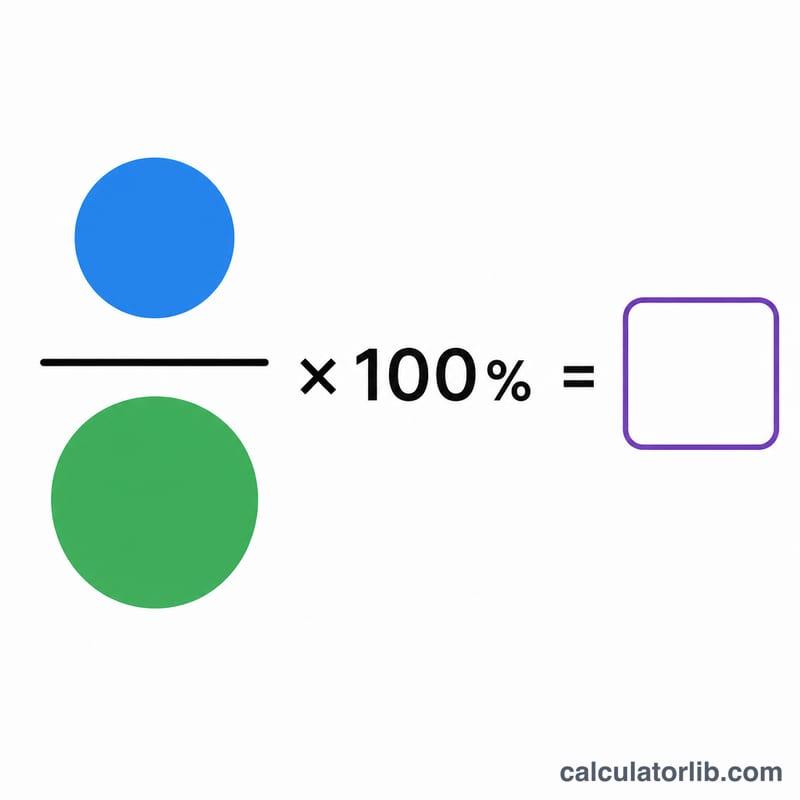
The relationship is simply:
$$\text{\% purity} = \frac{\text{mass of pure substance}}{\text{mass of sample}} \times 100\%$$
The pure mass is usually determined experimentally — for example, by isolating the desired product, titration, or analysis. The sample mass is the total mass you started with. Because purity is a ratio, both masses must be in the same unit (grams here, but any consistent unit works).
Worked Example
Suppose you recover 8 g of pure sodium chloride from a 10 g sample of rock salt. The percent purity is $$(8 \div 10) \times 100 = \mathbf{80\%}.$$ This means 20% of the sample, or 2 g, consists of impurities.
FAQ
Can percent purity exceed 100%? No. If you calculate more than 100%, either the pure mass is overestimated or there is a measurement error — pure substance cannot weigh more than the whole sample.
What units should I use? Any mass unit works as long as both inputs use the same one. Grams, kilograms, or milligrams all give the same percentage.
How does this differ from percent yield? Percent yield compares the actual product obtained to the theoretical maximum from a reaction, while percent purity describes the composition of a single sample.