
What is the Wire Gauge (AWG) Calculator?
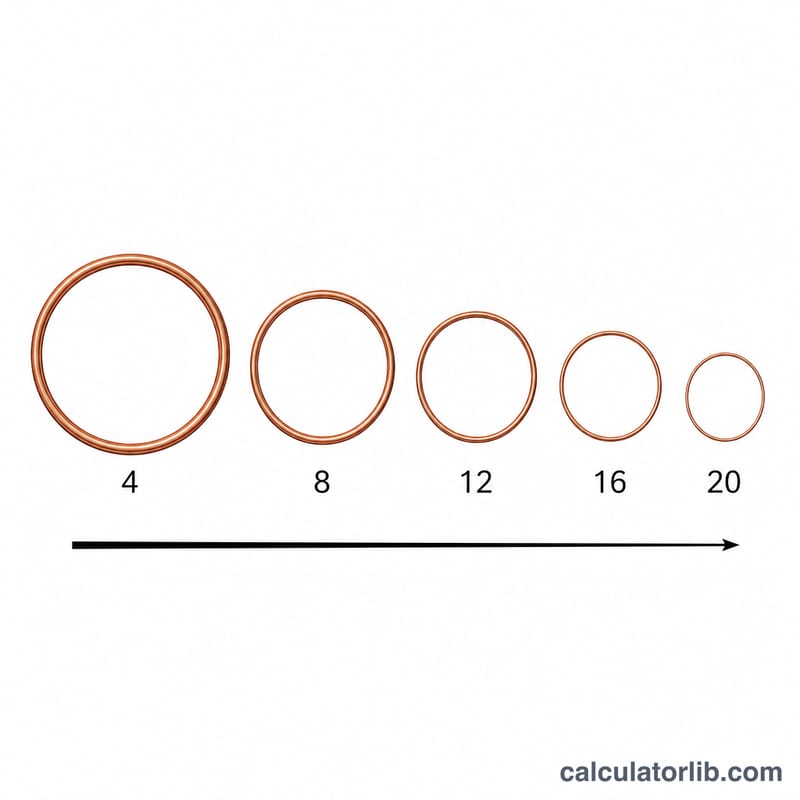
The American Wire Gauge (AWG) system is the standard way to describe the diameter of solid round electrical conductors in North America. This calculator converts an AWG number into its conductor diameter (mm) and cross-sectional area (mm²), then estimates a rough ampacity — how much current the wire can safely carry — using a chosen current-density factor. Lower AWG numbers mean thicker wire and higher current capacity.
How to use it
Enter the AWG size (for example, 12 for common household branch wiring). Pick a current-density factor that matches your situation: 4 A/mm² for conservative chassis or bundled wiring, 6 A/mm² for typical free-air use, and 8 A/mm² for power-transmission estimates. The calculator returns diameter, area, and approximate ampacity.
The formula explained
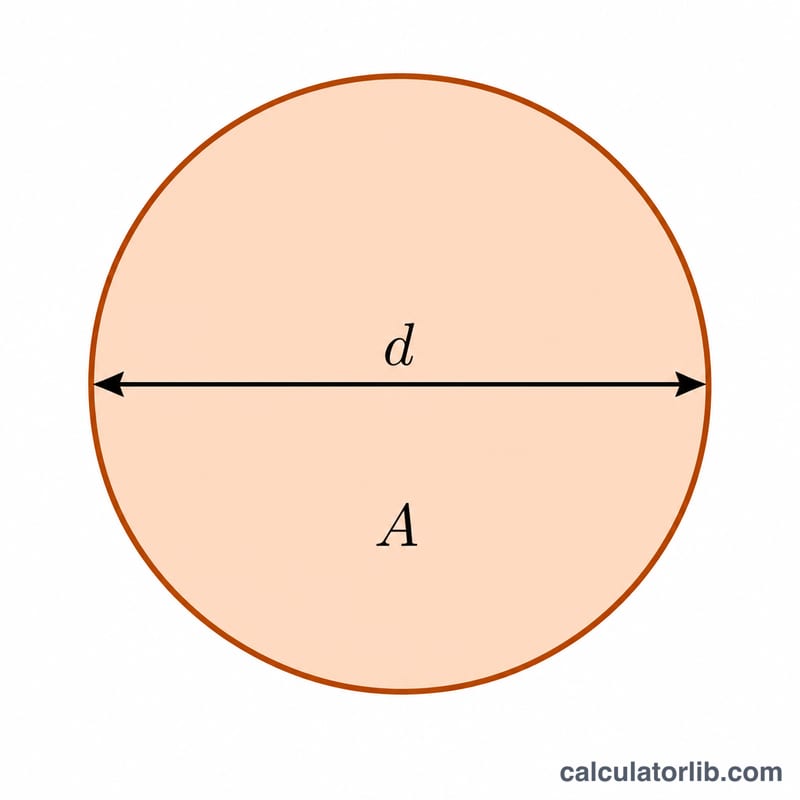
The diameter follows the geometric definition of the AWG scale: \( d = 0.127 \times 92^{(36 - \text{AWG}) / 39} \) millimetres. The constant 0.127 mm is the diameter of 36 AWG, and each step changes the diameter by the 39th root of 92. The area is the circle area \( A = \frac{\pi}{4} \times d^{2} \). Ampacity is approximated as \( I \approx k \times A \), where \(k\) is the allowable current density in amps per square millimetre.
Worked example
For 12 AWG:
$$d = 0.127 \times 92^{(36-12)/39} = 0.127 \times 92^{0.6154} \approx 2.053 \text{ mm}$$Area:
$$A = \frac{\pi}{4} \times 2.053^{2} \approx 3.31 \text{ mm}^2$$At 6 A/mm², estimated ampacity:
$$I \approx 6 \times 3.31 \approx 19.9 \text{ A}$$which is in line with the common ~20 A rating for 12 AWG copper.
FAQ
Is this a code-compliant ampacity? No. It is a physics estimate. Always follow the NEC or your local wiring code, which factors in insulation type, ambient temperature, bundling, and installation method.
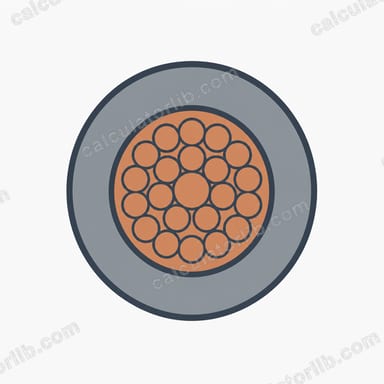
Does it work for stranded wire? The diameter formula models solid round conductors. Stranded wire of the same AWG has a similar copper area, so the area and ampacity estimates remain useful.
Why does a higher AWG give a smaller wire? The AWG scale is inverse: larger numbers represent thinner wires drawn through more dies.