
What Is Absolute vs Gauge Pressure?
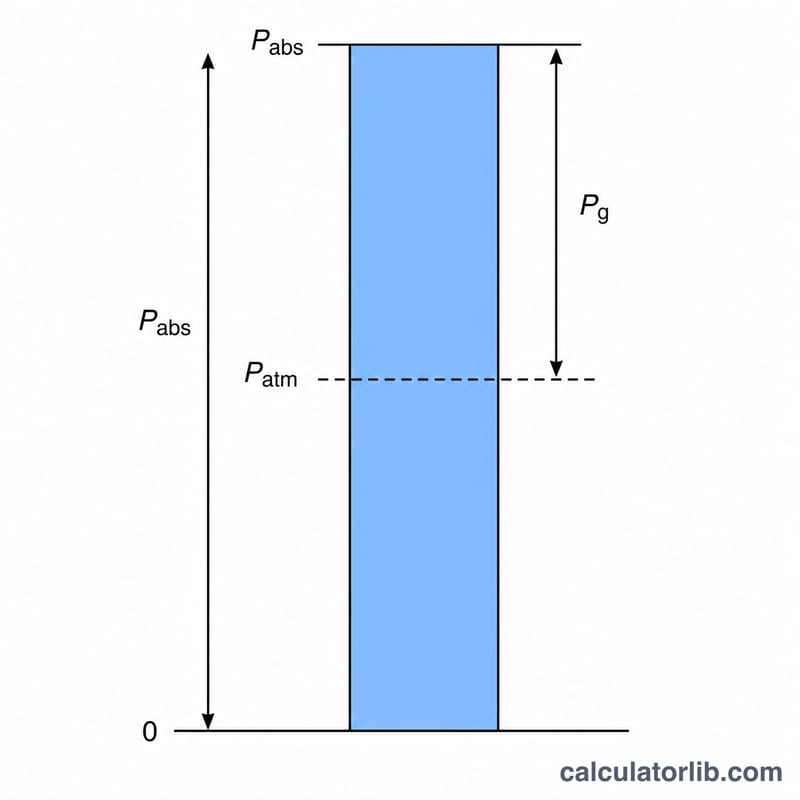
Pressure can be measured relative to two different references. Absolute pressure is measured relative to a perfect vacuum, so it is always positive. Gauge pressure is measured relative to the local atmospheric (ambient) pressure — it is what most pressure gauges read, since they ignore the atmosphere already pushing on them. This calculator converts an absolute pressure reading into gauge pressure by subtracting the atmospheric pressure.
How to Use This Calculator
Enter the absolute pressure and the atmospheric pressure in the same units (the defaults use kPa). The tool returns the gauge pressure. If your atmospheric value is the standard sea-level pressure, use 101.325 kPa (or 14.696 psi, or 1.01325 bar). A positive result means the system is above atmospheric; a negative result indicates a vacuum or suction condition.
The Formula Explained
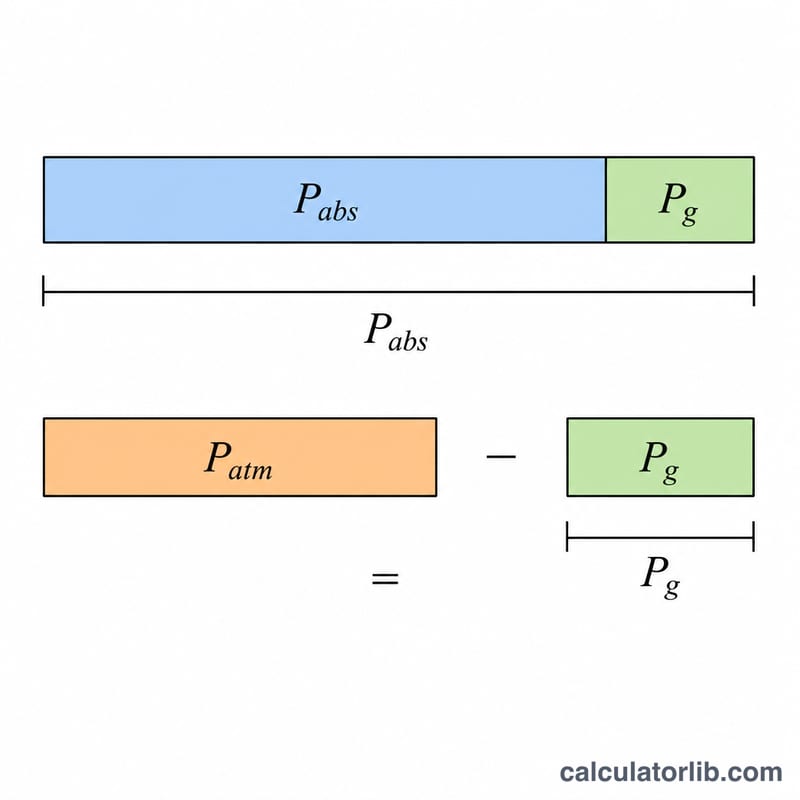
The relationship is simply: $$P_g = P_{abs} - P_{atm}$$ Because absolute and gauge pressure only differ by the atmospheric baseline, subtracting the local atmospheric pressure shifts the reference point. The calculator does not assume any units, so as long as both inputs share the same unit, the output is in that unit too.
Worked Example
Suppose a tank reads 201.325 kPa absolute and the local atmospheric pressure is 101.325 kPa. Then $$P_g = 201.325 - 101.325 = 100 \text{ kPa gauge}$$ That is the value a typical pressure gauge attached to the tank would display.
Pressure Unit Conversion Table
Gauge pressure is found by subtracting atmospheric pressure from absolute pressure, \(P_g = P_{abs} - P_{atm}\). Because pressure is reported in many different units, the table below lists conversion factors between the most common ones. To use the gauge-pressure formula correctly, make sure both \(P_{abs}\) and \(P_{atm}\) are expressed in the same unit before subtracting.
| From \ To | kPa | psi | bar | atm | mmHg | Pa |
|---|---|---|---|---|---|---|
| 1 kPa | 1 | 0.145038 | 0.01 | 0.00986923 | 7.50062 | 1000 |
| 1 psi | 6.894757 | 1 | 0.0689476 | 0.0680460 | 51.7149 | 6894.757 |
| 1 bar | 100 | 14.50377 | 1 | 0.986923 | 750.062 | 100000 |
| 1 atm | 101.325 | 14.69595 | 1.01325 | 1 | 760 | 101325 |
| 1 mmHg | 0.133322 | 0.0193368 | 0.00133322 | 0.00131579 | 1 | 133.322 |
| 1 Pa | 0.001 | 0.000145038 | 0.00001 | 9.86923×10⁻⁶ | 0.00750062 | 1 |
Standard atmospheric pressure is the same physical quantity in every column of the table above: 101.325 kPa = 14.696 psi = 1.01325 bar = 1 atm = 760 mmHg = 101 325 Pa. For example, an absolute reading of 250 kPa minus standard atmospheric pressure of 101.325 kPa gives a gauge pressure of 148.675 kPa.
Standard Atmospheric Pressure Values
The standard atmosphere (1 atm) is a defined reference pressure equal to the average air pressure at sea level. It is used as the default value of \(P_{atm}\) when no local barometric reading is available. The same standard pressure expressed in different units is:
| Unit | Standard sea-level value |
|---|---|
| atmospheres | 1 atm |
| kilopascals | 101.325 kPa |
| pascals | 101 325 Pa |
| bar | 1.01325 bar |
| pounds per square inch | 14.696 psi |
| millimeters of mercury (torr) | 760 mmHg |
| inches of mercury | 29.92 inHg |
Note on locally-measured barometric pressure: The 1 atm standard is an idealized reference, not the pressure at your exact location and moment. Actual atmospheric pressure varies with altitude, weather systems, and temperature — it falls by roughly 12 mmHg (about 1.6 kPa) per 100 m of elevation gain near sea level and shifts with passing high- and low-pressure weather. For accurate gauge-pressure results, use the locally measured barometric pressure for \(P_{atm}\) rather than the 101.325 kPa standard whenever possible. A local barometric reading can be converted to other units with a barometric pressure unit converter, and the expected pressure at a given elevation can be estimated with an air-pressure-at-altitude calculator.
FAQ
Can gauge pressure be negative? Yes. When absolute pressure is below atmospheric (a partial vacuum), gauge pressure becomes negative — sometimes called vacuum pressure.
What atmospheric value should I use? Standard sea-level pressure is 101.325 kPa. At altitude or in changing weather, use the locally measured barometric pressure for accuracy.
Does this work in psi or bar? Yes. Enter both values in the same unit (psi, bar, kPa, etc.) and the result is in that unit. The formula is unit-agnostic.