
What Is Dynamic Pressure?
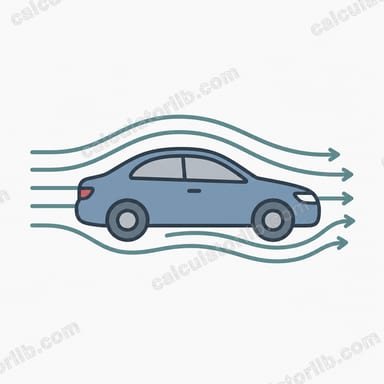
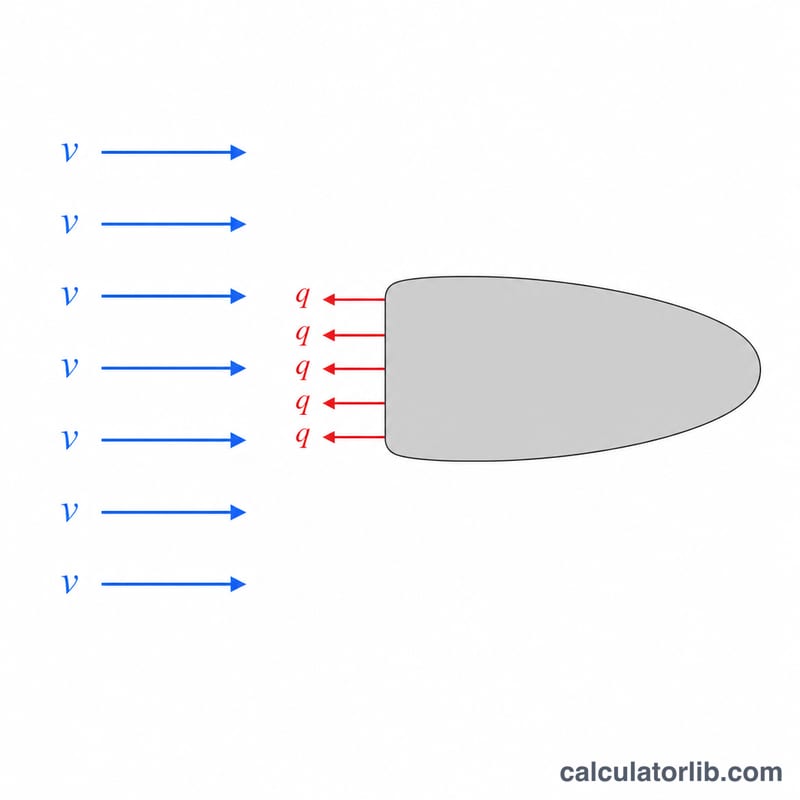
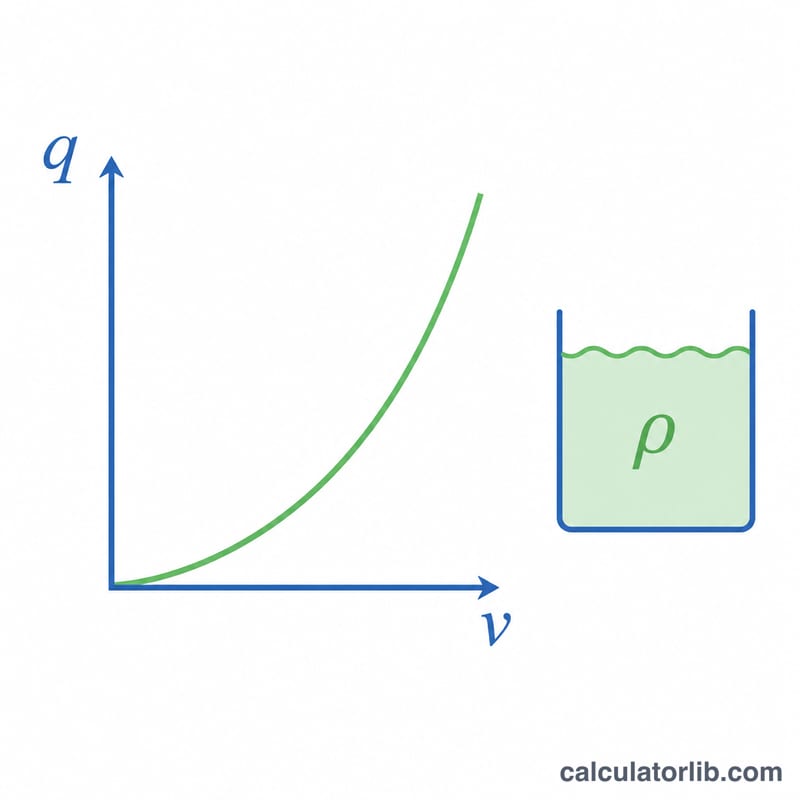
Dynamic pressure (often written q) is the kinetic energy per unit volume of a moving fluid. It represents the pressure increase that results from a fluid being brought to rest, and it is a cornerstone of aerodynamics, hydrodynamics, and HVAC design. The governing equation is $$q = \frac{1}{2} \cdot \rho \cdot v^{2}$$, where \(\rho\) is the fluid density and \(v\) is the flow velocity.
How to Use This Calculator
Enter the fluid density in kilograms per cubic metre and the flow velocity in metres per second, then read the dynamic pressure in pascals (and kilopascals). For air at sea level and 15 °C, density is about 1.225 kg/m³. For fresh water, use roughly 1000 kg/m³. Make sure both inputs use consistent SI units so the result comes out in pascals.
The Formula Explained
Because kinetic energy scales with the square of speed, dynamic pressure rises rapidly as velocity increases — doubling the speed quadruples \(q\). The ½ factor comes directly from the kinetic-energy term \(\frac{1}{2}mv^{2}\) rewritten per unit volume (mass per volume is density). Dynamic pressure is not the same as static pressure; in Bernoulli's equation the two add up to total (stagnation) pressure.
Worked Example
An aircraft flies at 50 m/s through air with density 1.225 kg/m³. Then $$q = \frac{1}{2} \times 1.225 \times 50^{2} = 0.5 \times 1.225 \times 2500 = 1531.25 \text{ Pa}$$ or about 1.53 kPa. This value is what an aerodynamicist multiplies by area and a coefficient to estimate lift or drag.
FAQ
What units does this use? SI units: density in kg/m³, velocity in m/s, and the resulting pressure in pascals (Pa).
Is dynamic pressure the same as static pressure? No. Static pressure is the fluid's ambient pressure; dynamic pressure is the extra pressure due to its motion. Their sum is the total or stagnation pressure.
What density should I use for air? Standard sea-level air is about 1.225 kg/m³, but density falls with altitude and rises with cold temperature, so adjust accordingly.