What is the kVA to Amps Calculator?
This tool converts apparent power, measured in kilovolt-amperes (kVA), into electrical current, measured in amperes (A). It supports both single-phase and three-phase electrical systems, making it useful for sizing generators, transformers, cables, breakers, and UPS systems. Because kVA represents apparent power rather than real power, no power factor is needed for this conversion.
How to use it
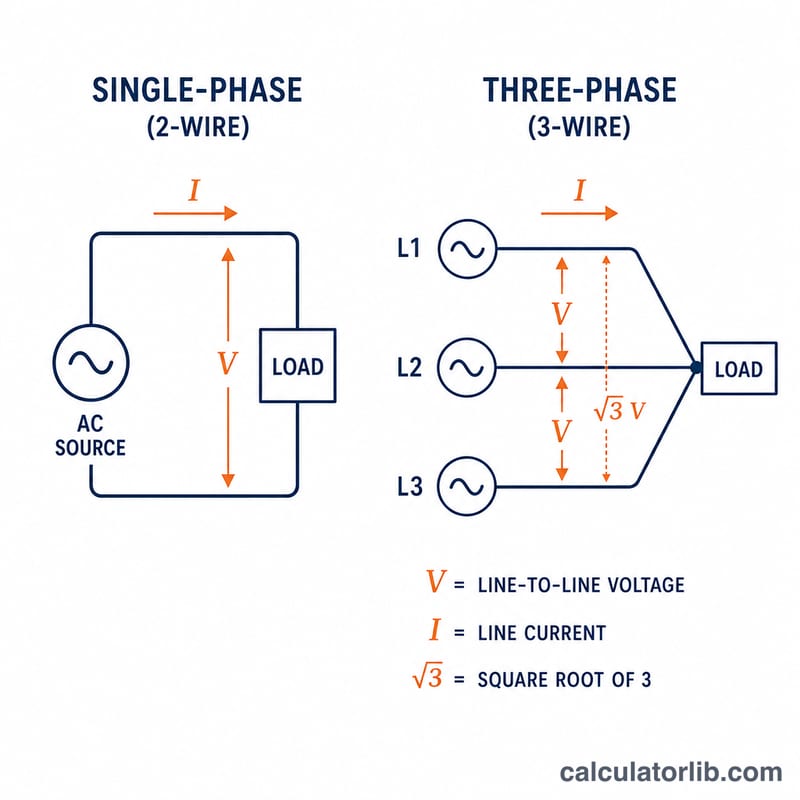
Select whether your system is single phase or three phase. Enter the apparent power in kVA and the system voltage in volts. For three-phase systems, use the line-to-line voltage (for example 400 V or 415 V). Click calculate to see the resulting current in amperes.
The formula explained
For a single-phase system the current is the apparent power in volt-amperes divided by the voltage: $$I = \frac{\text{kVA} \times 1000}{V}$$ For a three-phase system the line current uses the square root of three: $$I = \frac{\text{kVA} \times 1000}{\sqrt{3} \times V}$$ The factor of 1000 converts kilovolt-amperes to volt-amperes, and \(\sqrt{3} \approx 1.732\) accounts for the relationship between line and phase quantities in a balanced three-phase load.
Worked example
Suppose you have a 50 kVA three-phase transformer at 400 V. The current is $$I = \frac{50 \times 1000}{1.732 \times 400} = \frac{50000}{692.8} \approx 72.2 \text{ A}$$ For a 10 kVA single-phase load at 240 V, $$I = \frac{10 \times 1000}{240} \approx 41.67 \text{ A}$$
Interpreting Your Current Result
The value this calculator returns is the full-load rated line current: the current a transformer, generator or UPS rated at the entered kVA draws at the entered voltage when it is fully loaded. For single-phase, \(I = \frac{ \text{kVA} \times 1000}{V}\). For three-phase, \(I = \frac{ \text{kVA} \times 1000}{\sqrt{3} \times V_{LL}}\), where \(V_{LL}\) is the line-to-line voltage. The three-phase figure assumes a balanced load, meaning each phase carries the same current.
Example: a 100 kVA three-phase supply at 400 V line-to-line gives \(I = \frac{100 \times 1000}{1.732 \times 400} \approx 144.3\) A per line.
What the number does not tell you
- Conductor and breaker sizing: the calculated current is a starting point, not the final rating. Continuous loads (running 3 hours or more) are commonly sized at 125% of the load current under the US National Electrical Code (NEC). Other rules apply under IEC 60364 and local codes, such as installation method, ambient temperature, grouping of cables and voltage drop.
- Standard ratings: breakers and fuses come in discrete standard sizes, so the protective device rating is usually the next standard size at or above the adjusted current, subject to the conductor's capacity.
- Voltage deviations: for a constant-power load, current rises as supply voltage falls. A supply running below nominal draws more current than the calculated value.
- Unbalanced loads: in a three-phase system with unequal loading, one or more lines can carry more than the balanced figure, and the neutral may carry current.
Always verify the final design against the applicable electrical code and the equipment nameplate, and have it reviewed by a qualified electrician or engineer.
Key Terms: kVA, Amps, Line Voltage and Phase
- Apparent power (kVA)
- The product of voltage and current, in kilovolt-amperes. It is the total power the equipment must handle, whether or not it does useful work. Transformers, generators and UPS units are usually rated in kVA.
- Real power (kW)
- The power converted to useful work such as heat, light or motion. \(\text{kW} = \text{kVA} \times \text{power factor}\).
- Power factor
- The ratio of real power to apparent power, between 0 and 1. A lower power factor means more current is needed for the same real power. Converting kVA to amps does not need it, but converting kW to amps does.
- Current (A)
- The flow of electric charge, measured in amperes (amps). It determines heating in conductors and the size of protective devices.
- Line-to-line voltage
- The voltage between any two phase conductors in a three-phase system, for example 400 V.
- Phase (line-to-neutral) voltage
- The voltage between one phase conductor and neutral. It equals the line-to-line voltage divided by \(\sqrt{3}\): \(\frac{400}{1.732} \approx 230\) V. Likewise 208 V line-to-line corresponds to about 120 V line-to-neutral.
- Single-phase
- A supply with one alternating voltage waveform, common for homes and small loads.
- Three-phase
- A supply of three alternating voltages offset by 120°, used for industrial equipment and power distribution because it delivers power more efficiently.
- Balanced load
- A three-phase load in which all three phases carry equal current at equal power factor, so the line currents are equal in magnitude.
FAQ
Do I need power factor? No. kVA is apparent power, so the conversion to amps depends only on voltage. You would need power factor only when converting between kVA and kW.
Which voltage do I use for three phase? Use the line-to-line (phase-to-phase) voltage, such as 400 V or 480 V.
Why is there a \(\sqrt{3}\) for three phase? In a balanced three-phase system, total apparent power equals \(\sqrt{3}\) times line voltage times line current, so solving for current introduces the \(\sqrt{3}\) factor.