What Is the kVA to kW Calculator?
This calculator converts apparent power, measured in kilovolt-amperes (kVA), into real (active) power, measured in kilowatts (kW). The conversion depends on the power factor (PF) of the electrical system, which describes how efficiently current is being converted into useful work. This tool is universal and applies to any AC electrical system worldwide.
How to Use It
Enter the apparent power in kVA and the power factor (a value between 0 and 1). The calculator instantly returns the real power in kW, plus the reactive power in kVAR. A purely resistive load has a power factor of 1, while inductive loads such as motors typically range from 0.7 to 0.9.
The Formula Explained
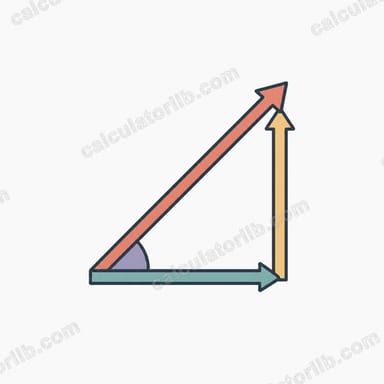
The core relationship is $$\text{kW} = \text{kVA} \times \text{PF}$$ Apparent power (kVA) is the total power flowing in the circuit, real power (kW) is the portion that does useful work, and the power factor is the ratio between them. The reactive power, which sustains magnetic fields in motors and transformers, follows \(\text{kVAR} = \text{kVA} \times \sqrt{1 - \text{PF}^2}\), forming the classic power triangle.

Worked Example
Suppose a generator is rated at 100 kVA and the load has a power factor of 0.8. The real power is $$100 \times 0.8 = 80 \text{ kW}$$ The reactive power is $$100 \times \sqrt{1 - 0.64} = 100 \times 0.6 = 60 \text{ kVAR}$$ So this generator can deliver 80 kW of usable power under these conditions.
Typical Power Factors by Load Type
Power factor (PF) depends on the type of equipment connected. The values below are approximate typical ranges and vary with manufacturer, design, loading and operating conditions. Use measured or nameplate values where available.
| Load type | Typical power factor |
|---|---|
| Incandescent lamps and resistive heaters | ~1.0 |
| Induction motor at full load | ~0.8-0.9 |
| Induction motor at light load | ~0.2-0.5 |
| Fluorescent lighting with magnetic ballast | ~0.5-0.8 |
| LED drivers | ~0.5-0.9 (higher with active PFC) |
| Welding equipment | ~0.5-0.7 |
| Computers / switch-mode power supplies without PFC | ~0.6-0.7 |
| Industrial plant with power factor correction | ~0.95 or higher |
Real power is calculated as \(\text{kW} = \text{kVA} \times \text{PF}\).
kW Output at Different Power Factors
The table shows a fixed 100 kVA rating at different power factors. Real power is \(\text{kW} = \text{kVA} \times \text{PF}\), and reactive power is \(\text{kVAR} = \text{kVA} \times \sqrt{1-\text{PF}^2}\).
| Power factor | Real power (kW) | Reactive power (kVAR) |
|---|---|---|
| 0.6 | 60 | 80 |
| 0.7 | 70 | 71.4 |
| 0.8 | 80 | 60 |
| 0.9 | 90 | 43.6 |
| 0.95 | 95 | 31.2 |
| 1.0 | 100 | 0 |
Example at PF 0.8: \(100 \times 0.8 = 80\) kW and \(100 \times \sqrt{1-0.8^2} = 100 \times 0.6 = 60\) kVAR. The three quantities satisfy \(\text{kVA}^2 = \text{kW}^2 + \text{kVAR}^2\).
Interpreting Your Result
- kVA is the equipment limit. Generators and transformers are rated in kVA because their current and heating limits depend on apparent power. At a lower power factor, the same kVA rating delivers fewer usable kW, as the 100 kVA table shows (60 kW at PF 0.6 versus 100 kW at PF 1.0).
- A larger kVAR share means more reactive current. Reactive current does no useful work but still flows through conductors, switchgear and transformers. This increases loading, I²R losses and voltage drop.
- Utility penalties. Many utilities apply penalties, surcharges or kVA-based demand charges when power factor falls below a threshold, commonly around 0.9-0.95. The threshold and billing method vary by utility and region, so check the applicable tariff.
- Correction reduces kVAR. Power factor correction, typically with capacitor banks or active filters, supplies reactive power locally. This lowers kVAR drawn from the supply, reduces kVA for the same kW, and frees capacity on existing equipment.
This is general technical information. Actual sizing and correction design should follow the equipment ratings and local electrical standards.
FAQ
Why is kW always less than or equal to kVA? Because the power factor is at most 1. The kW value only equals kVA when the power factor is exactly 1 (a perfectly resistive load).
What power factor should I use? Use the rated power factor of your equipment. If unknown, 0.8 is a common assumption for mixed industrial and commercial loads.
Does this work for single- and three-phase? Yes. The kVA-to-kW relationship via power factor holds regardless of the number of phases.