What Is the Watts to kVA Calculator?
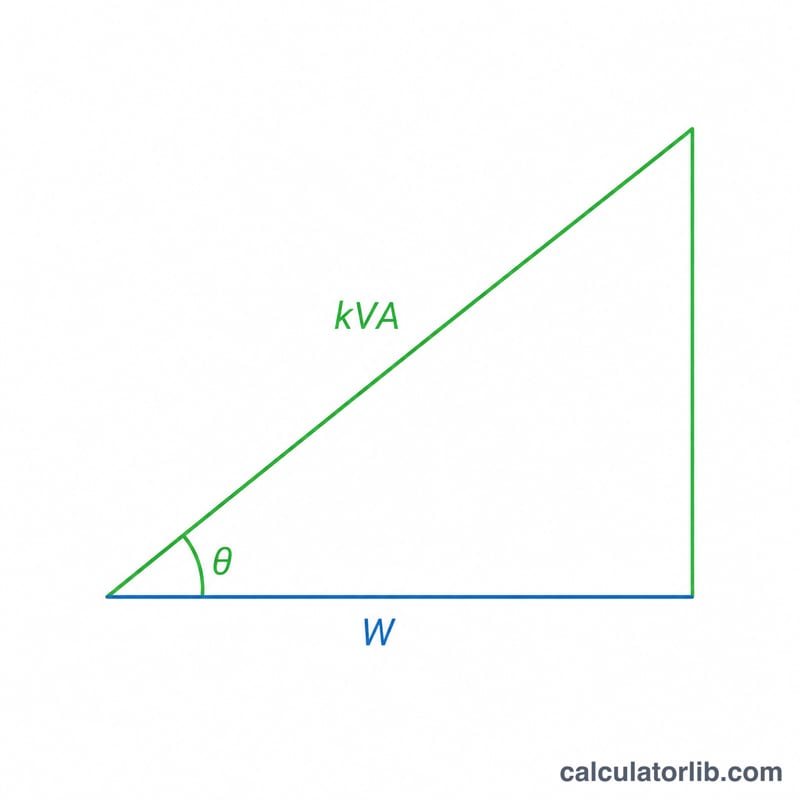
This tool converts real power measured in watts (W) into apparent power measured in kilovolt-amps (kVA). In AC electrical systems, the apparent power supplied by the source is larger than the real power consumed by the load whenever the power factor is less than 1. Engineers, electricians, and generator-sizing professionals use this conversion to correctly rate transformers, generators, and UPS systems.
How to Use It
Enter the real power in watts and the system's power factor (a value between 0 and 1, often 0.8 for typical loads). The calculator divides watts by 1000 to get kilowatts, then divides by the power factor to find the apparent power in kVA.
The Formula Explained
The conversion is $$\text{kVA} = \frac{\text{W} / 1000}{\text{PF}}$$ First convert watts to kilowatts by dividing by 1000. Real power (kW) only represents the energy actually doing work, while apparent power (kVA) is the total power the source must deliver, including the reactive component. A lower power factor means a larger gap between kW and kVA.
Worked Example
Suppose you have a load of 1000 W at a power factor of 0.8. First, \(1000 / 1000 = 1\) kW. Then \(1 \text{ kW} / 0.8 = 1.25\) 1.25 kVA. So a 1000 W load at 0.8 PF requires 1.25 kVA of apparent power.
Typical Power Factor Values by Load Type
Power factor (PF) is the ratio of real power (W) to apparent power (VA). Converting watts to kVA requires a PF, so these typical values can help when you do not have a measured figure. They are approximate ranges for AC systems and vary with equipment design, loading and age. Use a nameplate or measured value whenever you have one.
| Load type | Typical power factor |
|---|---|
| Resistive heaters, incandescent lighting | about 1.0 |
| LED or fluorescent lighting (with ballast or driver) | about 0.5 to 0.95 |
| Induction motors at full load | about 0.8 to 0.9 |
| Induction motors at light load | about 0.2 to 0.5 |
| Computers and switch-mode power supplies | about 0.6 to 0.95 (higher with power factor correction) |
| Welding equipment | about 0.5 to 0.7 |
| Transformers, lightly loaded | low, often well below 0.5 near no-load |
Note: these are approximate typical ranges, not guaranteed values. Actual PF depends on the specific equipment, its load level and any correction fitted.
kVA for the Same Load at Different Power Factors
The table below uses a fixed real power of 10 kW (10,000 W) and the formula \(\text{kVA} = \frac{W}{1000 \times PF}\). The same real power requires more apparent power as PF falls.
| Power factor | Apparent power (kVA) | Increase vs. PF 1.0 |
|---|---|---|
| 1.0 | 10.00 | 0% |
| 0.95 | 10.53 | about 5.3% |
| 0.9 | 11.11 | about 11.1% |
| 0.8 | 12.50 | 25% |
| 0.7 | 14.29 | about 42.9% |
| 0.6 | 16.67 | about 66.7% |
| 0.5 | 20.00 | 100% |
Worked check for PF 0.8: \(\frac{10000}{1000 \times 0.8} = \frac{10000}{800} = 12.50\) kVA.
Interpreting Your kVA Result
Generators, transformers and UPS units are usually rated in kVA rather than kW. Their heating and conductor limits depend on the current they carry, and current is set by apparent power (volts × amps), not by real power alone. The kVA rating therefore describes the load the equipment can supply regardless of how much of it does useful work.
Relating kVA to current
- Single phase: \(I = \frac{\text{kVA} \times 1000}{V}\)
- Three phase: \(I = \frac{\text{kVA} \times 1000}{\sqrt{3} \times V}\), where \(V\) is the line-to-line voltage.
For example, 12.5 kVA at 230 V single phase gives \(I = \frac{12500}{230} \approx 54.35\) A. At 400 V three phase it gives \(I = \frac{12500}{1.732 \times 400} \approx 18.04\) A.
kW capacity of a source: the real power a generator or UPS can deliver equals its kVA rating × its rated power factor. For example, a 20 kVA unit rated at PF 0.8 supplies up to 16 kW.
Effect of low power factor: for the same real power, a lower PF means a higher apparent power and so a higher current. That current causes greater resistive losses (I²R) and voltage drop in cables and transformers, and it needs larger equipment ratings.
This result is a calculation from the values you entered. It assumes a steady AC load, and real systems may have varying PF and harmonics. Confirm ratings against equipment nameplates and applicable local electrical standards.
FAQ
Why is kVA larger than kW? Because apparent power includes reactive power that flows back and forth without doing useful work. Only at a perfect power factor of 1.0 are kVA and kW equal.
What power factor should I use? If unknown, 0.8 is a common default for mixed industrial and motor loads. Resistive loads (heaters) are close to 1.0.
Does this work for single and three phase? Yes — the W-to-kVA relationship through power factor holds for both, since it relates total real to total apparent power.