
What is the Pittsburgh Sleep Quality Index?
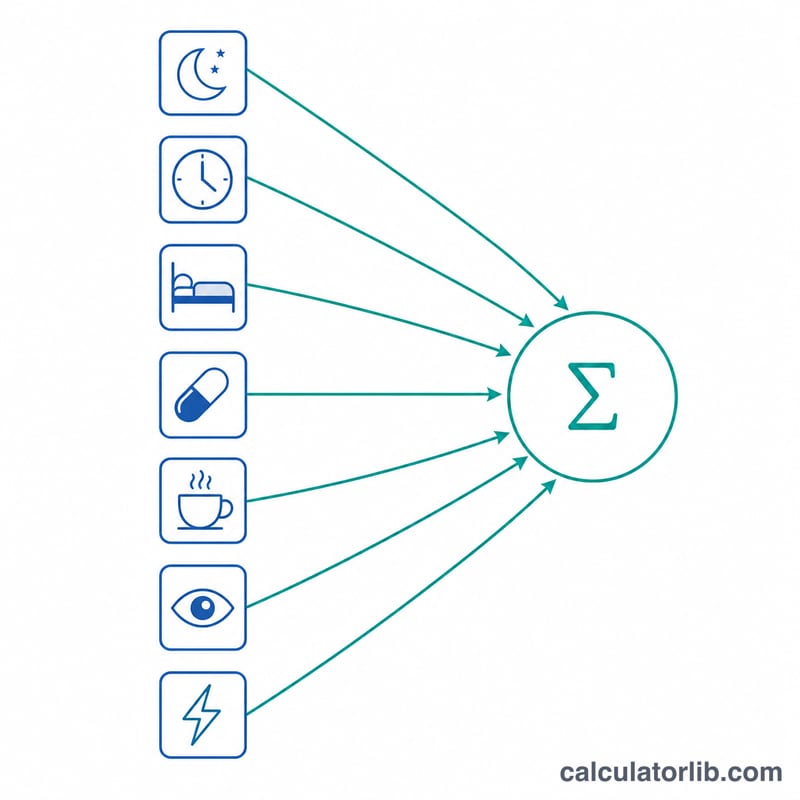
The Pittsburgh Sleep Quality Index (PSQI) is a widely used self-report questionnaire that measures sleep quality and disturbances over a one-month interval. Developed at the University of Pittsburgh, it combines answers into seven component scores: (1) subjective sleep quality, (2) sleep latency, (3) sleep duration, (4) habitual sleep efficiency, (5) sleep disturbances, (6) use of sleeping medication, and (7) daytime dysfunction. Each component is scored from 0 (no difficulty) to 3 (severe difficulty), and the seven are added to produce a global score ranging from 0 to 21.
How to use this calculator
If you have already derived your seven PSQI component scores from the full questionnaire, simply select each value (0-3) above. The calculator sums them into a global score and compares it against the standard cutoff. A higher score means poorer sleep quality. This tool assumes you have completed the component scoring; it does not convert the raw questionnaire items for you.
The formula explained
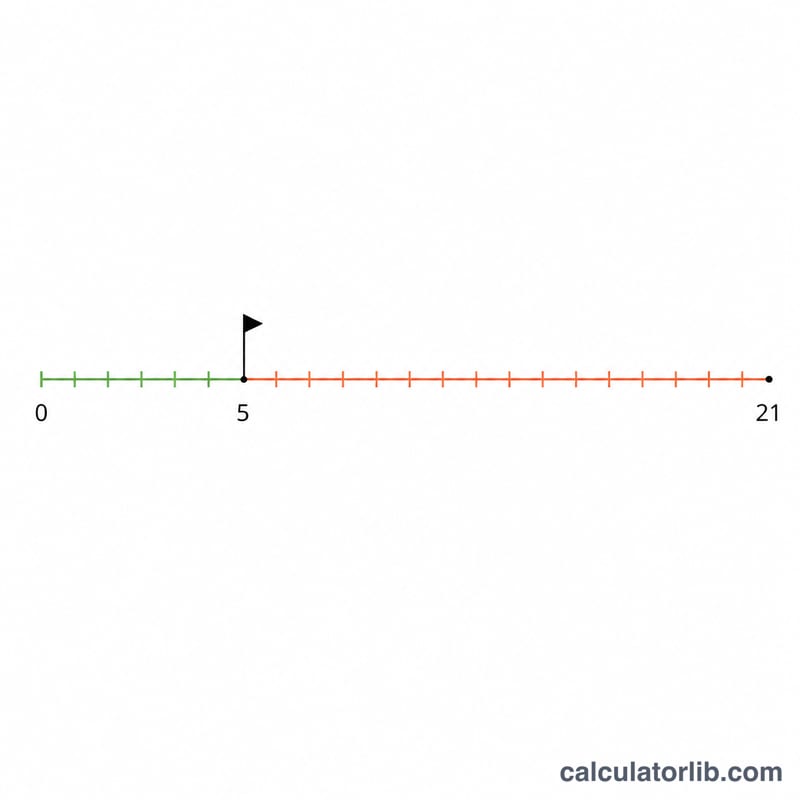
The math is straightforward addition: $$\text{PSQI} = \text{C}_1 + \text{C}_2 + \text{C}_3 + \text{C}_4 + \text{C}_5 + \text{C}_6 + \text{C}_7$$ Because each component is bounded at 3, the maximum possible total is \(7 \times 3 = 21\), and the minimum is 0. A global score greater than 5 is the validated threshold suggesting clinically poor sleep quality.
Worked example
Suppose your component scores are 2, 1, 2, 0, 1, 0 and 3. Adding them: $$2 + 1 + 2 + 0 + 1 + 0 + 3 = 9$$ Because 9 is greater than 5, this global PSQI of 9 indicates poor sleep quality.
FAQ
What score is considered "good" sleep? A global PSQI of 5 or below is generally interpreted as good sleep quality; above 5 suggests poor quality.
Is this a medical diagnosis? No. The PSQI is a screening and research instrument. A high score is a reason to discuss your sleep with a healthcare professional, not a diagnosis by itself.
Why are there only seven components when the questionnaire has many items? The full PSQI has multiple questions that are scored and grouped into the seven component scores. This calculator works from those already-computed component scores.