
What Is the Watts to Amps Calculator?
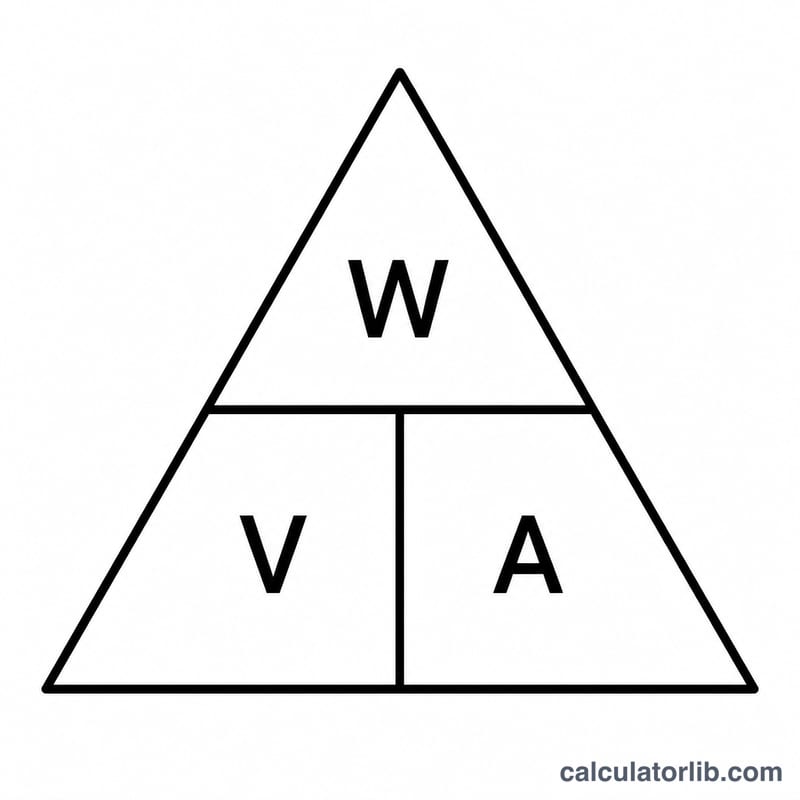
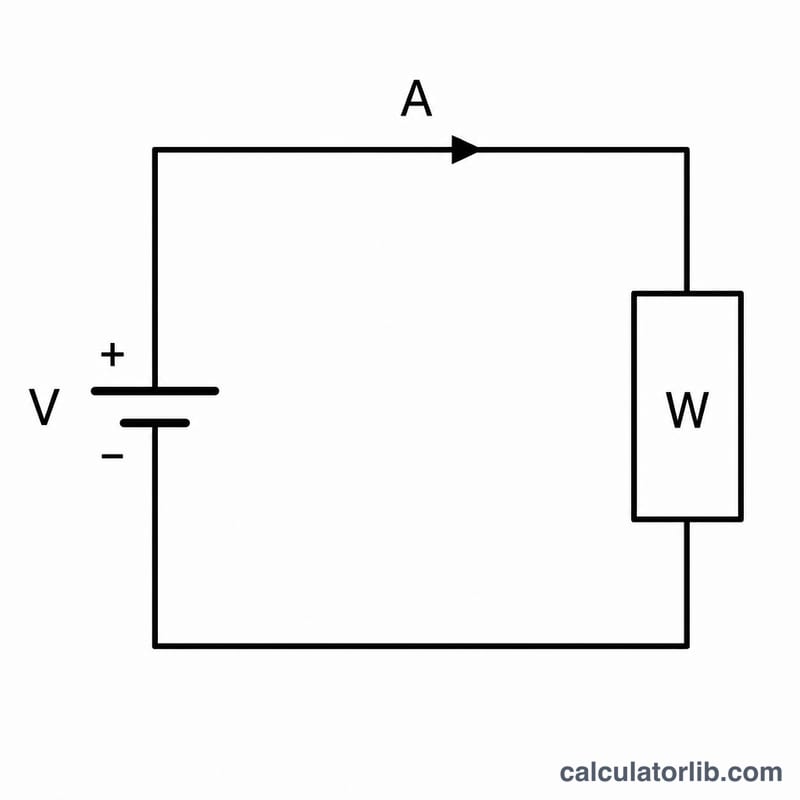
This calculator converts electrical power measured in watts (W) into current measured in amps (A) for a given voltage. It is based on the fundamental power relationship in a DC circuit, where power equals voltage multiplied by current. Rearranging that equation lets you solve for current when you know the power rating of a device and the supply voltage.
How to Use It
Enter the power consumption of your device in watts and the supply voltage in volts. The calculator divides watts by volts to give you the current draw in amps. This is useful for sizing fuses, choosing wire gauge, picking a power supply, or checking whether a circuit can handle a load.
The Formula Explained
The core equation is Amps = Watts ÷ Volts, written as $$I = \frac{P}{V}$$ Power (P) is in watts, voltage (V) is in volts, and current (I) comes out in amps. This direct division applies to DC circuits and resistive (unity power factor) AC loads. For AC loads with a power factor, you would divide the result by the power factor as well.
Worked Example
Suppose you have a 60 W light bulb running on a 12 V supply. Dividing 60 by 12 gives 5 amps of current draw.
$$\text{Current (A)} = \frac{60\ \text{W}}{12\ \text{V}} = 5\ \text{A}$$A 120 W device on the same 12 V rail would draw 10 amps. This tells you that a thicker wire and a higher-rated fuse are needed for the larger load.
FAQ
Does this work for AC power? For purely resistive AC loads it is accurate. For motors and other reactive loads, divide the result by the power factor to get the true current.
Why does higher voltage mean lower current? For the same power, raising voltage reduces current because power is the product of the two — this is why high-voltage transmission reduces line losses.
What if I enter 0 volts? Division by zero is undefined, so the calculator returns 0; always enter a valid supply voltage.