
What it is
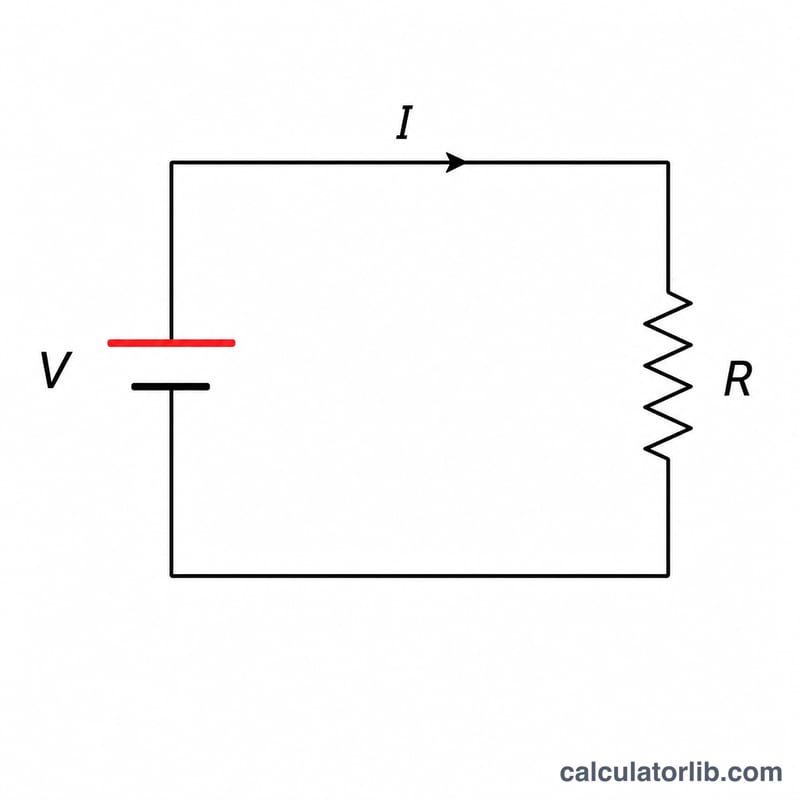
The Watts–Volts–Amps–Ohms calculator solves for any of the four fundamental electrical quantities — voltage (V), current (I), resistance (R) and power (P) — given any two of them. It combines Ohm's Law with the electrical power equations so you never have to remember which formula to rearrange.
How to use it
Enter exactly two of the four values and leave the other two blank. The calculator detects the two knowns and computes the remaining two automatically. For example, enter a power rating and a resistance to find the voltage and current a device will draw.
The formulas
The relationships used are Ohm's Law, \(\text{V} = \text{I} \times \text{R}\), and the power equations \(\text{P} = \text{V} \times \text{I}\), \(\text{P} = \text{I}^{2} \times \text{R}\) and \(\text{P} = \text{V}^{2} / \text{R}\). Any two known quantities uniquely determine the other two (taking positive roots for physical values).
$$\begin{gathered} \text{V} = \text{I} \times \text{R} \\[1em] \text{P} = \text{V} \times \text{I} = \text{I}^{2} \times \text{R} = \dfrac{\text{V}^{2}}{\text{R}} \end{gathered}$$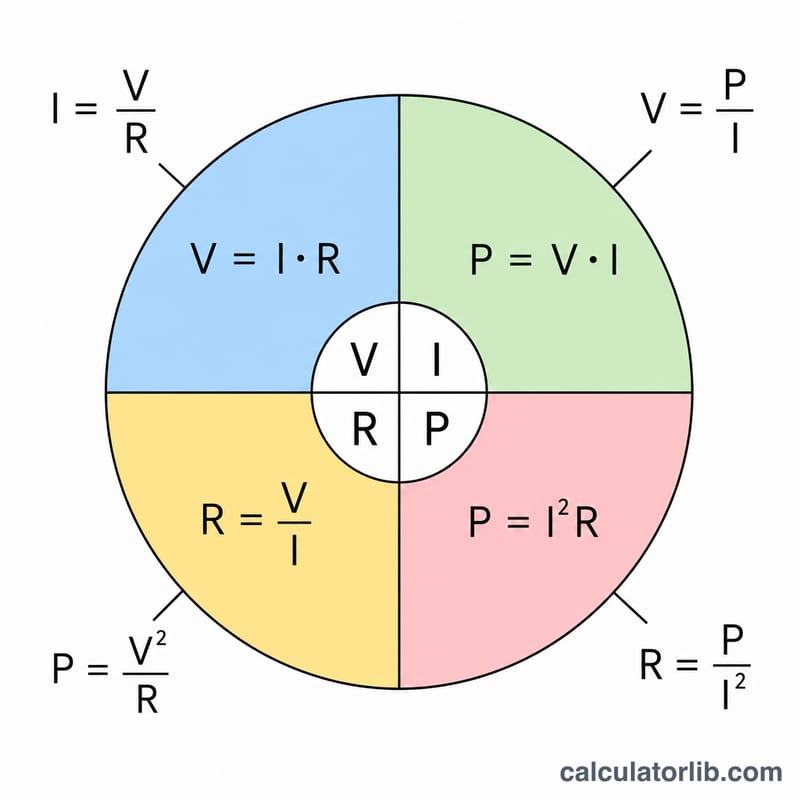
Worked example
Suppose a heating element is rated at 100 W and has a resistance of 10 Ω. Voltage = \(\sqrt{\text{P} \times \text{R}}\) = \(\sqrt{100 \times 10}\) = \(\sqrt{1000} \approx 31.62\) V. Current = \(\sqrt{\text{P} / \text{R}}\) = \(\sqrt{100 / 10}\) = \(\sqrt{10} \approx 3.16\) A. You can verify: \(\text{P} = \text{V} \times \text{I} = 31.62 \times 3.16 \approx 100\) W.
FAQ
What if I enter all four values? The calculator uses the values you provide and will not overwrite them, so make sure they are consistent.
Does this work for AC circuits? These formulas apply directly to DC and to purely resistive AC loads. For reactive AC loads you would need to account for power factor.
Why do I get a positive answer when a square root could be negative? Physical voltage, current and resistance are taken as positive magnitudes, so the positive root is always used.