What Is the Volts to Watts Calculator?
This tool converts an electrical voltage and current into power, expressed in watts. It uses the fundamental power equation \(P = V \times I\), where \(P\) is power (watts), \(V\) is voltage (volts), and \(I\) is current (amperes). It works for any DC circuit and for AC circuits where the power factor is 1 (purely resistive loads).
How to Use It
Enter the voltage in volts and the current in amperes, then read the resulting power in watts. For example, a device running at 12 V drawing 2 A consumes 24 watts. This is handy for sizing power supplies, batteries, fuses, and chargers.
The Formula Explained
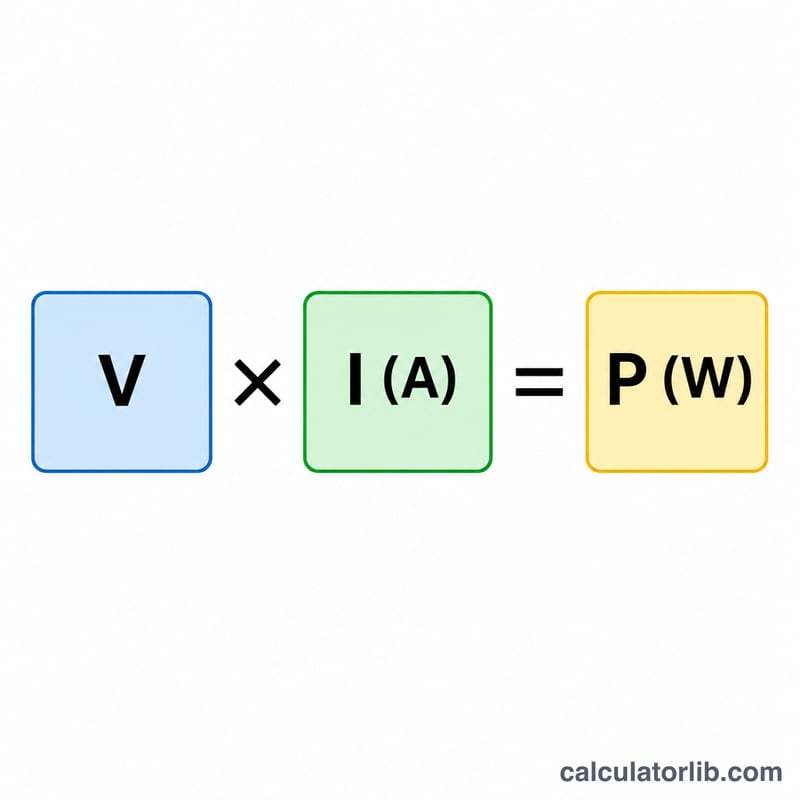
Electrical power is the rate at which energy is delivered. The product of voltage (the "push") and current (the "flow") gives power:
$$P = V \times I$$One watt equals one volt-ampere in a DC or unity-power-factor circuit. To get kilowatts, divide watts by 1000.
Worked Example
Suppose a USB charger outputs 5 V at 3 A. Power:
$$P = 5 \times 3 = 15 \text{ watts}$$A 230 V appliance pulling 10 A draws:
$$230 \times 10 = 2{,}300 \text{ watts } (2.3 \text{ kW})$$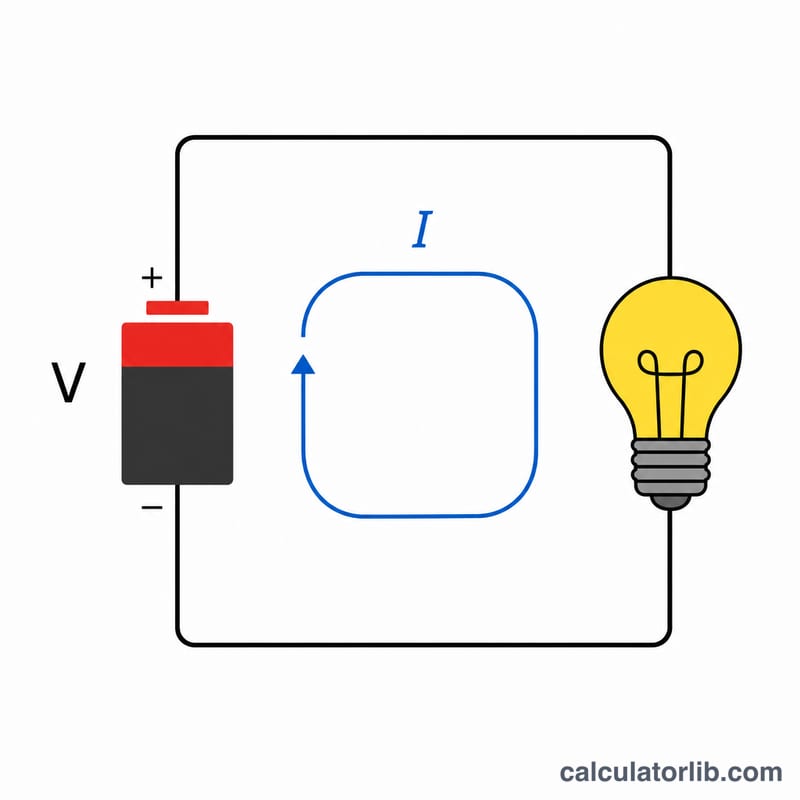
Typical Power Draw at Common Voltages and Currents
Power in watts is voltage multiplied by current: \(P = V \times I\). The table applies this formula to common voltage and current combinations. For AC loads, these figures are apparent power (VA) and equal real power (W) only when the power factor is 1.
| Voltage (V) | Current (A) | Power (W) | Typical device/context |
|---|---|---|---|
| 5 | 0.5 | 2.5 | Standard USB port (5 × 0.5) |
| 12 | 10 | 120 | Automotive accessory circuit (12 × 10) |
| 24 | 5 | 120 | 24 V truck or industrial DC load (24 × 5) |
| 48 | 20 | 960 | 48 V telecom or DC power system (48 × 20) |
| 120 | 15 | 1,800 | US 15 A outlet circuit at full rating (120 × 15) |
| 230 | 16 | 3,680 | EU 16 A outlet circuit at full rating (230 × 16) |
Note: the 120 V/15 A and 230 V/16 A rows are circuit maximums. In the US, continuous loads are commonly limited to 80% of a breaker's rating under the National Electrical Code, which would be 1,440 W on a 15 A circuit at 120 V.
Common Voltage Standards Reference
These are widely published nominal voltages. Actual voltages vary within a tolerance, for example a 12 V car battery reads about 12.6 V at rest and higher while the engine is charging. Mains voltage and frequency also differ by country.
| Nominal voltage | Type | Context |
|---|---|---|
| 5 V | DC | USB ports and chargers (standard USB power) |
| 12 V | DC | Car batteries, automotive accessories, many LED strips and small appliances |
| 24 V | DC | Trucks, buses, and many industrial or control systems |
| 48 V | DC | Telecom power systems and Power over Ethernet (PoE) class equipment |
| 100 V | AC | Japan mains (50 Hz in eastern Japan, 60 Hz in western Japan) |
| 120 V | AC | United States mains (60 Hz) for standard outlets; Canada is similar |
| 230 V | AC | European Union and United Kingdom mains (50 Hz) |
Key Terms: Volts, Amps, Watts and Power Factor
- Voltage (V): the electrical potential difference that pushes current through a circuit, measured in volts.
- Current (A): the rate of electric charge flow, measured in amperes (amps).
- Power (W): the rate at which energy is used or delivered. One watt equals one joule per second, and for DC \(P = V \times I\).
- Kilowatt (kW): 1,000 watts. For example, 3,680 W = 3.68 kW.
- Volt-ampere (VA): apparent power, the product of RMS voltage and RMS current in an AC circuit.
- Real power (W): the part of apparent power that does useful work. In AC circuits, \(\text{W} = \text{VA} \times PF\), so real power is never more than apparent power.
- Power factor (PF): the ratio of real power to apparent power, a value between 0 and 1. Resistive loads such as heaters have a PF near 1. Motors and some electronics have a lower PF.
Three-phase note: for a balanced three-phase AC load using line-to-line voltage, real power is:
$$P = \sqrt{3} \times V_{LL} \times I \times PF$$
The Volts to Watts calculator uses the simple \(P = V \times I\) relationship, which is exact for DC and for single-phase AC with a power factor of 1.
FAQ
Does this work for AC? It is exact for DC and for resistive AC loads. For reactive AC loads, multiply by the power factor: \(P = V \times I \times PF\).
How do I convert watts to kilowatts? Divide the watt value by 1,000.
Can I go backwards from watts to amps? Yes — rearrange to \(I = P \div V\).