
What is the Electrical Power Calculator?
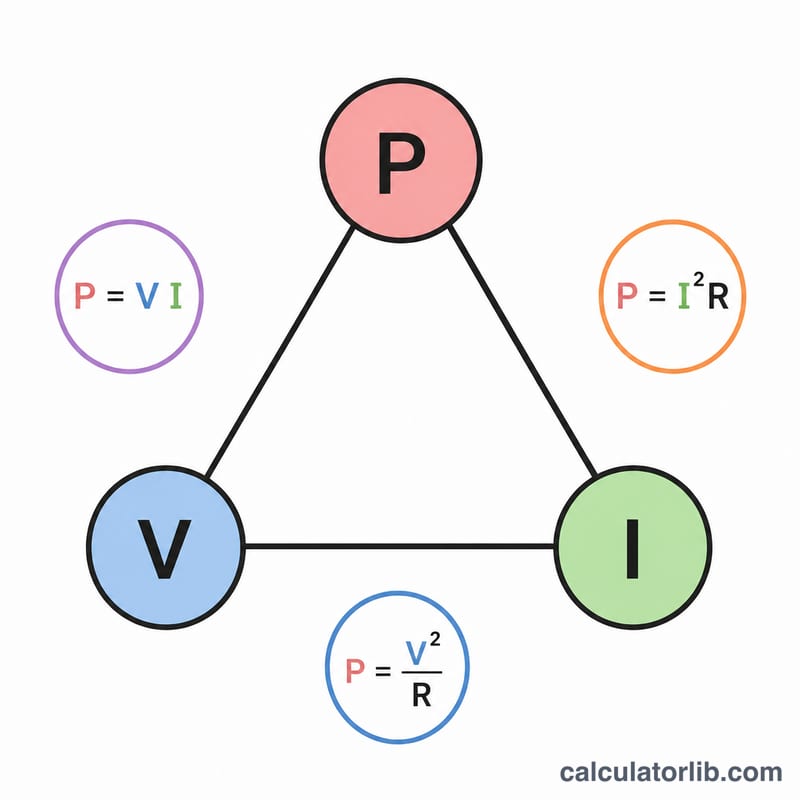
This calculator finds electrical power — the rate at which energy is used or delivered in a circuit, measured in watts (W). It combines the three forms of the power equation that follow directly from Ohm's law, so you can compute power from whichever two quantities you know: voltage (V), current (I), or resistance (R).
How to use it
Enter any two of the three values. If you provide voltage and current, the tool uses \(P = V \times I\). If you enter current and resistance, it uses \(P = I^{2} \times R\). If you enter voltage and resistance, it uses \(P = V^{2} / R\). The result shows the power in watts plus the complete set of V, I and R values for your circuit.
The formula explained
Power is the product of voltage and current: $$P = V \times I$$ Because Ohm's law states \(V = I \times R\), you can substitute to get two equivalent forms: \(P = I^{2} \times R\) (handy when you know the current through a known resistor) and \(P = V^{2} / R\) (handy when you know the voltage across it). All three return the same power for a consistent set of values.
Worked example
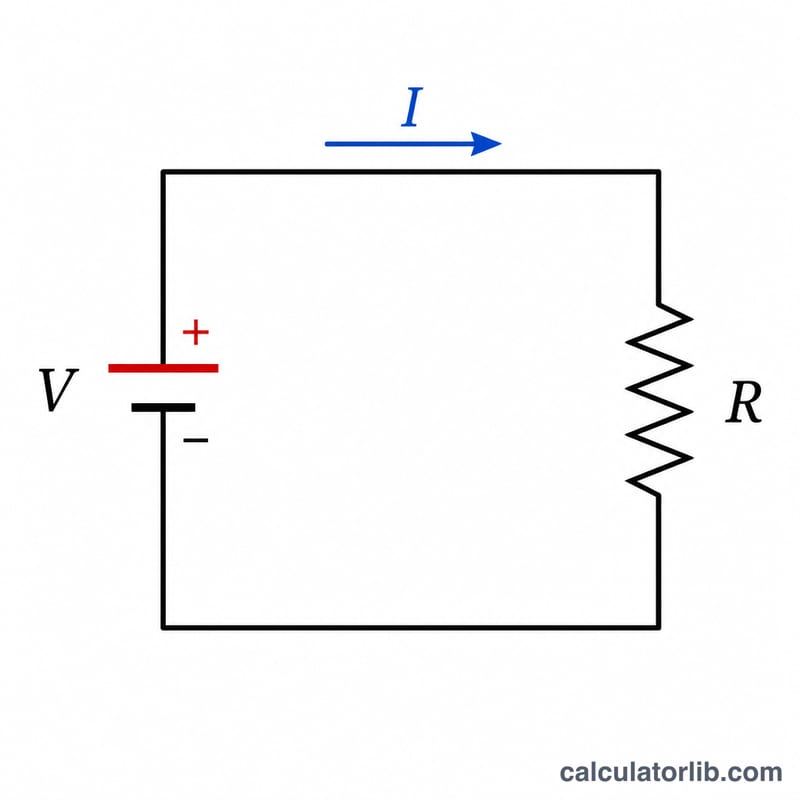
Suppose a device draws 2 A at 12 V. Power = $$12 \times 2 = 24 \text{ W}$$ Its effective resistance is \(V / I = 12 / 2 = 6\ \Omega\). Check with $$P = I^{2} \times R = 2^{2} \times 6 = 4 \times 6 = 24 \text{ W},$$ and $$P = V^{2} / R = 144 / 6 = 24 \text{ W}$$ — all consistent.
FAQ
What units should I use? Volts for voltage, amperes for current, and ohms for resistance. The result is in watts.
Does this work for AC circuits? These formulas give real power for DC or purely resistive AC loads. For reactive AC loads you must also account for the power factor (\(P = V \times I \times \cos \varphi\)).
Why does it need two values? Power depends on two independent quantities; with any two you can derive the third via Ohm's law and compute power.