
What is the Electric Field Calculator?
This tool computes the magnitude of the electric field produced by a single point charge at a given distance. It uses Coulomb's law in field form, \(E = kQ/r^{2}\), where the result is expressed in newtons per coulomb (N/C), which is numerically identical to volts per meter (V/m). The calculator is universal physics and applies anywhere.
How to use it
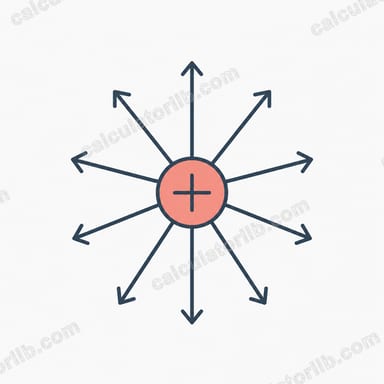
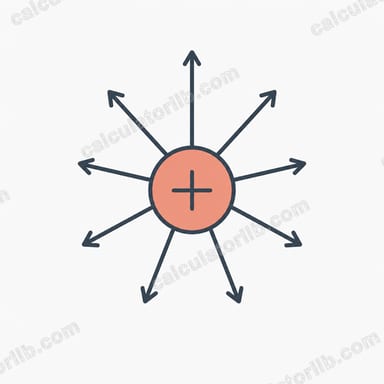
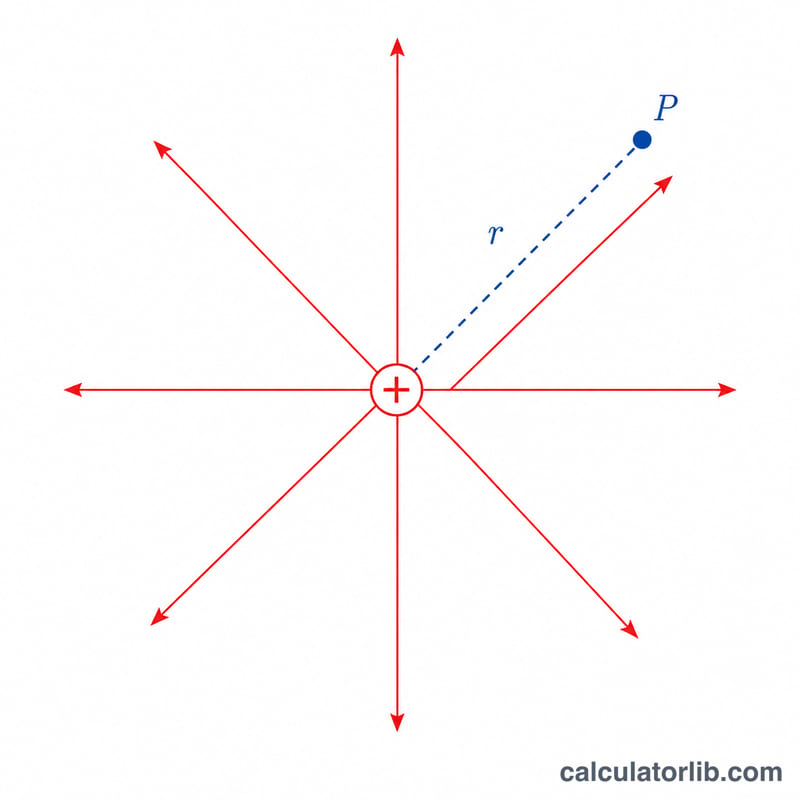
Enter the source charge Q in coulombs (use scientific quantities like 0.000001 for 1 µC) and the distance r in meters from the charge to the point where you want the field. Press calculate to read the field strength. A positive charge gives a positive (outward) field; a negative charge gives a negative value indicating the field points toward the charge.
The formula explained
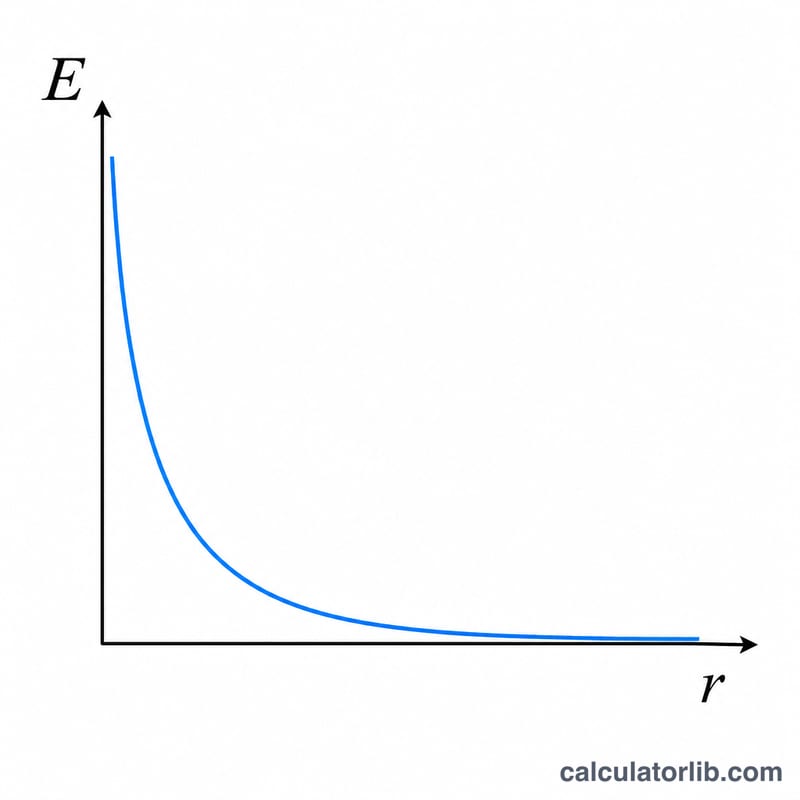
The electric field of a point charge falls off with the square of distance: $$E = \frac{kQ}{r^{2}}$$ Here \(k \approx 8.9876 \times 10^{9}\ \text{N}\cdot\text{m}^{2}/\text{C}^{2}\) is Coulomb's constant, Q is the charge in coulombs, and r is the separation in meters. Doubling the distance reduces the field to one quarter of its value.
Worked example
For a charge of \(Q = 1 \times 10^{-6}\ \text{C}\) (1 µC) at \(r = 1\ \text{m}\): $$E = \frac{8.9876 \times 10^{9} \times 1 \times 10^{-6}}{1^{2}} \approx 8{,}987.55\ \text{N/C}$$ At \(r = 2\ \text{m}\) the field drops to about 2,246.89 N/C — one quarter as strong.
FAQ
What are the units of E? Newtons per coulomb (N/C), equivalent to volts per meter (V/m).
Why is my result negative? A negative source charge produces a field directed toward the charge; the sign indicates direction along the radial line.
Does distance zero work? No — the field diverges at \(r = 0\), so the calculator returns 0 to avoid dividing by zero. Use a non-zero distance.