
What this calculator does
This tool computes the electric field strength produced by a single point charge at a given distance. The electric field describes the force a unit positive test charge would experience at that location, measured in newtons per coulomb (N/C), which is equivalent to volts per meter (V/m).
How to use it
Enter the source charge Q in coulombs (use scientific values such as 0.000001 for 1 microcoulomb, or a negative number for a negative charge) and the distance r in meters from the charge to the point of interest. The calculator returns the field magnitude and the signed value (negative indicates the field points toward a negative charge).
The formula explained
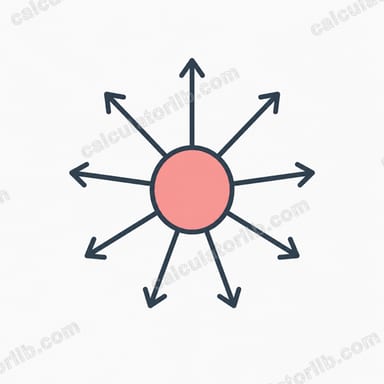
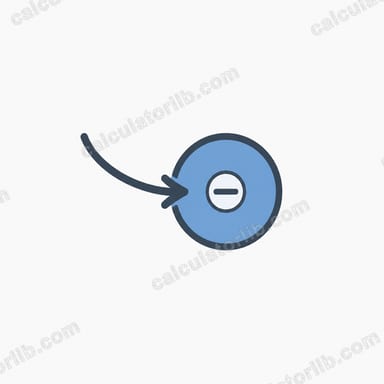
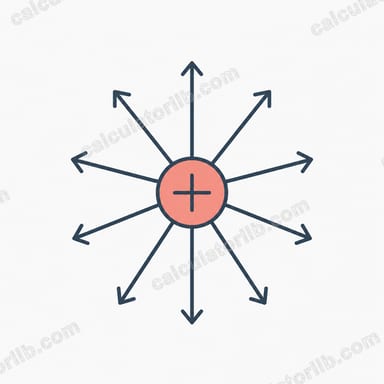
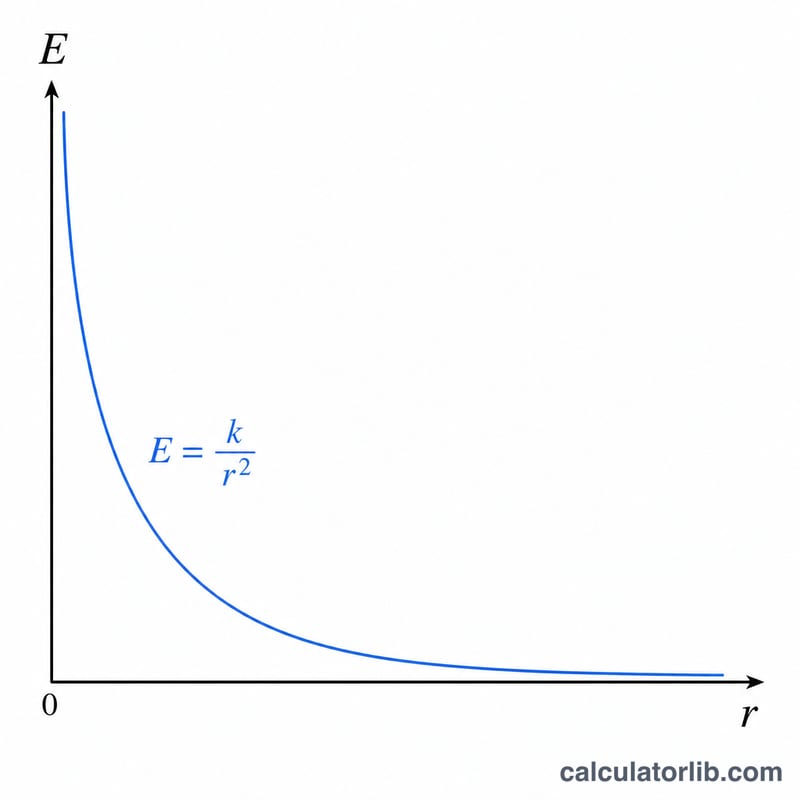
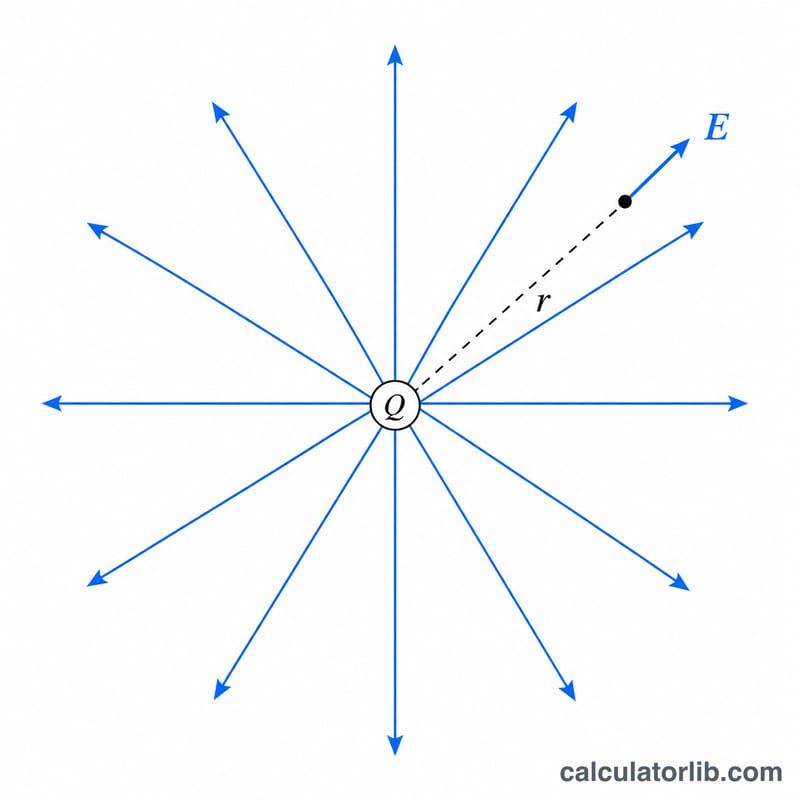
The field is given by $$E = k \cdot \frac{\text{Charge } Q}{\text{Distance } r^{2}}$$ where \(k \approx 8.988 \times 10^{9}\ \text{N}\cdot\text{m}^2/\text{C}^2\) is the Coulomb constant. Because the field falls off with the square of distance, doubling \(r\) reduces the field to one quarter of its previous value. The field points radially outward for a positive charge and radially inward for a negative charge.
Worked example
For \(Q = 1\) microcoulomb (\(1 \times 10^{-6}\ \text{C}\)) at \(r = 0.5\ \text{m}\): $$E = \frac{8.988 \times 10^{9} \times 1 \times 10^{-6}}{0.5^{2}} = \frac{8987.55}{0.25} \approx 35{,}950\ \text{N/C}$$ The field magnitude is about 35,950 N/C directed away from the positive charge.
FAQ
What units should I use? Charge in coulombs and distance in meters give the field in N/C. Convert microcoulombs (\(\mu\text{C} = 10^{-6}\ \text{C}\)) and nanocoulombs (\(\text{nC} = 10^{-9}\ \text{C}\)) accordingly.
Does the sign of Q matter? Yes. A positive charge gives a positive (outward) field; a negative charge gives a negative (inward) field. The magnitude shown ignores direction.
Is this for a vacuum? The default Coulomb constant assumes vacuum or air. In a dielectric medium, divide the result by the relative permittivity.