
What Is the Capacitor Charge Calculator?
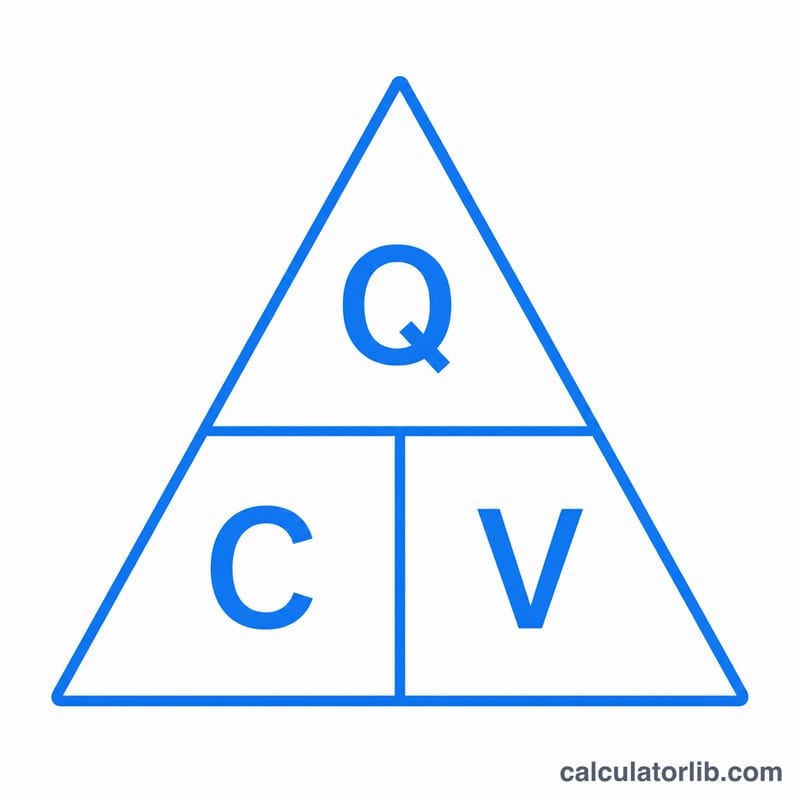
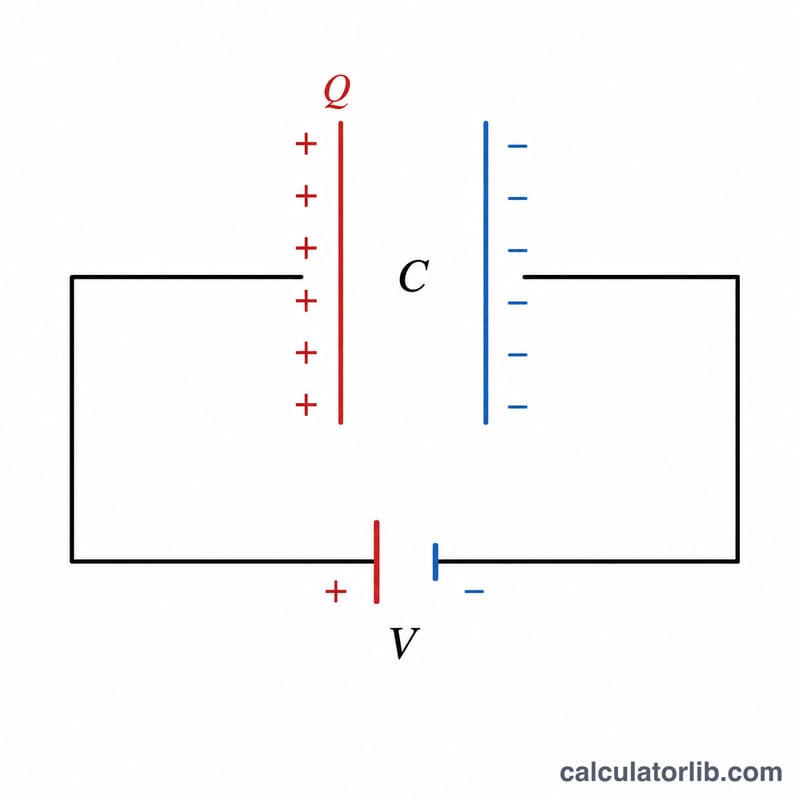
This tool computes the electric charge stored in a capacitor using the fundamental relationship \(Q = C \times V\), where Q is charge in coulombs, C is capacitance in farads, and V is the voltage across the plates. It also reports the charge in microcoulombs and the energy stored in the capacitor, making it handy for electronics design, lab work, and physics homework.
How to Use It
Enter the capacitance value and choose its unit (F, mF, µF, nF, or pF). Real-world capacitors are often rated in microfarads or picofarads, so pick the matching unit. Then enter the voltage applied across the capacitor in volts and read the stored charge instantly.
The Formula Explained
A capacitor stores charge proportional to the applied voltage: \(Q = C \cdot V\). Capacitance C measures how much charge the device holds per volt. The energy stored follows \(E = \tfrac{1}{2} \cdot C \cdot V^{2}\), which is why charged capacitors can deliver a sudden burst of energy.
Worked Example
Suppose you have a 100 µF capacitor charged to 12 V. First convert: 100 µF = 0.0001 F. Then $$Q = 0.0001 \times 12 = 0.0012 \ \text{C},$$ or 1,200 µC. The stored energy is $$E = \tfrac{1}{2} \times 0.0001 \times 12^{2} = 0.0072 \ \text{J}.$$
FAQ
What unit is charge measured in? The coulomb (C). One coulomb equals the charge transferred by a 1 amp current in 1 second.
Does voltage have to be positive? The magnitude matters; a negative voltage simply means the charge sign is reversed.
Why does energy use V squared? Because as charge accumulates the voltage rises, so the average work done per unit charge is half the final voltage, giving \(E = \tfrac{1}{2}CV^{2}\).