
What Is Capacitance?
Capacitance is a measure of a component's ability to store electric charge. It is defined as the ratio of the electric charge (Q) stored on a conductor to the potential difference (V) across it. The SI unit of capacitance is the farad (F), where one farad equals one coulomb per volt. Because a farad is a very large unit, practical capacitors are usually rated in microfarads (µF), nanofarads (nF), or picofarads (pF).
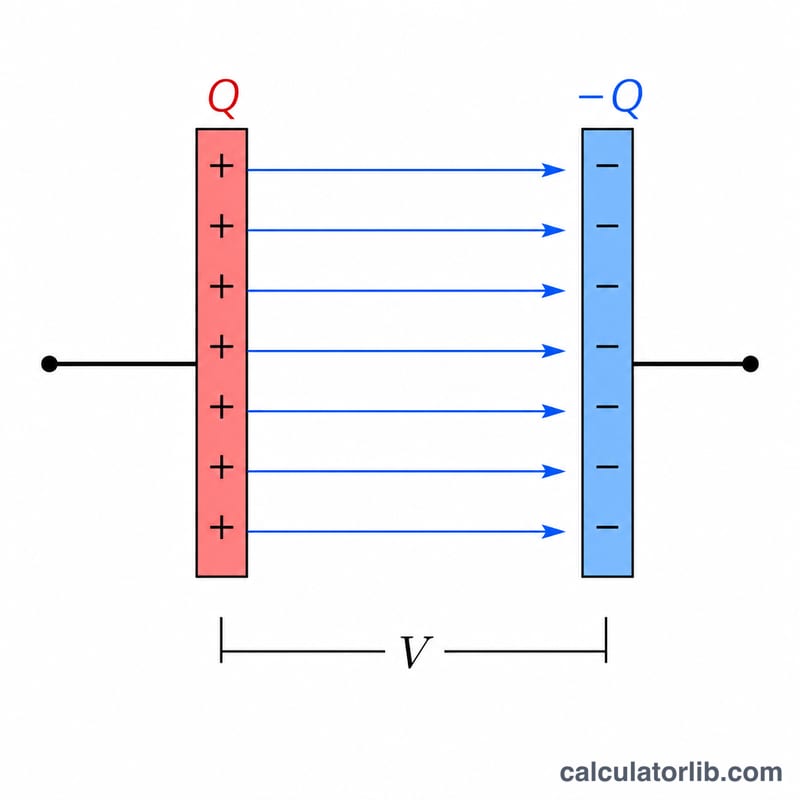
How to Use This Calculator
Enter the charge stored on the capacitor in coulombs and the voltage across it in volts. The calculator divides the charge by the voltage to return the capacitance in farads, and also converts the answer to microfarads for convenience. Make sure your inputs use consistent base units (coulombs and volts) for an accurate result.
The Formula Explained
The governing equation is \(C = Q / V\), where C is capacitance in farads, Q is charge in coulombs, and V is voltage in volts. Rearranging the equation lets you solve for any single variable: charge is \(Q = C \times V\), and voltage is \(V = Q / C\). This relationship is fundamental to circuit analysis, energy storage, and timing applications.
$$C = \frac{\text{Charge (C)}}{\text{Voltage (V)}}$$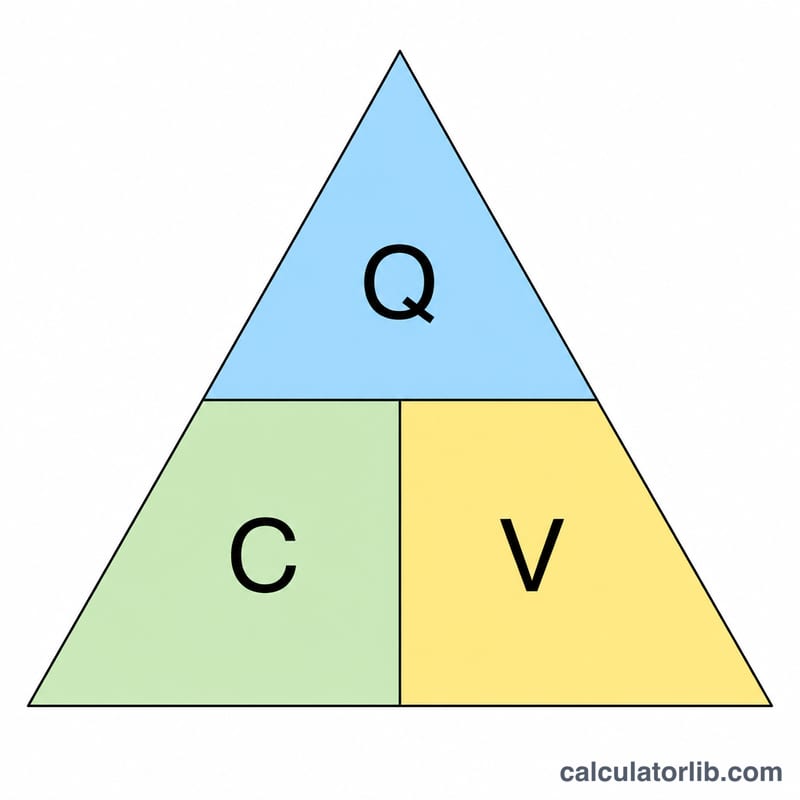
Worked Example
Suppose a capacitor stores 0.001 coulombs of charge at 5 volts. Then $$C = 0.001 / 5 = 0.0002 \text{ farads},$$ which equals 200 microfarads. A capacitor holding more charge at the same voltage would have a proportionally higher capacitance.
FAQ
What unit should I use for charge? Use coulombs (C). One coulomb is a large amount of charge; small capacitors often store microcoulombs, so convert accordingly.
Why is my answer so small? One farad is enormous. Even a 200 µF capacitor is only 0.0002 F, so small decimal results in farads are normal.
Can I find voltage or charge instead? Yes. Rearrange \(C = Q / V\) to get \(Q = C \times V\) or \(V = Q / C\) depending on which variable you know.