
What this calculator does
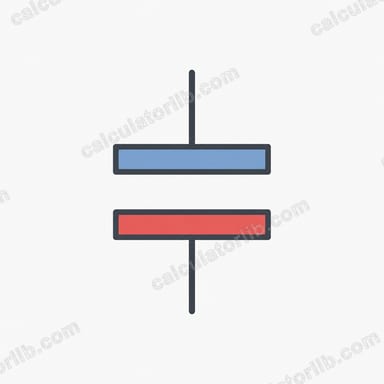
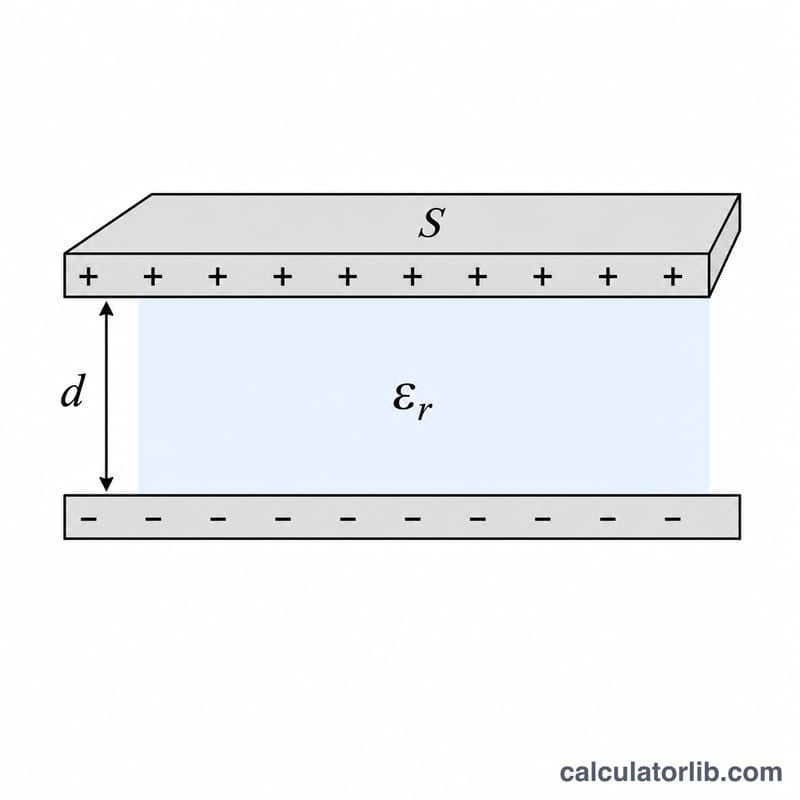
This tool computes the capacitance of an ideal parallel-plate capacitor. A parallel-plate capacitor stores electric charge between two flat conducting plates separated by an insulating dielectric. Its capacitance depends only on the geometry (plate area and separation) and the dielectric material between the plates. This is universal SI physics, with no region-specific rules.
How to use it
Enter the relative permittivity of the material between the plates (vacuum = 1, air ≈ 1.00059, quartz ≈ 3.8). Then enter the plate area and the plate gap, each with a convenient unit chosen from the dropdowns. The calculator converts everything to SI metres and square metres and returns the capacitance in farads, plus the same value scaled to microfarads, nanofarads and picofarads for convenience.
The formula explained
The capacitance is given by $$C = \varepsilon_r \cdot \varepsilon_0 \cdot \frac{S}{d}$$ where \(\varepsilon_r\) is the dimensionless relative permittivity, \(\varepsilon_0 = 8.85418781762\times10^{-12}\ \text{F/m}\) is the permittivity of free space, \(S\) is the plate area in square metres, and \(d\) is the gap between the plates in metres. Larger plates or a higher-permittivity dielectric raise capacitance, while a wider gap lowers it.
Worked example
Take air (\(\varepsilon_r = 1.00059\)), a plate area of \(S = 500\ \text{mm}^2\), and a gap of \(d = 1\ \text{mm}\). Convert: \(S = 500 \times 10^{-6} = 5\times10^{-4}\ \text{m}^2\), \(d = 1 \times 10^{-3} = 10^{-3}\ \text{m}\), so \(S/d = 0.5\ \text{m}\). Then $$C = 1.00059 \times 8.85418781762\times10^{-12} \times 0.5 \approx 4.4297\times10^{-12}\ \text{F}$$ which is about 4.4297 pF.
FAQ
Why does my result match a textbook only approximately? This model neglects edge (fringing) fields, so it is most accurate when the plate dimensions are much larger than the gap \(d\).
What if I leave the gap at zero? A zero gap would divide by zero, so the calculator returns zero capacitance for \(d \le 0\); use a positive distance.
What value should I use for relative permittivity? Use 1 for vacuum, about 1.00059 for air, and look up the dielectric constant of your insulator (for example roughly 3.8 for quartz).