What is the Wedding Countdown Calculator?
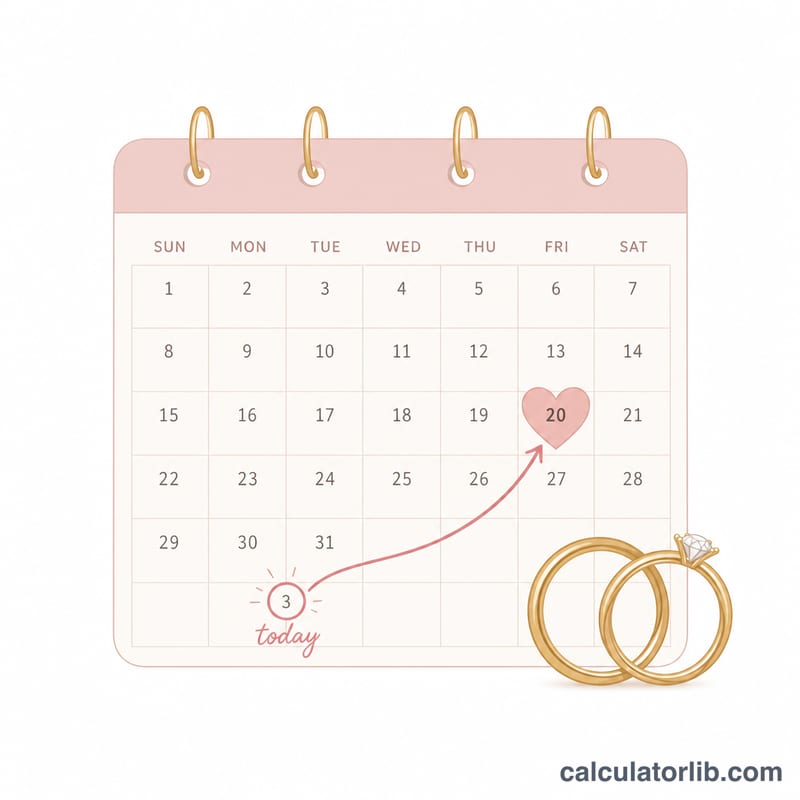
The Wedding Countdown Calculator tells you exactly how much time is left until your wedding day. Enter your wedding date and today's date, and it instantly shows the number of days, weeks, hours, and minutes remaining — perfect for tracking planning milestones, building excitement, or counting down on a save-the-date.
How to use it
Pick your wedding date from the date picker. The today's date field defaults to the current day, but you can change it to count down from any reference point. The calculator subtracts today from the wedding date and breaks the gap into easy-to-read units.
The formula explained
The core calculation is simple: $$\text{Time Remaining} = \text{Wedding Date} - \text{Today}$$ Both dates are converted to milliseconds since the epoch. The difference is divided by 86,400,000 ms to get days, by 3,600,000 ms for hours, and by 60,000 ms for minutes. The day total is also split into whole weeks (days ÷ 7, rounded down) plus the leftover days.
$$\begin{gathered} \text{Days} = \text{Wedding Date} - \text{Today Date} \\[1.5em] \text{where}\quad \left\{ \begin{aligned} \text{Hours} &= \text{Days} \times 24 \\ \text{Minutes} &= \text{Days} \times 1440 \\ \text{Weeks} &= \left\lfloor \frac{|\text{Days}|}{7} \right\rfloor \\ \text{Rem. Days} &= |\text{Days}| - 7\,\text{Weeks} \end{aligned} \right. \end{gathered}$$
Worked example
Suppose your wedding is on 2025-06-15 and today is 2025-06-01. The gap is 14 days, which equals 2 weeks and 0 days, 336 hours (\(14 \times 24\)), and 20,160 minutes (\(14 \times 24 \times 60\)). The calculator displays all of these at once.
Countdown Across Different Wedding Dates
The countdown is a plain date subtraction: the number of whole days between today's date and the wedding date, converted upward into weeks, hours and minutes.
$$\text{Days Until Wedding} = \text{Wedding Date} - \text{Today Date}$$Every row below uses the same fixed reference day, 2026-10-03, so the spans are directly comparable. Hours and minutes follow from the day count with \(1\ \text{day} = 24\ \text{h} = 1440\ \text{min}\).
| Today's Date | Wedding Date | Days Remaining | Weeks + Leftover Days | Hours | Minutes |
|---|---|---|---|---|---|
| 2026-10-03 | 2026-10-10 | 7 | 1 week 0 days | 168 | 10,080 |
| 2026-10-03 | 2026-11-02 | 30 | 4 weeks 2 days | 720 | 43,200 |
| 2026-10-03 | 2027-01-11 | 100 | 14 weeks 2 days | 2,400 | 144,000 |
| 2026-10-03 | 2027-10-03 | 365 | 52 weeks 1 day | 8,760 | 525,600 |
| 2026-10-03 | 2026-09-26 | −7 (date already passed) | −1 week 0 days | −168 | −10,080 |
How the 100-day row is built: from 2026-10-03 there are 28 days left in October (31 − 3), plus 30 in November, plus 31 in December, plus 11 in January:
$$28 + 30 + 31 + 11 = 100\ \text{days}$$$$100 \times 24 = 2{,}400\ \text{h} \qquad 2{,}400 \times 60 = 144{,}000\ \text{min}$$Dividing by 7 gives \(100 = 14 \times 7 + 2\), i.e. 14 weeks and 2 leftover days.
Leap-year handling. The one-year row spans 2026-10-03 to 2027-10-03 and contains no 29 February, so it is a 365-day common span. A span that does cross a leap day is one day longer: 2027-10-03 to 2028-10-03 includes 29 February 2028 and therefore measures 366 days (8,784 hours, 527,040 minutes). This is why a "one-year countdown" is not always the same number of days — the calculator counts actual calendar days rather than multiplying by 365.
A negative result simply means the wedding date is in the past relative to the reference day; the final row is 7 days before 2026-10-03, giving −7.
Time Unit Conversions Used in the Countdown
Internally the countdown works in milliseconds since a fixed epoch, then divides down into the units shown on screen. These are the exact factors involved — all of them are fixed definitions, not approximations.
| Unit | In smaller units | Seconds | Milliseconds |
|---|---|---|---|
| 1 minute | — | 60 | 60,000 |
| 1 hour | 60 minutes | 3,600 | 3,600,000 |
| 1 day | 24 hours = 1,440 minutes | 86,400 | 86,400,000 |
| 1 week | 7 days = 168 hours = 10,080 minutes | 604,800 | 604,800,000 |
| 1 common year | 365 days = 8,760 hours = 525,600 minutes | 31,536,000 | 31,536,000,000 |
| 1 leap year | 366 days = 8,784 hours = 527,040 minutes | 31,622,400 | 31,622,400,000 |
Each row chains from the one above it, for example:
$$1\ \text{week} = 7 \times 24 = 168\ \text{h} = 168 \times 60 = 10{,}080\ \text{min}$$$$1\ \text{common year} = 365 \times 24 = 8{,}760\ \text{h} = 8{,}760 \times 60 = 525{,}600\ \text{min}$$Why no months or years in the output. Calendar months hold 28, 29, 30 or 31 days and calendar years hold 365 or 366, so "4 months until the wedding" has no single day value — it depends entirely on which months are crossed. Days, weeks, hours and minutes all convert by fixed factors, so the calculator reports only those and leaves months out rather than publishing a figure that shifts with the starting date.
Daylight saving time. In places that observe DST (for instance the European Union's last-Sunday-in-March and last-Sunday-in-October changeovers, or the second-Sunday-in-March and first-Sunday-in-November dates used in the United States), the local wall-clock length of the transition day is 23 or 25 hours instead of 24. That can shift a clock-time display by ±1 hour across the change. The midnight-to-midnight day count is unaffected — 3 October to 2 November is 30 calendar days whether or not a clock change falls inside it — so the headline "days remaining" figure stays stable even if the hour-and-minute readout appears to jump once. Regions without DST, and countdowns measured in UTC, see no such shift.
FAQ
What if the wedding date is in the past? The result will show negative values, indicating how long ago the date was.
Does it account for time of day? No — both dates are treated as starting at midnight, so the countdown is based on full calendar days.
Can I count down to any event? Absolutely. While designed for weddings, it works for any future date such as an anniversary, vacation, or graduation.