
What is the Helium Balloon Lift Calculator?
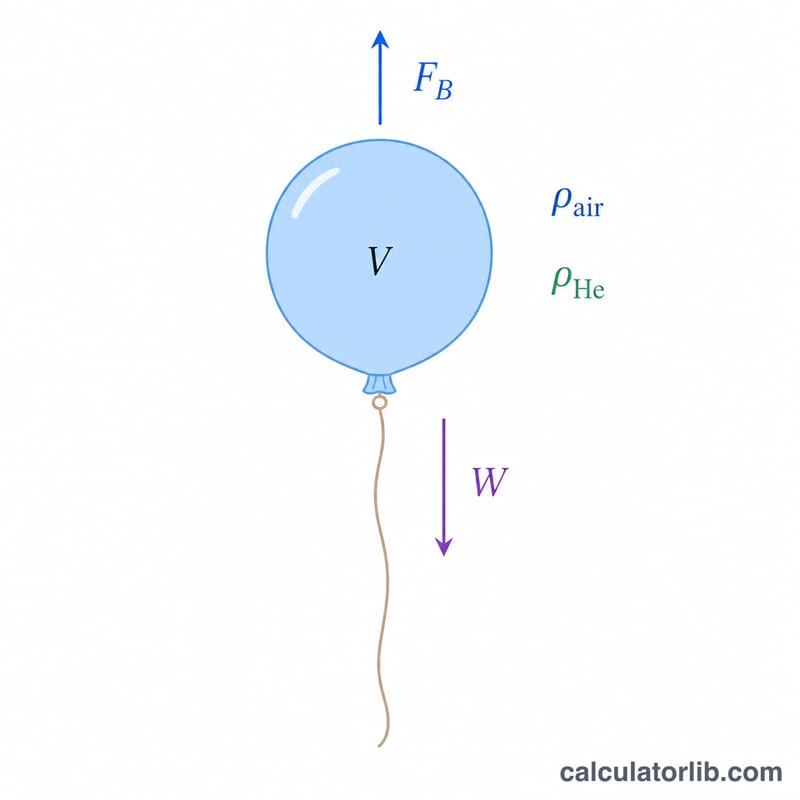
This calculator estimates how many helium-filled balloons you need to lift a given weight. It works by applying Archimedes' principle of buoyancy: a balloon floats because the helium and rubber inside it weigh less than the air they displace. The net upward force per balloon is its volume multiplied by the difference between the density of air and the density of helium.
How to use it
Enter the weight you want to lift in grams, the diameter of one inflated balloon in centimetres, and (optionally) adjust the air and helium densities. The defaults use standard sea-level air density (1.225 kg/m³) and helium density (0.1786 kg/m³). The tool returns the lift produced by a single balloon, its volume in litres, and the whole number of balloons required.
The formula explained
A spherical balloon of diameter d has radius \(r = d/2\) and volume \(V = \frac{4}{3}\pi r^{3}\). The lift it generates is \(L = V \times (\rho_{\text{air}} - \rho_{\text{He}})\), giving the mass it can support. Dividing the target weight by this lift and rounding up gives the number of balloons: $$n = \left\lceil \frac{W}{L} \right\rceil$$ Note this ignores the weight of the balloon material itself, so real-world counts are slightly higher.
Worked example
A typical 28 cm party balloon has a radius of 0.14 m and a volume of about 0.01149 m³ (11.49 L). With \(\rho_{\text{air}} - \rho_{\text{He}} = 1.225 - 0.1786 = 1.0464\) kg/m³, each balloon lifts roughly 0.01202 kg, or about 12 g. To lift a 100 g object you would need $$\left\lceil \frac{100}{12.02} \right\rceil = 9 \text{ balloons.}$$

FAQ
Why does the answer round up? You cannot use a fraction of a balloon, so the result is always rounded to the next whole balloon.
Does it account for the balloon's own weight? No — the calculation uses pure buoyant lift. Latex balloons weigh a few grams each, so in practice add a small safety margin.
Can I use it for foil or large balloons? Yes, just change the diameter. For non-spherical balloons treat the diameter as the equivalent sphere size.