
What this estimator does
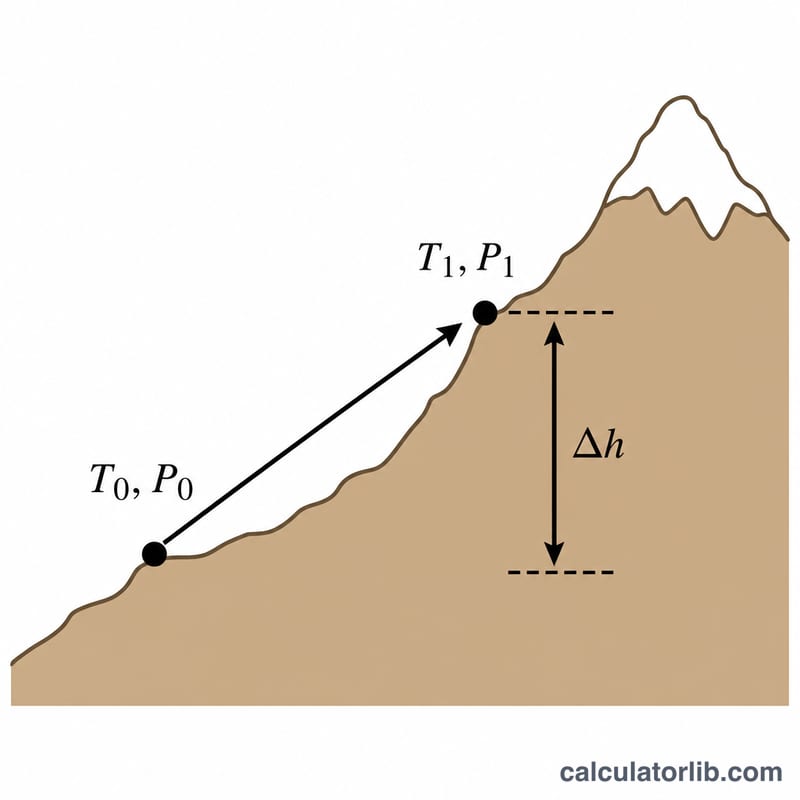
This is a universal Earth-science and physics tool. Given the temperature, air pressure and altitude at your current location, plus the altitude of a destination, it projects the temperature and atmospheric pressure you would expect at that destination using the standard atmosphere model. It works anywhere on Earth and handles destinations that are higher or lower than your starting point.
How to use it
Enter the current temperature (choose °C or K), the current air pressure (hPa, Pa, kPa, atm or mmHg), and the current altitude (m, km or ft). Then enter the destination altitude in your preferred unit. The tool converts everything to SI internally, applies the lapse-rate and barometric formulas, and reports the destination temperature in °C (and K) and the destination pressure in your chosen pressure unit (and Pa).
The formula explained
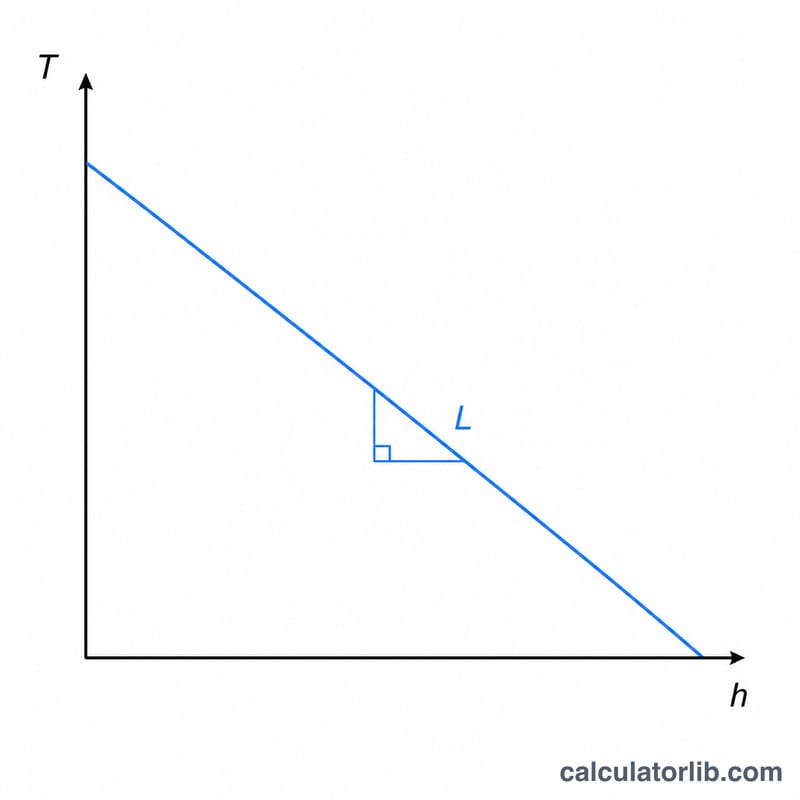
In the troposphere, temperature drops at a standard environmental lapse rate of \(L = 0.0065\) K per metre (6.5 °C per 1000 m). With altitude change \(\Delta h\) = destination minus current altitude, the destination temperature is $$T_1 = T_0 - L\,\Delta h$$ where \(T_0\) is the current temperature in Kelvin.
Pressure follows the barometric formula referenced to your current level: $$P_1 = P_0 \left(\frac{T_1}{T_0}\right)^{gM/(RL)}$$ Using \(g = 9.80665\ \text{m/s}^2\), \(M = 0.0289644\ \text{kg/mol}\), \(R = 8.31447\ \text{J/(mol}\cdot\text{K)}\) and \(L = 0.0065\), the exponent is approximately \(5.25579\). The pressure ratio requires absolute (Kelvin) temperature, which is why \(T_0\) is converted before the calculation.
Worked example
Current: 15 °C, 1013.25 hPa, 0 m. Destination: 1000 m. Then \(T_0 = 288.15\ \text{K}\), \(P_0 = 101325\ \text{Pa}\), \(\Delta h = 1000\ \text{m}\). Temperature: $$T_1 = 288.15 - 6.5 = 281.65\ \text{K} = \mathbf{8.5\ \degree C}$$ Pressure ratio \(281.65/288.15 = 0.977442\); raised to \(5.25579\) gives \(0.886993\), so $$P_1 = 101325 \times 0.886993 \approx 89875\ \text{Pa} = \mathbf{898.75\ \text{hPa}}$$ These match the standard-atmosphere values at 1 km.
FAQ
Does it work if the destination is lower? Yes. A negative \(\Delta h\) makes temperature rise and pressure increase, exactly as the formula predicts.
How accurate is it? It is a standard-atmosphere estimate valid in the troposphere (up to about 11 km). It ignores humidity, local weather and real lapse-rate variation, so treat it as a physical estimate, not a forecast.
Why convert to Kelvin? The lapse-rate term is the same in °C or K because it is a temperature difference, but the pressure ratio \(T_1/T_0\) only makes physical sense with absolute (Kelvin) temperatures.