
What Is the "How Old Was I" Calculator?
This tool tells you exactly how old you were on any date in the past. Whether you want to know your age when you graduated, started your first job, met someone special, or experienced a historic event, just enter your birth date and the event date. The calculator returns your age in years, months, and days, along with handy totals in months, weeks, and days.
How to Use It
Enter your date of birth (year, month, and day) in the first row, then enter the past event date in the second row. The event date should be on or after your birth date. Submit the form to see your precise age on that day. All calculations are based on the standard calendar, automatically accounting for varying month lengths and leap years.
The Formula Explained
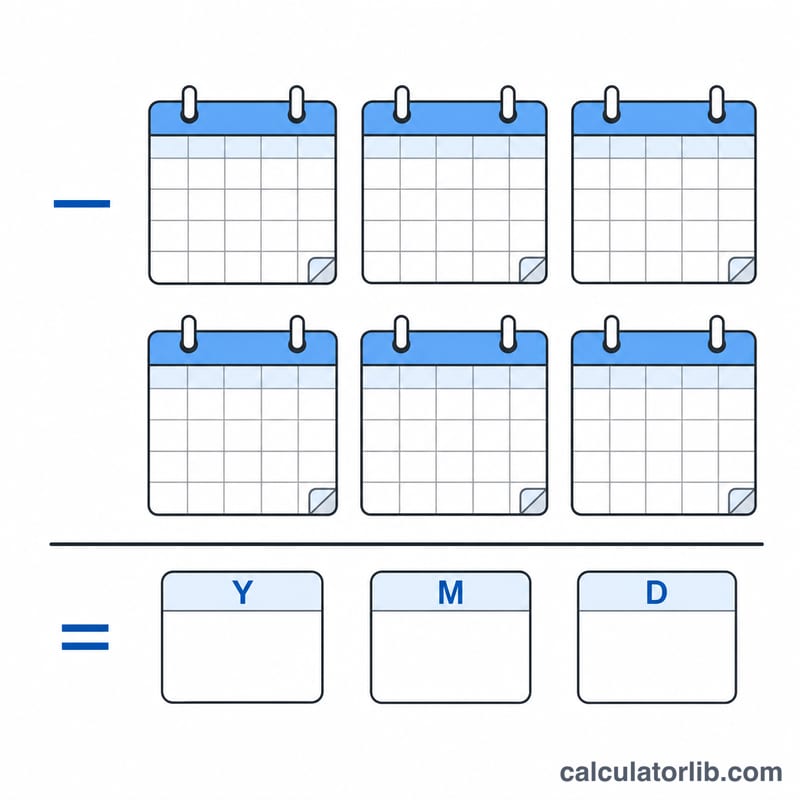
The age is calculated by subtracting the birth date from the event date, component by component: years minus years, months minus months, days minus days. When the day difference is negative, the calculator "borrows" the number of days from the previous month. When the month difference is then negative, it borrows 12 months from the year count. This keeps every component non-negative and accurate, exactly the way human age is normally expressed.
$$\text{Age} = \left(\text{Event Year} - \text{Birth Year}\right)\text{y},\ \left(\text{Event Month} - \text{Birth Month}\right)\text{m},\ \left(\text{Event Day} - \text{Birth Day}\right)\text{d}$$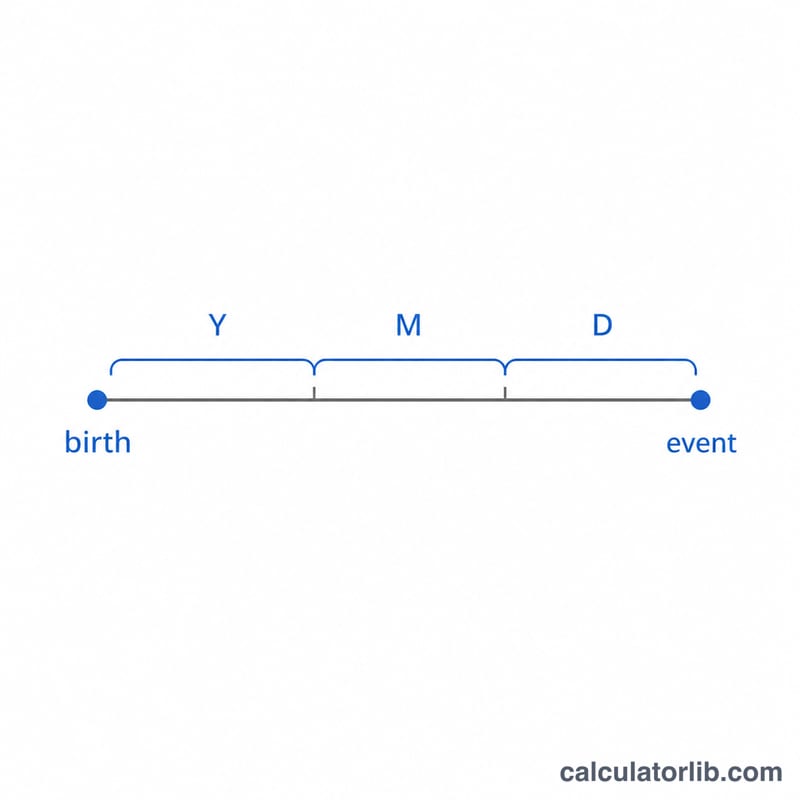
Worked Example
Suppose you were born on June 15, 1990, and the event happened on September 1, 2010. The day difference (\(1 - 15\)) is negative, so we borrow days from August (31 days): \(1 + 31 - 15 = 17\) days, and reduce months by one. Months become \(9 - 6 - 1 = 2\). Years stay at \(2010 - 1990 = 20\). So you were 20 years, 2 months, and 17 days old on that date.
FAQ
What if the event date is before my birth date? The result would be negative or zero; this tool assumes the event happened on or after you were born.
Does it handle leap years? Yes. The day-borrowing step uses the actual number of days in the relevant month, so February's 28 or 29 days are handled correctly.
Why are total months and total days shown? They give alternative ways to express the same age span, useful for milestones measured in months (like a baby's age) or in days.