
What this calculator does
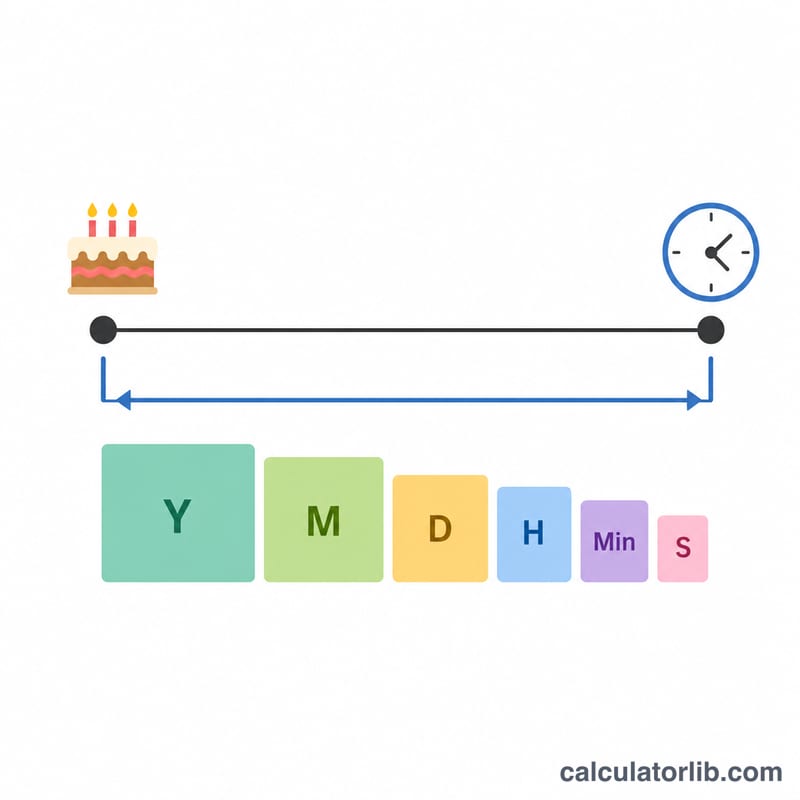
This "How old am I?" calculator tells you your exact age as of right now, broken down into completed years, months, days, hours, minutes and seconds. It uses the standard Western completed-age method on the Gregorian calendar (the actual age you celebrate on each birthday), not a counted-age or era system. The reference moment is read from your device clock at the instant you calculate, so the seconds tick forward in real time.
How to use it
Pick your birth Month, Day and Year. Choose a 12-hour or 24-hour clock, then type your birth time as four digits (hhmm) - for example 0830 for 8:30 or 1415 for 2:15 PM. On the 12-hour clock, select am or pm. Optionally tick "Display Age in Wide Format" for a horizontal layout. The result shows your full age and a breakdown grid.
The formula explained
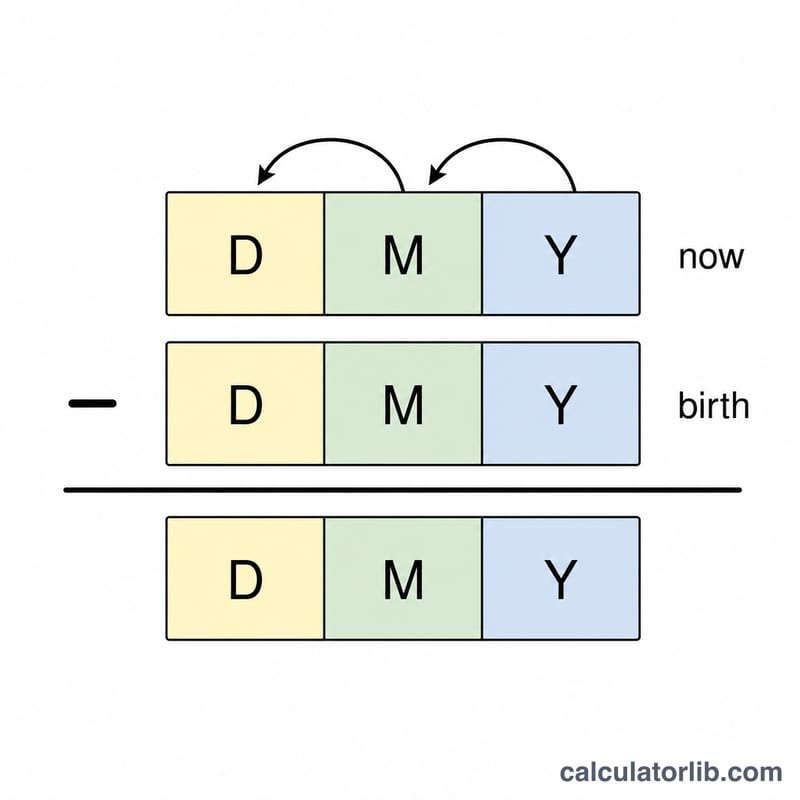
The tool does a calendar-difference using a borrowing algorithm rather than simple division. It subtracts each component of your birth date/time from the current date/time, starting at seconds. The core relationship is:
$$\text{Age} = \text{now} - \text{birth} \;\Rightarrow\; (Y, M, D, H, Min, S)$$
Whenever a component goes negative it borrows from the next-larger unit: seconds borrow 60 from minutes, minutes borrow 60 from hours, hours borrow 24 from days, days borrow the length of the previous calendar month (leap-year aware), and months borrow 12 from years. This produces the natural Y/M/D/H/M/S breakdown people expect. The general step is \(\Delta = \text{now} - \text{birth}\), with borrow per unit, and a year is a leap year when \((y\bmod 4=0)\wedge((y\bmod100\neq0)\vee(y\bmod400=0))\).
Worked example
Born 15 June 1990 at 08:30:00 (entered as 0830, am). Now: 10 March 2024, 14:45:20. Seconds \(20-0=20\). Minutes \(45-30=15\). Hours \(14-8=6\). Days \(10-15=-5\), borrow February 2024 (leap, 29 days) \(\to 24\), months\(-1\). Months \(3-6=-3\), then \(-1 = -4\), borrow \(+12 \to 8\), years\(-1\). Years \(2024-1990=34\), then \(-1 = 33\). Result: 33 years, 8 months, 24 days, 6 hours, 15 minutes, 20 seconds.
FAQ
Does it account for leap years? Yes. February 29 is valid in leap years and the day-borrow step uses the correct previous-month length.
What about time zones? The calculation uses your device's local time. If you were born in a different time zone than where you are now, adjust the birth-time input by the offset (e.g. born 8:00 am Eastern but now in Pacific, enter 5:00 am).
What if I enter a future date? Age cannot be negative, so a birth date in the future returns all zeros.