
What this calculator does
This tool answers a simple question: how old will you be on a specific date in the future? Enter your date of birth and any target date — a birthday, a graduation, a retirement day, a wedding, or the year a child turns 18 — and it returns your exact age on that day in years, months and days, plus handy totals in months and days.
How to use it
Type your birth year, month and day, then enter the future date you are curious about. Click calculate. The hero box shows your age in whole years, months and days on that date, and the table below gives the age as a decimal number of years and the total elapsed months and days.
The formula explained
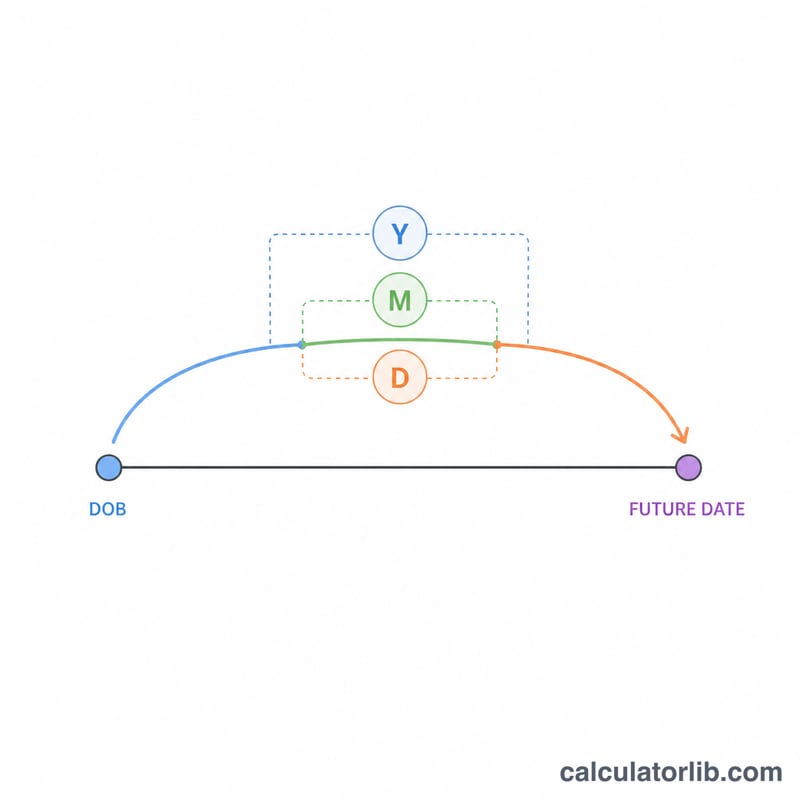
The calculation subtracts the date of birth from the future date one component at a time. It starts with the day difference; if it is negative it borrows days from the previous month. It then does the same with months, borrowing 12 months from the year count when needed. The decimal age divides the raw day count by 365.25 (the average year length including leap years), so it stays accurate over long spans.
$$\text{FutureAge} = (\text{FutureDate} - \text{DOB})\ \text{in years, months, days}$$
$$\text{Age} = \text{FutureDate} - \text{DOB}$$
$$\text{Years} = \dfrac{\text{TotalDays}}{365.25}$$
Worked example
Born on 15 June 1990, how old will you be on 1 January 2030? The day part \((1 - 15)\) is negative, so we borrow December's 31 days: \(\text{days} = 31 - 14 = 17\) (after the month borrow). Months become \(7 - 6 - 1 = \ldots\) resolving to 6 months, and years to 39. The answer is 39 years, 6 months, 17 days.
Key Terms Explained
- Date of birth (DOB)
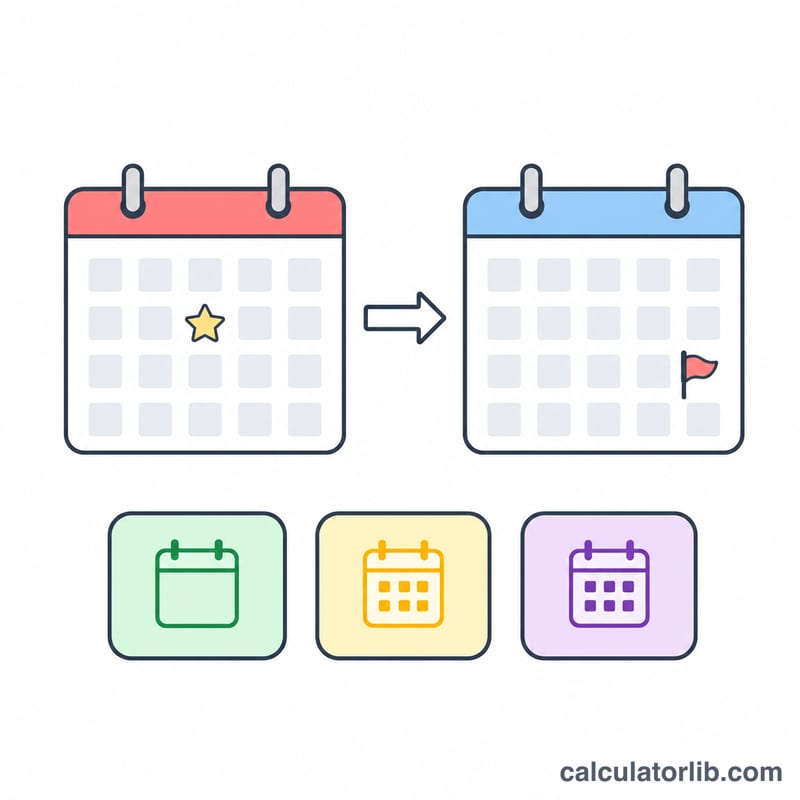
- The calendar date a person was born, supplied here as dobYear, dobMonth and dobDay. It is the fixed starting point from which age is measured.
- Target (future) date
- The date you want to know your age on, entered as futYear, futMonth and futDay. It can be any date after (or even before) the birth date; the difference between the two dates is the age.
- Elapsed years, months and days
- Age expressed as three separate units rather than one total. It counts whole years first, then the leftover whole months, then the remaining days — e.g. \(34\text{ y},\ 7\text{ m},\ 12\text{ d}\). This is the natural "how old am I" format used on birthdays.
- Decimal age
- Age written as a single number with a fractional part, such as \(34.6\) years. It is obtained by dividing the total elapsed days by the average length of a year (about \(365.25\) days) and is convenient for charts and calculations, though it hides the exact months and days.
- Leap year
- A year of 366 days, containing 29 February. Years divisible by 4 are leap years, except century years not divisible by 400 (so 2000 was a leap year but 1900 was not). Leap years affect day counts and how a 29 February birthday is treated in non-leap years.
- Month borrowing
- An adjustment used when the target day or month is earlier than the birth day or month, giving a negative difference. The calculator "borrows" one month (adding that month's number of days) or one year (adding 12 months) so that each unit stays in its valid range — the same idea as borrowing in column subtraction.
FAQ
Does it account for leap years? Yes. Day-of-month borrowing uses each month's real length, and the decimal-year figure uses 365.25 days per year.
Can the future date be in the past? If the target date is before your birth date the result will be negative or zero; the tool is designed for future dates.
Why do months and days look different from a simple subtraction? Calendar months have different lengths, so the result is normalized to whole years, months and remaining days rather than raw arithmetic.