
What is the EST to CST Converter?
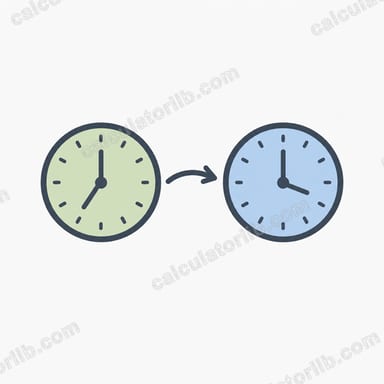
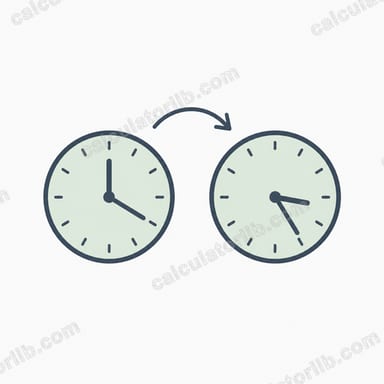
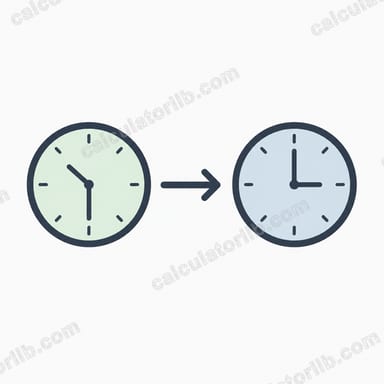
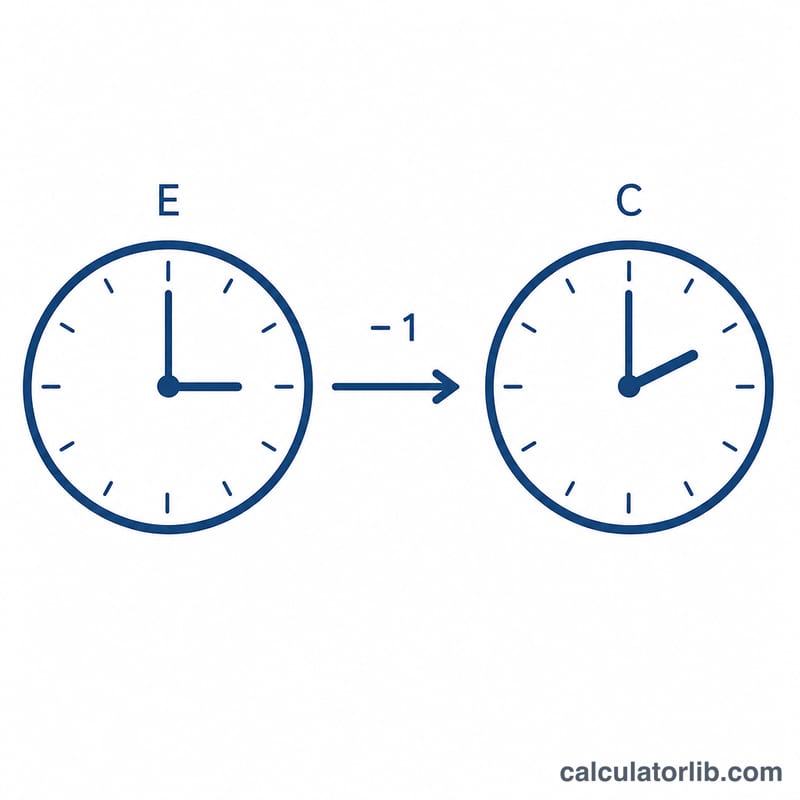
This tool converts a time in Eastern Time (EST) to the equivalent time in Central Time (CST). Both are time zones used in the United States and Canada. Central Time is always exactly one hour behind Eastern Time, so when it is 3:00 PM in New York (EST), it is 2:00 PM in Chicago (CST).
How to use it
Enter the EST hour using the 24-hour clock (0–23) and the minute (0–59). The converter subtracts one hour and displays the matching CST time, automatically wrapping around midnight so an early-morning EST time still produces a correct CST result.
The formula explained
The conversion is simply CST = EST − 1 hour. Internally the time is changed into total minutes since midnight, 60 minutes are subtracted, and the result is taken modulo 1440 (the number of minutes in a day) to keep it inside a single 24-hour cycle.
$$\text{CST} = \left(\left(\left(\text{EST Hour} \times 60 + \text{EST Minute}\right) - 60\right) \bmod 1440\right)$$
Worked example
Suppose it is 14:30 (2:30 PM) EST. In minutes that is \(14 \times 60 + 30 = 870\). Subtract 60 to get 810 minutes, which equals 13 hours and 30 minutes — so the CST time is 13:30 (1:30 PM).
FAQ
Is CST always 1 hour behind EST? Yes. Both zones observe daylight saving on the same dates, so the one-hour gap is constant year-round (EDT vs CDT keeps the same difference).
What happens just after midnight? 00:30 EST converts to 23:30 CST the previous day — the calculator wraps the time correctly.
Does this account for daylight saving? The fixed 1-hour offset holds whether the regions are on standard or daylight time, so no extra adjustment is needed.