
What Is the CST to EST Converter?
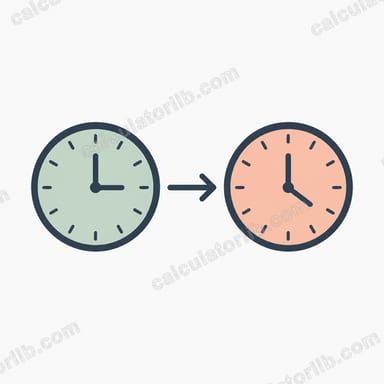
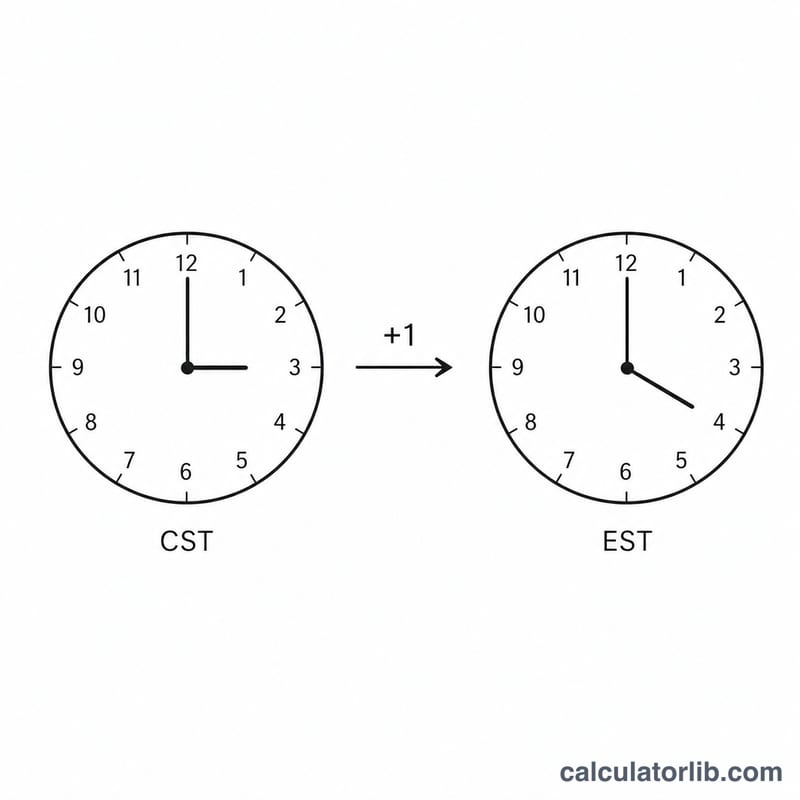
This tool converts a time given in Central Time (CST) to Eastern Time (EST). In the United States, the Eastern Time Zone is always one hour ahead of the Central Time Zone. So when it is 9:00 in Chicago (Central), it is 10:00 in New York (Eastern). This converter applies to the US/North American time zones and assumes a fixed one-hour difference, which holds true year-round (both zones shift together for Daylight Saving Time).
How to Use It
Enter the CST hour using the 24-hour clock (0 through 23) and the minutes (0 through 59). The calculator adds one hour and shows the equivalent Eastern Time. If adding an hour rolls past midnight (for example 23:30 CST), the result wraps around to the next day (00:30 EST).
The Formula Explained
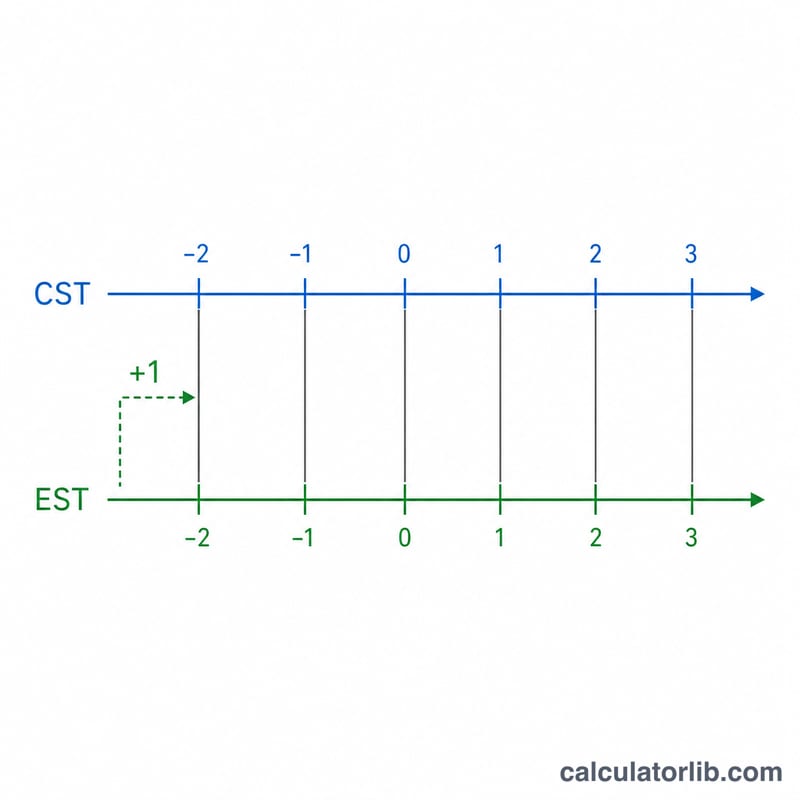
The conversion is simply EST = CST + 1 hour. To keep the hour in the valid 0–23 range when it crosses midnight, we use modulo 24: $$\text{EST} = \left(\text{CST} + 1\right) \bmod 24$$. Minutes never change between these two zones because the offset is a whole hour.
Worked Example
Suppose a meeting is scheduled for 2:30 PM CST, which is 14:30 in 24-hour format. Add one hour: \(14 + 1 = 15\). The minutes stay at 30. So the meeting starts at 15:30 EST, or 3:30 PM Eastern.
FAQ
Is EST always one hour ahead of CST? Yes. Both zones observe Daylight Saving Time on the same dates, so the one-hour gap is constant throughout the year.
What happens near midnight? Times like 23:45 CST become 00:45 EST (the following day), because the hour wraps around the 24-hour clock.
Do I need to adjust for Daylight Saving Time? No. Since both Central and Eastern shift together, the difference between them is unaffected by DST.