

What Is the GMT to EST Converter?
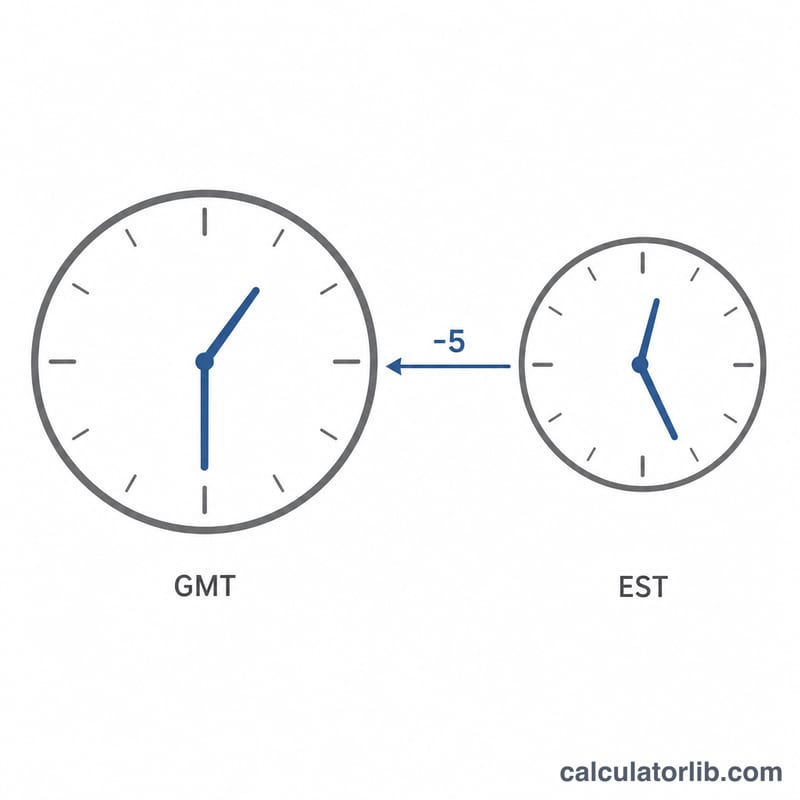
This tool converts a time given in Greenwich Mean Time (GMT, equivalent to UTC+0) into Eastern Standard Time (EST), the standard time observed along the east coast of the United States and Canada during the winter months. EST is fixed at UTC-5, meaning it is always exactly 5 hours behind GMT.
Note: this converter uses standard time (EST, UTC-5). During daylight saving time, the US east coast switches to Eastern Daylight Time (EDT, UTC-4), which would be GMT minus 4 hours instead.
How to Use It
Enter the GMT time using the 24-hour clock — the hour (0–23) and the minutes (0–59). The calculator subtracts 5 hours and returns the corresponding EST time. If subtracting 5 hours crosses midnight, the result automatically wraps to the previous day's clock value.
The Formula Explained
The core formula is simply:
$$\text{EST} = (\text{GMT} - 5) \bmod 24$$
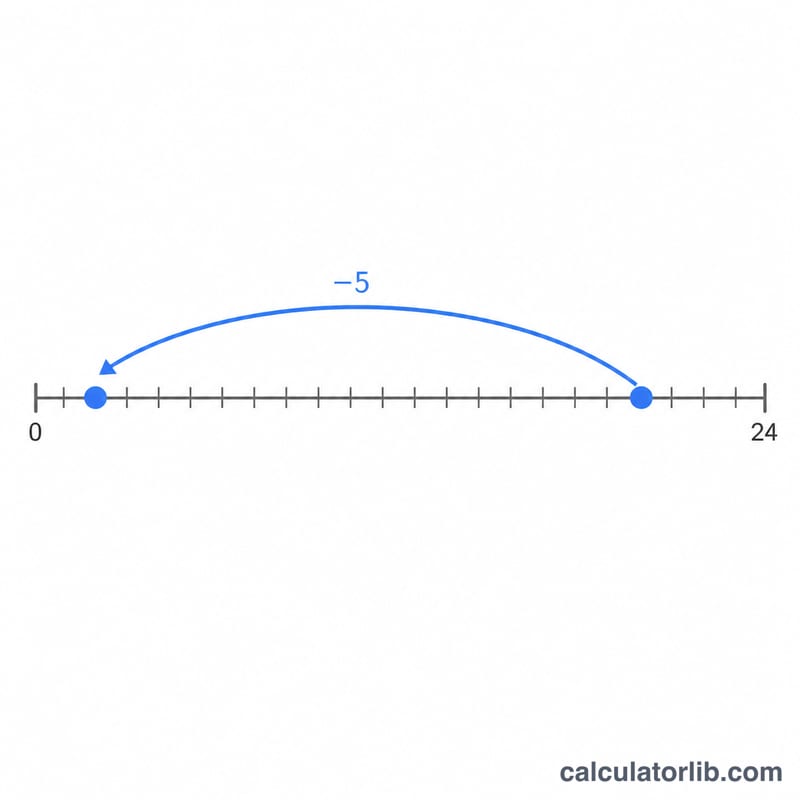
The modulo-24 operation keeps the result within a valid 24-hour clock. For example, 03:00 GMT minus 5 hours gives \(-2\), and adding 24 yields 22:00 EST (10 PM the previous day). Minutes are unchanged because GMT and EST differ only by whole hours.
Worked Example
Suppose a webinar starts at 14:30 GMT. Subtract 5 hours: \(14 - 5 = 9\). The minutes stay at 30. So the webinar starts at 09:30 EST.
Another case: a broadcast at 02:00 GMT. \(2 - 5 = -3\), plus 24 = 21. That's 21:00 EST (9:00 PM) on the previous calendar day.
FAQ
Is EST the same as ET? "ET" (Eastern Time) is a general label that switches between EST (winter, UTC-5) and EDT (summer, UTC-4). This tool uses EST specifically.
What about daylight saving time? During EDT, the offset is only 4 hours, so you would subtract 4 instead of 5. This converter assumes standard time year-round.
Why does the date sometimes change? Because EST is behind GMT, early-morning GMT times can fall on the previous day in EST.