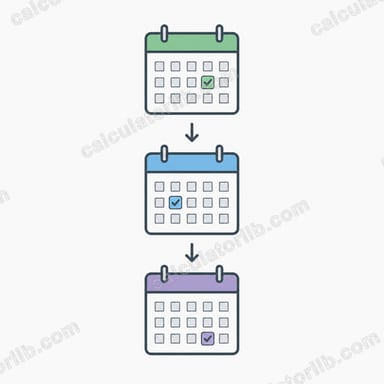

What Is the Next Leap Year Calculator?
This tool finds the first leap year that occurs after any year you enter. Leap years add a 29th day to February to keep our calendar aligned with Earth's orbit around the Sun, which takes about 365.2422 days. This calculator uses the modern Gregorian calendar rules and works for any year worldwide.
How to Use It
Type a starting year (for example, the current year) into the box and submit. The calculator returns the next leap year and how many years away it is. The starting year itself is excluded — even if it is a leap year, the result will be the following leap year.
The Leap Year Formula Explained
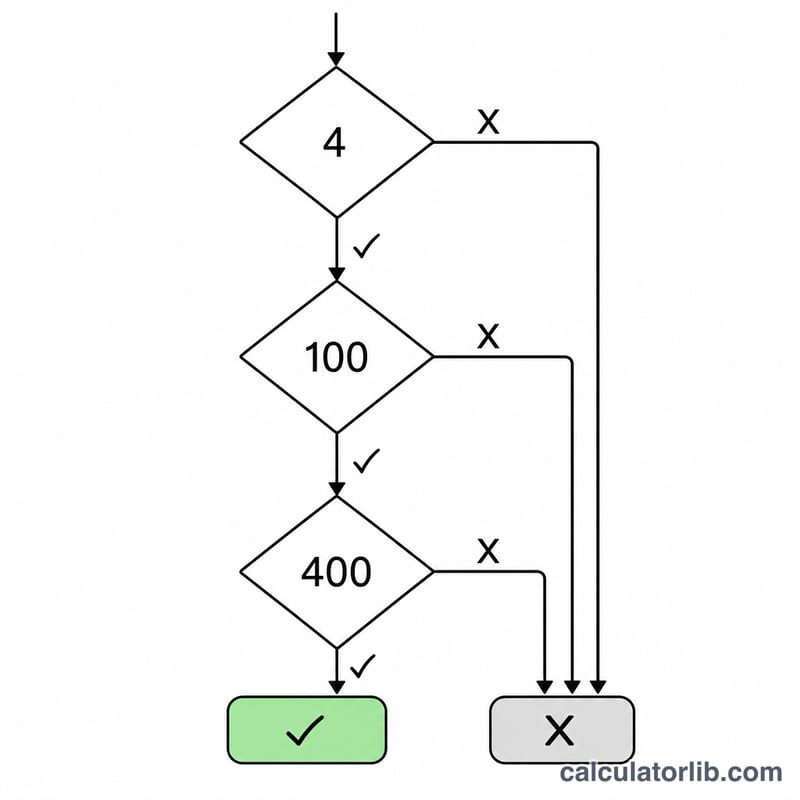
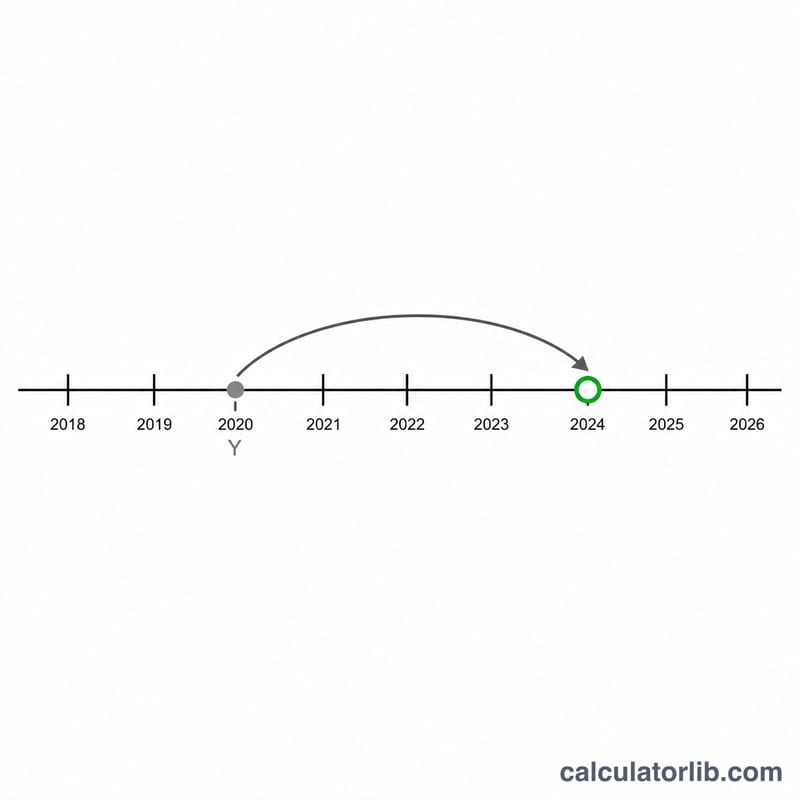
A year y is a leap year when it is divisible by 4, but century years (divisible by 100) only count if they are also divisible by 400. So 2000 was a leap year, but 1900 and 2100 are not. The calculator starts at \(Y+1\) and steps forward until it finds the first year satisfying this rule.
$$\text{Next Leap Year} = \min\left\{\, y > \text{Starting Year} \;:\; (y \bmod 4 = 0) \;\wedge\; \big((y \bmod 100 \neq 0) \vee (y \bmod 400 = 0)\big) \right\}$$
Worked Example
Suppose you enter 2023. Checking 2024: \(2024 \div 4 = 506\) with no remainder, and 2024 is not a century year, so it is a leap year. The next leap year is 2024, which is 1 year away.
Enter 2096: the next candidate 2097, 2098, 2099 fail. 2100 is divisible by 100 but not 400, so it is skipped. The next leap year is 2104.
FAQ
Is the entered year ever returned? No. The result is always strictly after your input, so a leap year input gives the next one.
Why isn't 2100 a leap year? Century years must be divisible by 400. \(2100 \div 400\) is not whole, so it has no February 29.
How far apart are leap years? Usually 4 years, but the gap can be 8 years around skipped centuries like 1896 → 1904.