What this calculator does
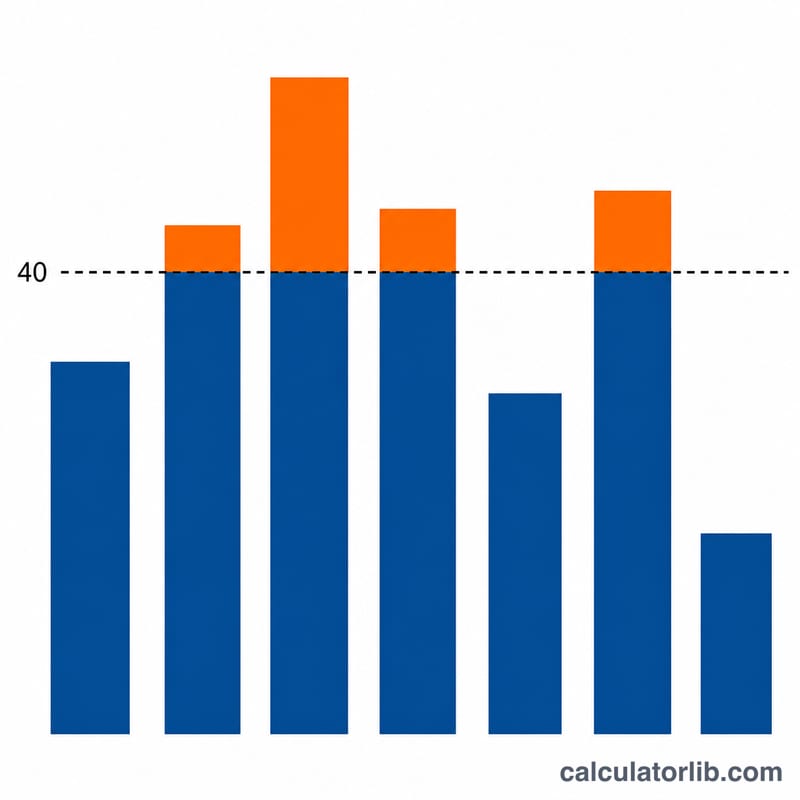
The Weekly Hours Worked Calculator tallies how many hours you actually worked over a week using your daily clock-in and clock-out times, then subtracts any unpaid breaks. It returns your total weekly hours, the number of days you worked, your average hours per day, and how many hours fall above the common 40-hour overtime threshold.
How to use it
For each day, enter the time you started and the time you finished in 24-hour decimal form: 9 means 9:00 AM, 13.5 means 1:30 PM, and 17.25 means 5:15 PM. Add unpaid break minutes (for example 30 or 60). Leave a day blank when you didn't work. The calculator adds up every completed day automatically.
The formula explained
Each day's worked hours equal clock-out minus clock-in, minus the break converted to hours (break minutes ÷ 60). Those daily values are summed to give the weekly total. A negative daily result is treated as zero, so a typo can't subtract hours. The 40-hour overtime row is a U.S.-style convenience figure — your actual overtime rules may differ by country, state, or employment contract.
$$\text{Weekly Hours} = \sum_{d \in \text{days}} \left[ \left( \text{Out}_d - \text{In}_d \right) - \frac{\text{Break}_d \text{ (min)}}{60} \right]$$$$\text{Avg/Day} = \frac{\text{Weekly Hours}}{\text{Days Worked}}$$$$\text{Overtime} = \max\left(0,\; \text{Weekly Hours} - 40 \right)$$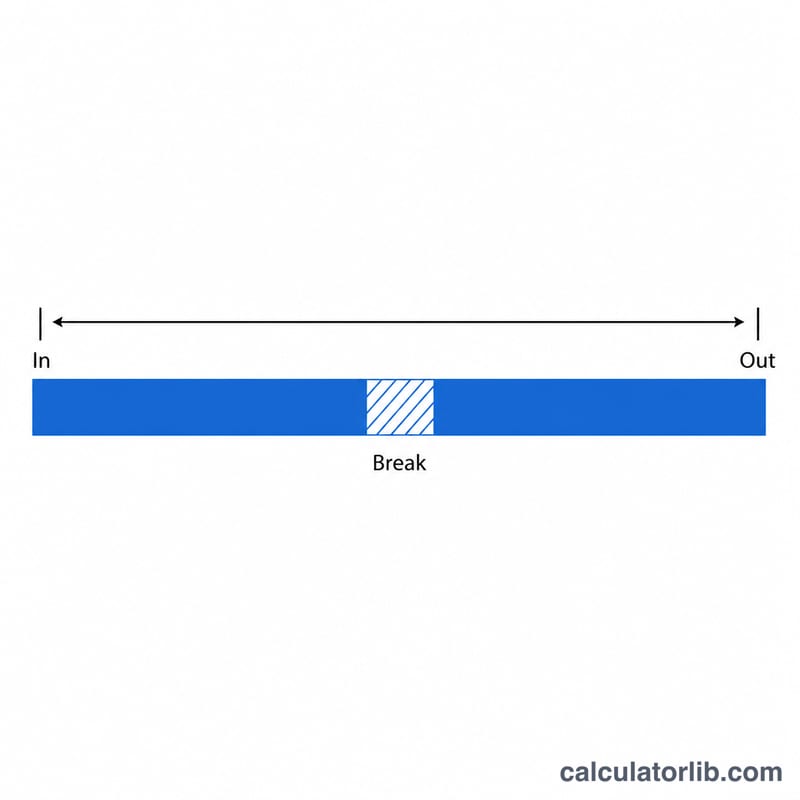
Worked example
Suppose Monday to Friday you clock in at 9:00 (9) and out at 17:00 (17) with a 30-minute break. Each day is \((17 - 9) - 30/60 = 8 - 0.5 = 7.5\) hours. Five such days give \(5 \times 7.5 =\) 37.5 hours, an average of 7.5 hours per day across 5 days, and 0 overtime.
FAQ
How do I enter half-hours? Use decimals: 8:30 is 8.5, 12:15 is 12.25, 16:45 is 16.75.
What if I worked past midnight? This tool assumes each shift starts and ends on the same calendar day. For overnight shifts, split the time or add the spillover to the next day's hours.
Is the overtime figure legally accurate? No. It simply flags anything above 40 hours as a guide. Always check your local labor laws and your employer's policy for exact overtime rules.