What This Calculator Does
The Days Until Easter Calculator finds the exact date of Easter Sunday for any year and counts how many days remain from today. It uses the Computus — the centuries-old method the Church uses to fix Easter — implemented as the well-known anonymous Gregorian (Western) algorithm. This tool follows the Western Christian calendar used by Catholic and most Protestant churches; Eastern Orthodox Easter often falls on a different date and is not computed here.
How to Use It
Enter a year (1583 or later, the start of the Gregorian calendar) and submit. You'll see the date of Easter Sunday for that year and the number of days from today until that date. A negative number means Easter has already passed this year — enter next year to count down to the next one.
The Formula Explained
Easter falls on the first Sunday after the first ecclesiastical full moon on or after March 21. Rather than tracking the moon directly, the Computus uses modular arithmetic on the year. Intermediate values (the golden number, century corrections, the epact h, and the weekday factor l) combine into a single expression: \((h + l - 7m + 114)\). Dividing by 31 gives the month (3 = March, 4 = April) and the remainder plus one gives the day. The day count is then simply the Easter date minus today's date.
$$\begin{gathered} \text{Days Until Easter} = \frac{\text{Easter}(\text{Year}) - \text{Today}}{86400000\ \text{ms/day}} \\[1.5em] \text{where Easter month \& day come from the Gregorian Computus:} \\[0.5em] \left\{ \begin{aligned} \text{Month} &= \left\lfloor \frac{h + \ell - 7m + 114}{31} \right\rfloor \\ \text{Day} &= \left[(h + \ell - 7m + 114) \bmod 31\right] + 1 \end{aligned} \right. \end{gathered}$$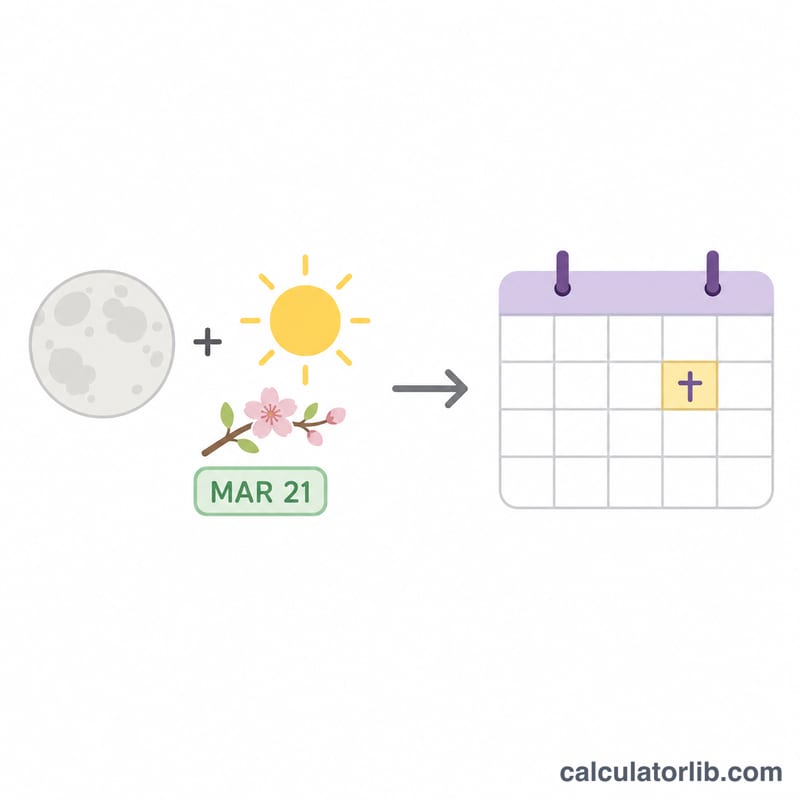
Worked Example
For the year 2024, the algorithm yields month = 3 and day = 31 — so Easter Sunday is March 31, 2024. If today were March 1, 2024, the countdown would read 30 days. For 2025 the result is April 20, 2025.
$$\text{Days Until Easter} = \frac{\text{Mar 31, 2024} - \text{Mar 1, 2024}}{86400000\ \text{ms/day}} = 30\ \text{days}$$
Western Easter Dates by Year (2024–2035)
The table lists Easter Sunday in the Western (Gregorian) calendar, as used by Catholic and most Protestant churches. Orthodox churches that follow the Julian Paschal calculation usually celebrate on a different date (see the glossary below).
| Year | Western Easter Sunday |
|---|---|
| 2024 | March 31 |
| 2025 | April 20 |
| 2026 | April 5 |
| 2027 | March 28 |
| 2028 | April 16 |
| 2029 | April 1 |
| 2030 | April 21 |
| 2031 | April 13 |
| 2032 | March 28 |
| 2033 | April 17 |
| 2034 | April 9 |
| 2035 | March 25 |
In the Gregorian calendar, Western Easter can never fall earlier than March 22 or later than April 25. To count the days, the calculator takes the Easter date for the chosen year and subtracts today's date. If Easter has already passed this year, enter next year to see the next countdown.
Computus Terms Explained
- Computus
- The set of rules, historically done by hand, for calculating the date of Easter. The name is Latin for "computation". Modern algorithms such as the one used here reproduce the Gregorian rules with integer arithmetic.
- Ecclesiastical full moon
- A full moon defined by church tables, taken as the 14th day of a lunar month, rather than the astronomically observed full moon. It can differ from the real full moon by a day or two.
- March 21 equinox (ecclesiastical)
- For Easter purposes the spring equinox is fixed at March 21, regardless of the actual astronomical equinox, which can fall on March 19, 20 or 21.
- Golden number
- The position of a year in the 19-year Metonic lunar cycle: \((\text{Year} \bmod 19) + 1\). In the algorithm, the value \(a = \text{Year} \bmod 19\) is one less than the golden number.
- Epact
- The age of the ecclesiastical moon on a reference date (traditionally January 1). It is used to find where the lunar months fall in a given year and is adjusted by century in the Gregorian calendar.
- Paschal full moon
- The first ecclesiastical full moon on or after March 21. Easter Sunday is the first Sunday strictly after it, so Easter is never on the same day as the Paschal full moon.
- Variable h
- In the Meeus/Jones/Butcher algorithm, \(h = (19a + b - d - g + 15) \bmod 30\), where \(a\) is the year mod 19 and \(b, d, g\) are century-based corrections. It fixes the date of the Paschal full moon, measured in days from March 21 (with a small adjustment).
- Variable ℓ (l)
- \(\ell = (32 + 2e + 2i - h - k) \bmod 7\), where \(e, i, k\) come from the century and the year within the century. It gives the number of days from the Paschal full moon to the following Sunday.
- Variable m
- \(m = \lfloor (a + 11h + 22\ell)/451 \rfloor\) is a correction term that handles rare edge cases so that Easter does not land after April 25.
- Gregorian vs Julian calendar
- The Julian calendar adds a leap day every 4 years. The Gregorian calendar, introduced in 1582, skips three leap days every 400 years, which keeps the equinox closer to March 21. Currently (1900–2099) the Julian calendar is 13 days behind the Gregorian one.
- Western vs Orthodox Easter
- Western churches use the Gregorian Computus. Many Orthodox churches compute Easter using the Julian calendar rules, so their Easter usually falls later, between April 4 and May 8 on the Gregorian calendar for 1900–2099. In some years, such as 2025, the two dates coincide. This calculator gives the Western date only.
FAQ
Why must the year be 1583 or later? The Gregorian calendar (and this Computus variant) began in October 1582, so earlier dates would not be meaningful.
Does this give Orthodox Easter? No. It computes the Western (Gregorian) date. Orthodox churches use the Julian calendar, which usually produces a later date.
Can Easter fall in March? Yes — it ranges from March 22 to April 25 depending on the lunar cycle.