What Is the Days Until Christmas Calculator?
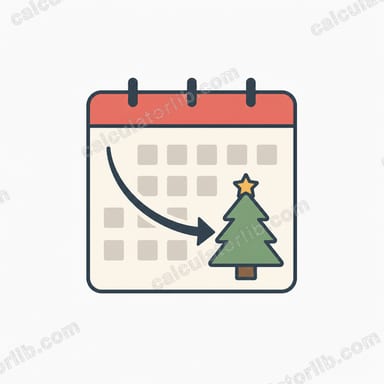
This tool counts how many days remain until Christmas Day, December 25. Pick any start date — usually today — and the calculator instantly shows the number of days and weeks until the holiday. If your start date already falls after December 25 of the current year, the countdown automatically rolls forward to next year's Christmas, so you always get a positive, meaningful result.
How to Use It
Choose the date you want to count from in the date picker (it defaults to today). The result hero displays the days remaining until the next December 25, while the table below breaks the total into weeks and confirms which Christmas year is being targeted.
The Formula Explained
Internally the calculator finds December 25 of the start date's year. It compares that to your chosen date: if your date is on or before Dec 25, that same year is used; if it is later, the next year's Dec 25 becomes the target. The day count is the millisecond difference between the two dates divided by 86,400,000 (the number of milliseconds in a day), then rounded.
$$\text{Days} = \frac{\text{Christmas}_{\,Y} - \text{Count from date}}{86400000\ \text{ms/day}}$$ $$\text{where}\quad \left\{ \begin{aligned} \text{Christmas}_{\,Y} &= \text{Dec 25, year } Y \\ Y &= \begin{cases} \text{year of } \text{Count from date}, & \text{if} \le \text{Dec 25} \\ \text{that year} + 1, & \text{otherwise} \end{cases} \\ \text{Weeks} &= \dfrac{\text{Days}}{7} \end{aligned} \right.$$
Worked Example
Suppose today is December 1, 2024. December 25, 2024 is the next Christmas. December has 31 days, so from the 1st to the 25th is exactly 24 days. The calculator reports 24 days, which is about 3.43 weeks \((24 \div 7)\).

How to Count the Days to Christmas by Hand
The countdown is pure calendar arithmetic: you are counting the whole days between your start date and 25 December on the Gregorian calendar (the date used for Christmas by Western churches and by most civil calendars worldwide; some Orthodox churches keep the Julian date, which currently falls on 7 January in Gregorian terms). Work through the steps below and you will match the calculator exactly.
- Note the start date. Write down the day, month and year you are counting from — normally today, but any date works.
- Decide the target year. If the start date falls on or before 25 December of that same year, the target is this year's Christmas. If it is 26–31 December, the target rolls over to next year's Christmas.
- Count the days left in the start month: \(\text{days in month} - \text{start day}\). Counting this way excludes the start date itself, so a start date of 25 December gives 0 days.
- Add the full length of every month in between. January 31, February 28 (29 in a leap year), March 31, April 30, May 31, June 30, July 31, August 31, September 30, October 31, November 30.
- Add 25 for December — the days from 1 December through the 25th.
- Check for a 29 February inside the span and add 1 day if you used 28 in step 4. A year is a leap year if it is divisible by 4, except century years, which must also be divisible by 400 — so 2024 and 2000 are leap years, but 1900 and 2100 are not.
- Convert to weeks: divide the total by 7. The whole-number quotient is the number of full weeks; the remainder is the leftover days.
As a single expression:
$$\text{Days} = (\text{days in start month} - \text{start day}) + \sum \text{full months} + 25$$Worked check: 31 October 2026 to 25 December 2026
- Days left in October: \(31 - 31 = 0\)
- Full month in between: November \(= 30\)
- December portion: \(25\)
- Total: \(0 + 30 + 25 = 55\) days → 55 days
- Weeks: \(55 \div 7 = 7\) remainder \(6\), i.e. 7 weeks and 6 days
Worked check with a leap day: 26 December 2027 to 25 December 2028
The start date is after 25 December, so the target rolls to Christmas 2028 — and 2028 is divisible by 4, so February has 29 days.
$$(31 - 26) + (31 + 29 + 31 + 30 + 31 + 30 + 31 + 31 + 30 + 31 + 30) + 25$$$$= 5 + 335 + 25 = 365 \text{ days}$$That gives 365 days, or \(365 \div 7 = 52\) weeks and 1 day. Note that a leap-day span of a full year is 366 days only when 29 February falls inside it — here it does, which is why the count is 365 rather than the 364 you would get from a non-leap 26 December start.
Common slips to avoid: forgetting that the start date is not counted (so 24 December gives 1 day, not 2); using 28 for February in a leap year; and forgetting to roll the year forward between 26 and 31 December. Also remember this is a count of calendar days, not of elapsed 24-hour periods — if you start at 6 p.m., the final day is only partly left, which is why a clock-based countdown can show one fewer full day than the date arithmetic above.
FAQ
What if today is December 25? The result is 0 days — Christmas is here. Pick December 26 or later and the countdown jumps to next year's Christmas.
Does it count today as a full day? The result is the whole-day difference between midnight of your start date and midnight on December 25.
Can I count from a past date? Yes. Enter any date and the tool finds the next December 25 on or after it.