
What is the Countdown to New Year Calculator?
This tool tells you exactly how much time is left until the start of the next calendar year — midnight on January 1. It measures the gap between a moment you choose and 00:00:00 on January 1 of the following year, then breaks that gap down into days, hours, minutes and seconds. It is handy for party planning, marketing countdowns, goal deadlines, or simply satisfying curiosity about how far away the celebration really is.
How to use it
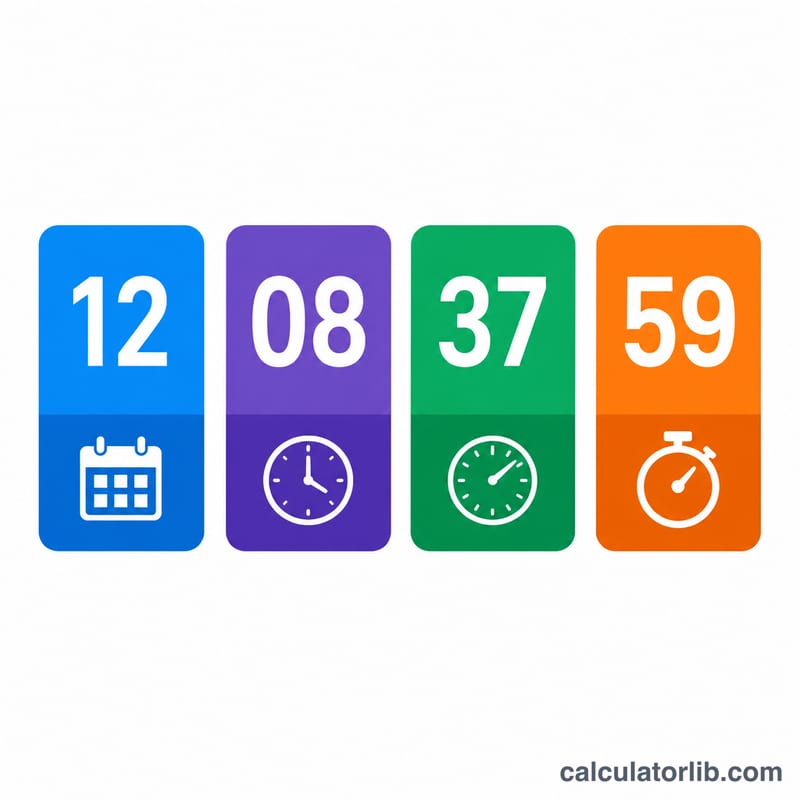
Pick the date and time you want to count from using the picker (it defaults to the current moment). Submit, and the calculator returns the remaining whole days plus the leftover hours, minutes and seconds, along with the total figures in days, hours, minutes and seconds. The target is always midnight at the very start of January 1 in the year after your selected date.
The formula explained
The calculator finds the timestamp of January 1 of the next year at 00:00:00 and subtracts the timestamp of your chosen moment. The difference, in milliseconds, is converted to seconds and then split:
$$\Delta t = \text{Jan 1, }00{:}00\;(\text{next year}) - \text{Count from date and time}$$total days = \(\left\lfloor \tfrac{\Delta t}{86400} \right\rfloor\); the remaining seconds become hours (mod 24), minutes (mod 60) and seconds (mod 60).
$$\begin{gathered} \Delta t = T_{\text{NY}} - \text{Count from date and time} \\[1.5em] \text{where}\quad \left\{ \begin{aligned} T_{\text{NY}} &= \text{Jan 1, }00{:}00{:}00\text{ of next year} \\ \text{Days} &= \left\lfloor \tfrac{\Delta t}{86400} \right\rfloor \\ \text{Hours} &= \left\lfloor \tfrac{\Delta t}{3600} \right\rfloor \bmod 24 \\ \text{Minutes} &= \left\lfloor \tfrac{\Delta t}{60} \right\rfloor \bmod 60 \\ \text{Seconds} &= \Delta t \bmod 60 \end{aligned} \right. \end{gathered}$$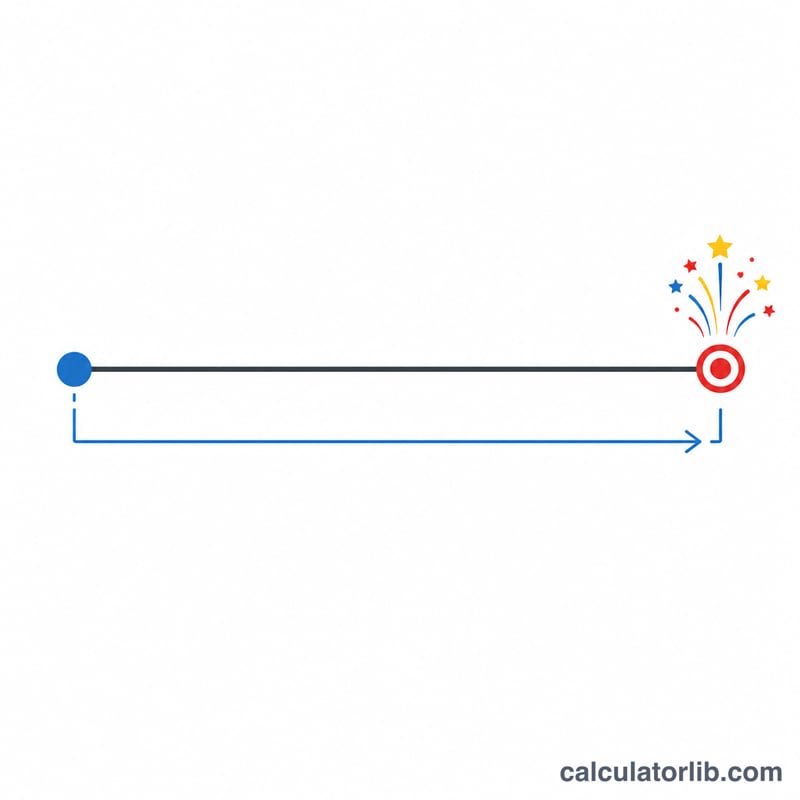
Worked example
Suppose you count from December 31 at 23:59:00. The target is January 1 at 00:00:00 — just 60 seconds away. The result shows 0 days, 0 hours, 1 minute and 0 seconds, or 60 total seconds. Counting from January 1 at 00:00:00 instead gives a full non-leap year: 365 days, or \(365 \times 86400 = 31{,}536{,}000\) seconds.
FAQ
Does it account for leap years? Yes. The math uses real calendar dates, so a leap year correctly produces 366 days between consecutive January firsts when February 29 falls inside the span.
What time zone is used? The calculation uses the server's local time consistently for both endpoints, so the difference is unaffected by zone offset.
Can the result be negative? No. Since the target is always the next January 1 after your chosen date, the remaining time is always zero or positive.