What is the New Year Countdown Calculator?
This tool tells you exactly how many days, weeks, and hours remain until the next New Year's Day (January 1). Pick any starting date and instantly see the countdown to the stroke of midnight that begins the next year. It's perfect for party planning, goal setting, or simply satisfying your curiosity about how much of the current year is left.
How to use it
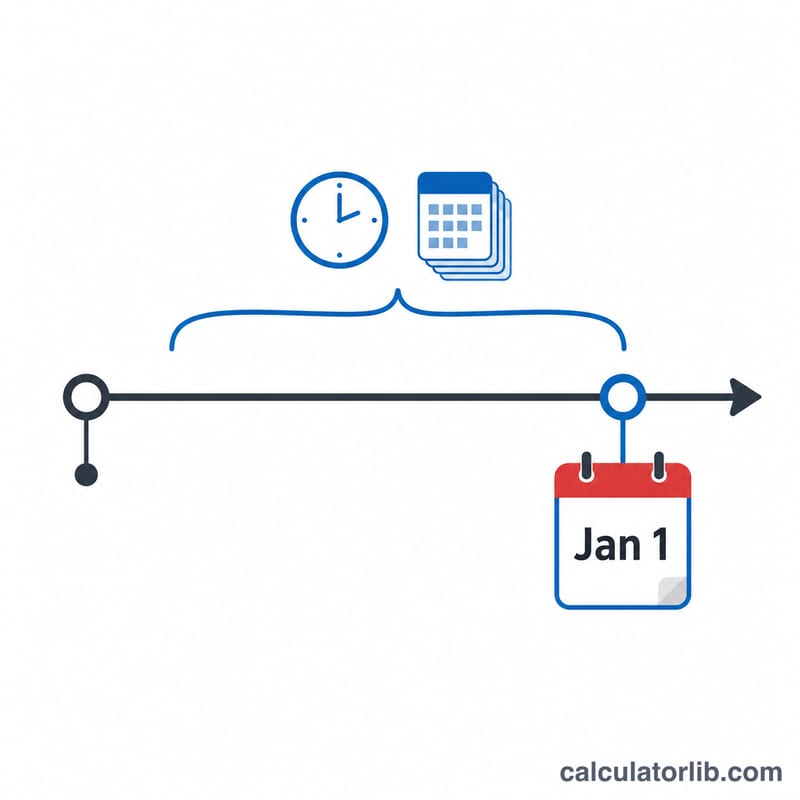
Choose your "count from" date — by default it is today. The calculator finds January 1 of the year that follows that date and computes the gap. The result shows the total days remaining, along with the equivalent number of weeks and hours, plus the exact target date.
The formula explained
The core calculation is simple date subtraction:
$$\text{Days} = \text{(Jan 1 of next year)} - \text{Count from date}$$The calendar engine accounts for leap years automatically, so the count is always accurate whether the upcoming year is 365 or 366 days long. Weeks are \(\text{days} \div 7\) and hours are \(\text{days} \times 24\).
$$\left\{ \begin{aligned} \text{Weeks} &= \frac{\text{Days}}{7} \\ \text{Hours} &= \text{Days} \times 24 \end{aligned} \right.$$
Worked example
Suppose you count from December 25, 2024. The next New Year is January 1, 2025, which is 7 days later. The calculator returns 7 days, 1 week, and 168 hours, with a target of January 1, 2025. If you instead count from January 1, 2024, the next New Year is January 1, 2025 — a full leap year of 366 days away.
$$\text{Days} = \text{Jan 1, 2025} - \text{Dec 25, 2024} = 7$$$$\text{Weeks} = \frac{7}{7} = 1 \qquad \text{Hours} = 7 \times 24 = 168$$Days Until New Year From Different Dates
The table counts from each date to the next January 1. It assumes a non-leap (365-day) year, and the count is in whole calendar days. Hours are days × 24, which ignores daylight-saving clock changes.
| Count from | Days remaining | Weeks (+ days) | Hours |
|---|---|---|---|
| Jan 1 | 365 | 52 weeks + 1 day | 8,760 |
| Mar 1 | 306 | 43 weeks + 5 days | 7,344 |
| Jun 1 | 214 | 30 weeks + 4 days | 5,136 |
| Sep 1 | 122 | 17 weeks + 3 days | 2,928 |
| Oct 31 | 62 | 8 weeks + 6 days | 1,488 |
| Dec 1 | 31 | 4 weeks + 3 days | 744 |
| Dec 25 | 7 | 1 week | 168 |
| Dec 31 | 1 | 0 weeks + 1 day | 24 |
Leap years: if the period you are counting includes February 29, add one day. This affects dates from Jan 1 through Feb 29 in a leap year (Jan 1 becomes 366 days, 8,784 hours). Dates from Mar 1 onward are unchanged, because February 29 has already passed.
How to Count the Days by Hand
Month lengths (Gregorian calendar): Jan 31, Feb 28 (29 in a leap year), Mar 31, Apr 30, May 31, Jun 30, Jul 31, Aug 31, Sep 30, Oct 31, Nov 30, Dec 31.
- Days left in the current month: subtract the day of the month from the month's length (for example, Nov 15 gives 30 − 15 = 15).
- Add the full months that follow: add the length of every month after the current one through December.
- Add 1 for the step from December 31 to January 1.
- Adjust for leap years: if the current month is January or February of a leap year, use 29 days for February, which adds one day in total. From March onward, no adjustment is needed.
Quick check from Nov 15: 15 days left in November + 31 days in December + 1 = 47 days. December has 31 days, not 30. Another check: from Oct 31 the count is 0 + 30 + 31 + 1 = 62, which matches the table above.
FAQ
Does it handle leap years? Yes. Because it subtracts two real calendar dates, February 29 is included automatically when the span crosses a leap year.
What date does "next year" mean? It is always January 1 of the year immediately after the one in your chosen date, so counting from any day in 2024 targets January 1, 2025.
Can I count from a future date? Yes — any valid date works, and the countdown is measured to the following January 1.